Where to buy
These are the three portable charger black friday deals we would check first. Start with the three picks below, then read the full six before you decide, because the right choice depends on how you actually use this kind of product rather than on the biggest headline discount. Check the latest price, availability and delivery on Amazon. Orders are placed on Amazon, and prices during Black Friday Week can change by the hour, so the figure on the live listing is the one that counts. We may earn a commission from qualifying purchases.
- Best Overall: UGREEN Nexode 20000mAh 130W Portable Power Bank
- Best with Built-in Cable: UGREEN Nexode 20000mAh 45W Power Bank with Built-in Cable
- Best Magnetic for iPhone: Anker 621 MagGo Magnetic Power Bank (5,000mAh)
Disclosure: As an Amazon Associate, kajuandouglas.com earns from qualifying purchases. Links to Amazon on this page are affiliate links; they cost you nothing extra. Listing details such as price and availability change often — during this event they can change several times a day — so check the current Amazon listing before you buy.
Portable Charger Black Friday Deals: Capacity, Watts and One Safety Rule
Amazon Black Friday Week runs from November 19 to November 30, 2026. Black Friday itself is November 27, and Cyber Monday closes the event on November 30. The best portable charger black friday deals reward buyers who understand two numbers — milliamp-hours for how much charge, watts for how fast — and who apply one safety rule before everything else: know the exact model you are buying. This guide therefore begins with its exclusions stated in plain sight. Three recalled power bank models are excluded absolutely and appear nowhere in these picks: the Anker PowerCore A1263, the Anker A1112 and the INIU BI-B41. Every pick below was selected only after its model identity was checked in Amazon’s catalogue data, Anker listings without a clearly identified model were passed over entirely, and INIU was excluded as a brand from this guide as a precaution beyond the single recalled model.
Every price in this guide was checked against Amazon’s own catalogue data on November 20, 2026, and every price is written as a dated sighting: ‘seen at $54.99 on November 20, 2026’ means exactly that, no more. Power bank prices move during Black Friday Week and near-identical listings multiply — same brand, similar names, different capacities and cables — so each review names the exact model, capacity and cable arrangement its price belongs to. Where the catalogue also returned a list price, we show the percentage that pair of numbers represents; where no list price came back, we print no percentage at all.
The six picks divide by job rather than by brand. Two 20,000mAh UGREEN banks serve travellers and laptop owners, one with maximum wattage and a smart display, one with a built-in cable. A clearly identified Anker 621 MagGo serves iPhone owners who want a snap-on top-up. A compact Baseus PicoGo AC22 puts 45W in a pocket. And two Belkin banks serve mixed-cable households and budget buyers who still want a mainstream name. Capacity classes, airline rules and wattage sharing are explained in the sections after the reviews, because in this category the education is worth as much as the discount. Readers charging a full desk rather than a pocket should also see Oled Tv Black Friday Deals Oledtvblackfridaydeals Oledtvblackfridaydeals for the living-room end of this sale — this guide stays on the road.
One expectation to set before the picks: no power bank delivers its full printed capacity into a phone. Conversion between the bank’s cells and your device’s battery, cable losses and heat typically return roughly two-thirds to three-quarters of the headline figure as usable charge. That is physics, not deception, and it applies equally to every brand here — which is why this guide translates capacities into approximate phone charges in each review instead of letting the biggest number win by default.
In this guide
Quick Picks
Short on time? These are the six deals, the buyer each one suits, and the price we verified on November 20, 2026. Every price is a dated sighting — check the live price before you buy.
| Best for | Deal | Spotted price | Link |
|---|---|---|---|
| Best Overall | UGREEN Nexode 20000mAh 130W Portable Power Bank | seen at $54.99 on November 20, 2026 (list $89.99) | Check on Amazon |
| Best with Built-in Cable | UGREEN Nexode 20000mAh 45W Power Bank with Built-in Cable | seen at $32.9 on November 20, 2026 (list $49.99) | Check on Amazon |
| Best Magnetic for iPhone | Anker 621 MagGo Magnetic Power Bank (5,000mAh) | seen at $27.99 on November 20, 2026 (list $42.99) | Check on Amazon |
| Best Compact | Baseus PicoGo AC22 Mini Power Bank (10,000mAh, 45W) | seen at $28.46 on November 20, 2026 (list $39.99) | Check on Amazon |
| Best for Mixed Apple and USB-C Homes | Belkin 10,000mAh 23W Power Bank with Integrated USB-C and Lightning Cables | seen at $39.99 on November 20, 2026 (list $54.99) | Check on Amazon |
| Best Budget | Belkin 10,000mAh 20W USB-C Power Bank with Integrated USB-C Cable | seen at $19.99 on November 20, 2026 (list $24.99) | Check on Amazon |
How These Deals Were Chosen
We verified every pick the slow way: by searching Amazon’s own catalogue data for the exact brand and model, matching the returned listing title against the charger we intended to recommend, and recording the price and list price the catalogue returned on November 20, 2026. In this category the matching step carried extra weight, because of the recall exclusions. The Anker PowerCore A1263, Anker A1112 and INIU BI-B41 were excluded absolutely. Any Anker listing whose title did not clearly identify its model was skipped — several generic Anker listings were passed over on exactly that ground — and the single Anker pick in this guide, the 621 MagGo, is included only because its model number is stated in its verified title and is not a recalled model. No INIU product appears in this guide at all.
A deal then had to clear three further bars. First, the listing had to state its capacity and output plainly, in watt-hours or milliamp-hours and watts, so the review could translate them honestly. Second, the product had to be a current model from an identifiable maker — UGREEN, Anker, Baseus and Belkin are the four names that survived — rather than an unbranded listing with unverifiable claims. Third, the price had to be worth printing against the list price returned alongside it. During research, one search line for a further Anker model returned an HTTP 429 rate-limit response; that line was stopped, the rhythm of checking was slowed, and no data from it was used or guessed — the six picks here rest only on successful, recorded verifications.
We also weighted the features that decide whether a bank is carried or abandoned: built-in cables that cannot be forgotten, displays that end capacity guesswork, magnetic formats that remove cables entirely for iPhone owners, and sizes matched to pockets, bags and airline rules. The companion coverage on this site covers the wearables many of these banks will be topping up on the road.
The Six Deals, In Detail

1. UGREEN Nexode 20000mAh 130W Portable Power Bank — Best Overall
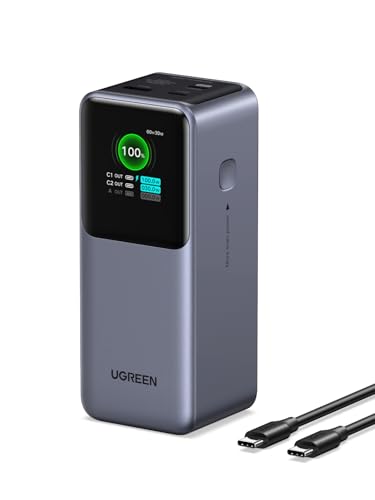
Badge: Best Overall. A laptop-class power bank that still fits a day bag: 20,000mAh (72Wh per the verified listing), up to 130W Power Delivery output, a TFT smart display showing what is happening, and three ports for multiple devices. This is the pick for buyers whose portable charger has to rescue a MacBook-class laptop, a tablet and a phone in the same afternoon, not just top up a handset.
Spec snapshot: 20,000mAh capacity, 72Wh per the verified listing; 130W portable PD output, PD 3.0; TFT smart display; 3-port design for multiple devices; positioned by the maker for MacBook Pro 16, iPad and iPhone per the listing title; confirm included cables on the live listing.
Who it suits: Remote workers, travellers and students who carry a USB-C laptop. The 72Wh figure is the one to understand: it sits below the 100Wh threshold airlines use for cabin batteries, so this capacity class is the largest practical size for flying without special approval, while still holding several full phone charges or a meaningful laptop extension. The display earns its place here too — knowing whether the bank is delivering full speed or a trickle ends the guesswork that plagues cheaper bricks.
Wattage sharing is the honest caveat for every multi-port bank. The headline figure is the maximum the unit can deliver, and when three devices draw at once the output divides between them under the maker’s rules. For a single laptop charge at speed, plug in one device; for overnight top-ups of everything you own, plug in all three and let time do the work. Both patterns are legitimate — the mistake is expecting the first while wiring for the second.
Deal details: Seen at $54.99 on November 20, 2026, against a $89.99 list price returned by the same catalogue check — 39% below list on those two figures. Check the live price before you buy, and confirm the exact contents and configuration on the listing, because sale-week listings can rotate bundles and editions.
Strengths
- 130W PD output genuinely serves USB-C laptops, not just phones.
- 72Wh capacity is the largest practical fly-without-approval class.
- TFT display shows output and remaining capacity clearly.
Trade-offs
- Too large and heavy for a trouser pocket; it is a bag battery.
- Headline wattage divides when several ports are used at once.
- Premium price against phone-only banks in this guide.
Verdict — Best for: laptop-carrying travellers and remote workers who need one bank for every device. Not suited for: pocket-only phone users, who should take the Baseus or Belkin picks below. Check on Amazon · See the listing · View the live price and full details

2. UGREEN Nexode 20000mAh 45W Power Bank with Built-in Cable — Best with Built-in Cable
Badge: Best with Built-in Cable. The same 20,000mAh class as our top pick, traded down in wattage and price, with the feature forgetful travellers actually need: a built-in USB-C cable, alongside a digital display and three ports per the verified listing. No separate cable to leave in a hotel room, no borrowing at the airport — the cable is part of the bank.
Spec snapshot: 20,000mAh capacity per the verified listing; 45W output; built-in USB-C cable; digital display; 3-port design; positioned for current iPhone, Galaxy and iPad models per the listing title; confirm the full port layout on the live listing.
Who it suits: Frequent travellers, commuters and anyone whose charging cable history is a trail of losses. Forty-five watts is the sweet spot for phones and tablets: fast enough to meaningfully charge a handset during a layover or a coffee, and sufficient for many thin laptops at a steadier pace. The built-in cable also doubles as a carry loop on many designs of this type, which is a small, daily convenience that spec sheets never capture.
Treat the built-in cable as the primary and the ports as the flexibility. If a travelling companion needs Lightning or a second USB-C, the ports cover it with a cable of theirs; if it is just you and your phone, the bank is complete in one hand. One care note applies to every built-in-cable design: avoid yanking the cable by its cord when unplugging, because that cable cannot be replaced separately — pull the connector body, and the design will outlast several loose cables.
Deal details: Seen at $32.9 on November 20, 2026, against a $49.99 list price returned by the same catalogue check — 34% below list on those two figures. Check the live price before you buy, and confirm the exact contents and configuration on the listing, because sale-week listings can rotate bundles and editions.
Strengths
- Built-in USB-C cable: nothing separate to forget or lose.
- 20,000mAh capacity with a clear digital display.
- 45W covers fast phone charging and tablet top-ups.
Trade-offs
- 45W is not a full-speed laptop supply under load.
- Built-in cable is short and cannot be replaced if damaged.
- Still a bag-sized bank rather than a pocket one.
Verdict — Best for: travellers and commuters who want capacity plus a cable that cannot be left behind. Not suited for: laptop users who need maximum wattage, or anyone rough on cables. Check on Amazon · See the listing · View the live price and full details

3. Anker 621 MagGo Magnetic Power Bank (5,000mAh) — Best Magnetic for iPhone
Badge: Best Magnetic for iPhone. A snap-on magnetic battery for iPhone, identified here with deliberate care: this is the Anker 621 MagGo, model 621, verified by that exact model name in the catalogue title — it is not one of the recalled Anker models excluded from this guide (the PowerCore A1263 and A1112 are different products entirely, and neither appears anywhere in these picks). The 621 MagGo is a 5,000mAh pocket battery that clicks onto the back of a MagSafe-compatible iPhone and tops it up without a cable.
Spec snapshot: 5,000mAh capacity per the verified listing; magnetic portable charger in the MagGo line, model 621; supplied with a USB-C cable per the listing title; compatible with iPhone 16 / 15 / 14 / 13 / 12 series per the listing; this listing is the Purple finish — check colour options on the live listing. Model identity verified against the API title; recalled models A1263 and A1112 were excluded from selection.
Who it suits: iPhone owners who hate cables and want an emergency half-to-full charge that rides on the phone itself: commuters, festival and match-day crowds, parents at long events, anyone whose battery anxiety peaks at 6pm. Five thousand milliamp-hours is a top-up class, not a expedition supply — after conversion losses it returns roughly one substantial phone charge, which is precisely the job it is sized for.
Magnetic charging trades speed and efficiency for convenience, and this review will not pretend otherwise: a wired bank delivers more of its capacity, faster. What the snap-on format delivers is use-while-charging without a dangling cable, a phone that stays one object instead of two tethered ones, and a battery you will actually carry because it adds so little bulk. If your phone case is thick or non-magnetic, check its compatibility before ordering, because the snap is the whole product.
Deal details: Seen at $27.99 on November 20, 2026, against a $42.99 list price returned by the same catalogue check — 35% below list on those two figures. Check the live price before you buy, and confirm the exact contents and configuration on the listing, because sale-week listings can rotate bundles and editions.
Strengths
- Snap-on magnetic format: no cable between phone and battery.
- Clearly identified model 621 — not a recalled Anker model.
- Pocketable top-up size for daily carry.
Trade-offs
- 5,000mAh is a top-up, not multi-day capacity.
- Magnetic charging is slower and less efficient than wired.
- Needs a MagSafe-compatible phone or case to attach properly.
Verdict — Best for: iPhone owners who want a cable-free daily top-up that rides on the phone. Not suited for: Android-first users, campers, or anyone needing multiple full charges. Check on Amazon · See the listing · View the live price and full details

4. Baseus PicoGo AC22 Mini Power Bank (10,000mAh, 45W) — Best Compact
Badge: Best Compact. The pocketable end of serious capacity: the Baseus PicoGo AC22 — model code AC22, stated in the verified listing title — packs 10,000mAh and 45W Power Delivery into an ultra-small body with a built-in USB-C cable. It is the bank for buyers who refused to carry the big bricks and quietly went without; this one fits the pocket they were protecting.
Spec snapshot: Model AC22 per the verified listing title; 10,000mAh capacity; 45W PD fast charging; built-in USB-C cable; ultra-small battery pack design; positioned for iPhone, Samsung Galaxy, Pixel and iPad per the listing title.
Who it suits: Everyday carriers: jacket-pocket commuters, students, dog-walkers, gig workers, anyone whose phone must survive a long day away from sockets. Ten thousand milliamp-hours is the classic daily size — roughly two phone charges after real-world losses — and 45W means the first of those charges arrives quickly rather than eventually, which is what a lunch-break top-up actually requires.
Baseus is the value-engineered name in this guide, and the honest framing is that you are trading the flagship brands’ polish for specifications per dollar that they do not match at this price. The fundamentals that matter are all present and verified in the listing: named model, stated capacity, PD output, built-in cable. As with every built-in cable, unplug by the connector rather than the cord, and this compact bank should outlast the phone it charges.
Deal details: Seen at $28.46 on November 20, 2026, against a $39.99 list price returned by the same catalogue check — 29% below list on those two figures. Check the live price before you buy, and confirm the exact contents and configuration on the listing, because sale-week listings can rotate bundles and editions.
Strengths
- 10,000mAh and 45W in a genuinely pocketable body.
- Built-in USB-C cable keeps the pocket kit to one item.
- Named AC22 model verified in the listing title.
Trade-offs
- Fewer ports and less capacity than the 20,000mAh picks.
- Built-in cable cannot be replaced separately.
- Brand polish and support trail UGREEN, Anker and Belkin.
Verdict — Best for: daily carriers who want two fast charges in a jacket pocket. Not suited for: laptop users or multi-device travellers who need the big banks above. Check on Amazon · See the listing · View the live price and full details

5. Belkin 10,000mAh 23W Power Bank with Integrated USB-C and Lightning Cables — Best for Mixed Apple and USB-C Homes
Badge: Best for Mixed Apple and USB-C Homes. The diplomat of this guide: a 10,000mAh Belkin bank carrying both integrated cables — USB-C and Lightning — plus a USB-C port, at 23W, per the verified listing. Households split between an older Lightning iPhone and newer USB-C everything else no longer need two banks or a cable hunt; this one was designed for exactly that mixed reality.
Spec snapshot: 10,000mAh capacity per the verified listing; 23W fast charging; integrated USB-C cable and integrated Lightning cable; additional USB-C port; positioned for iPhone, Samsung Galaxy, Pixel, AirPods and iPad per the listing title.
Who it suits: Mixed-device households, parents lending a bank to children with different phones, and travellers carrying both a Lightning iPhone and USB-C earbuds, tablets or a partner’s Android. Belkin is also the reassurance pick in this category: a long-established accessories maker whose name retailers and workplaces recognise, which matters to buyers who prioritise a known brand over a specification bargain.
Twenty-three watts is phone-class speed and this review says so without varnish: it fast-charges handsets properly and will not impress a laptop. The value here is not wattage, it is completeness — two cables that live inside the product, a port for a third device, and nothing to pack separately. When the bank itself is empty it recharges over USB-C, so one wall adapter and one short cable at home keep the whole system ready.
Deal details: Seen at $39.99 on November 20, 2026, against a $54.99 list price returned by the same catalogue check — 27% below list on those two figures. Check the live price before you buy, and confirm the exact contents and configuration on the listing, because sale-week listings can rotate bundles and editions.
Strengths
- Both cables built in: USB-C and Lightning in one bank.
- Trusted mainstream brand with broad device compatibility.
- 10,000mAh daily capacity in a travel-friendly size.
Trade-offs
- 23W is for phones and small devices, not laptops.
- Integrated cables are fixed and short by design.
- Costs more than higher-wattage value rivals.
Verdict — Best for: mixed Apple and USB-C households that share one bank. Not suited for: laptop charging, or buyers chasing maximum watts per dollar. Check on Amazon · See the listing · View the live price and full details

6. Belkin 10,000mAh 20W USB-C Power Bank with Integrated USB-C Cable — Best Budget
Badge: Best Budget. The cheapest pick in this guide is not a no-name gamble: it is a 10,000mAh Belkin bank with 20W USB-C output, an integrated USB-C cable and an extra USB-C port, able to charge two devices per the verified listing, at the lowest sighting in the roundup. As a first power bank, a glovebox spare or a stocking-filler that will actually be used, it is the easiest recommendation here.
Spec snapshot: 10,000mAh capacity per the verified listing; 20W USB-C output; integrated USB-C cable; extra USB-C port (the listing title’s ‘Eatra’ is read as ‘Extra’); charges 2 devices; positioned for iPhone, iPad and Samsung Galaxy per the listing title.
Who it suits: First-time power bank buyers, drivers keeping a spare in the car, students, and anyone equipping several family members at once during the sale. Twenty watts charges modern phones at a genuinely useful pace — slower than the 45W picks, faster than the ancient 5W bricks many people still carry — and the integrated cable means the bank in the glovebox is complete when it is needed, months from now, without a matching cable hunt.
The budget discipline in this guide matters: a cheap bank from an unknown label can overstate capacity and underdeliver on safety circuitry, which is why the budget pick here is a mainstream brand at a sale price rather than the cheapest listing the search returned. You give up wattage and display frills, not the basics: stated capacity from a verifiable maker, USB-C in and out, and a cable that lives with the bank.
Deal details: Seen at $19.99 on November 20, 2026, against a $24.99 list price returned by the same catalogue check — 20% below list on those two figures. Check the live price before you buy, and confirm the exact contents and configuration on the listing, because sale-week listings can rotate bundles and editions.
Strengths
- Lowest verified price in the guide, from a mainstream brand.
- Integrated cable plus a second port charges two devices.
- 10,000mAh is the right daily capacity class.
Trade-offs
- 20W is the slowest output among these picks.
- No display; simple indicator-class feedback.
- Phone-class only — laptops need the UGREEN picks.
Verdict — Best for: first-time buyers, car spares and equipping a whole family cheaply. Not suited for: fast-charge enthusiasts or laptop users. Check on Amazon · See the listing · View the live price and full details
Comparison Table
| Pick | Type | Key detail | Seen Nov 20, 2026 | Watch out for |
|---|---|---|---|---|
| UGREEN Nexode 20000mAh 130W Portable Power Bank | Laptop power bank | 20000mAh / 72Wh; 130W PD 3.0; TFT display; 3-port per listing | $54.99 (list $89.99) | Size and weight suit bags, not pockets; cables checked separately |
| UGREEN Nexode 20000mAh 45W Power Bank with Built-in Cable | Power bank with built-in cable | 20000mAh; 45W; built-in USB-C cable; digital display; 3-port per listing | $32.9 (list $49.99) | Built-in cable length is short by design; check connector type |
| Anker 621 MagGo Magnetic Power Bank (5,000mAh) | Magnetic power bank | 5,000mAh; magnetic snap-on; iPhone 12-16 series per listing; Purple | $27.99 (list $42.99) | Model checked: 621 MagGo — NOT a recalled model; magnetic charging is slower than wired |
| Baseus PicoGo AC22 Mini Power Bank (10,000mAh, 45W) | Compact power bank | Model AC22; 10000mAh; 45W PD; built-in USB-C cable per listing | $28.46 (list $39.99) | Compact size means fewer ports; verify model code AC22 at checkout |
| Belkin 10,000mAh 23W Power Bank with Integrated USB-C and Lightning Cables | Power bank with integrated cables | 10000mAh; 23W; integrated USB-C and Lightning cables per listing | $39.99 (list $54.99) | 23W is phone-class speed; integrated cables are fixed lengths |
| Belkin 10,000mAh 20W USB-C Power Bank with Integrated USB-C Cable | Budget power bank | 10000mAh; 20W; integrated USB-C cable; charges 2 devices per listing | $19.99 (list $24.99) | 20W is the slowest output here; still a full daily bank |
Understanding Capacity, Wattage and Airline Rules Before You Buy
Capacity first. Milliamp-hours describe the bank’s reservoir, and the useful translation is into your phone’s charges: a 5,000mAh bank is a top-up returning roughly one substantial phone charge after losses; 10,000mAh is the daily class, around two charges; 20,000mAh is the travel class, several charges plus tablet or laptop help. Watt-hours are the figure airlines use — capacity in milliamp-hours multiplied by voltage, divided by a thousand — and the cabin rule of thumb is that banks up to 100Wh travel in hand luggage without special approval. The largest pick here is 72Wh, deliberately inside that line; every pick in this guide belongs in your cabin bag, never in checked luggage.
Wattage is speed. A phone sipping 20W charges respectably; at 45W most modern phones charge at or near their fastest; a USB-C laptop under load wants 65W and above to gain charge while working, which is why only the 130W UGREEN pick is recommended here as a laptop supply. More watts than a device can accept does no harm — devices negotiate what they draw — so buying headroom is safe, but buying too little for a laptop is the category’s most common disappointment.
Wattage sharing is the fine print that matters. A multi-port bank’s headline output is its total ceiling, and simultaneous devices divide it under the maker’s rules. Charge one laptop alone for full speed; charge three devices overnight when speed does not matter. Built-in cables follow the same physics, with one addition: they are part of the product, so treat their connectors gently, because a damaged built-in cable cannot be swapped like a loose one.
Safety deserves its own paragraph in a category built on stored energy. Buy identified models from identifiable makers, as this guide does; check model numbers against recall notices before buying any power bank, anywhere — the exclusions applied in this guide (Anker A1263, Anker A1112, INIU BI-B41) are the worked example of that habit. Retire a bank that swells, overheats or smells unusual, charge banks on hard surfaces rather than bedding, and keep them out of extreme heat in parked cars. A power bank is a decade-long household object when chosen and treated properly.
Built-in Cables, Magnetic Snaps and Displays: Which Convenience Is Worth Paying For
Three of the six picks sell a convenience as much as a battery, and it is worth pricing those conveniences honestly before the sale ends. A built-in cable, on the UGREEN 45W, the Baseus AC22 and both Belkin banks in their different ways, removes the single most common power-bank failure — owning a charged bank and no way to connect it. Its value is highest for travellers and shared household banks, lowest for a desk bank that lives next to its own cable anyway. If your bank will be borrowed, lent and carried, built-in cables are worth a small premium and a few watts of headline speed.
A display, on the two UGREEN picks, answers the question every four-dot indicator leaves vague: how much is actually left, and how fast is it moving? For a laptop traveller rationing a bank across a long day, that precision changes decisions in a way that justifies its cost. For a phone top-up bank, it is a nicety rather than a necessity, which is why the budget picks omit it without apology. Magnetic attachment, on the Anker 621 MagGo, is the most personal of the three: people who try it for daily top-ups rarely return to cables for that job, while people who charge overnight never missed it. None of these conveniences changes the stored energy — they change whether the energy is there, connected and understood at the moment you need it, which in practice is most of what owners remember about a power bank.
How to Choose the Right Portable Charger Deal for Your Travel
Start with the longest day, not the average day. Count the hours between sockets on your hardest regular day — a long-haul travel day, a festival, a double shift, a day of site visits — and size the bank to that day plus margin. Daily-carry buyers land on 10,000mAh; travel-day buyers land on 20,000mAh; phone-only top-up buyers who prize pocketability land on the magnetic 5,000mAh pick. Buying for the average day guarantees the bank fails precisely when it is needed most.
Decide whether a laptop is in the picture. If the bank must ever rescue a USB-C laptop, the shortlist is one pick long: the 130W UGREEN. If the heaviest device is a tablet, 45W suffices and both the UGREEN built-in-cable pick and the Baseus serve. If it is phones only, every pick qualifies and the decision becomes cables, size and price — which is where the Belkin pair earn their places.
Count your household’s connectors. A USB-C-only home can choose freely. A home split between Lightning and USB-C should buy the Belkin with both cables integrated and end the argument. iPhone owners who value convenience over raw efficiency should try the magnetic format once — for many people it permanently replaces wired banks for daily top-ups, as readers who film on phones will recognise from their own kit bags.
Three example shopping lists. For a frequent flyer: the 130W UGREEN in the cabin bag, full stop. For a commuter couple with mixed phones: the Belkin dual-cable bank in the shared hallway drawer, plus the budget Belkin in the car. For a student: the Baseus PicoGo AC22 in the jacket pocket, charged on Sunday night, forgotten about until Thursday’s low-battery warning.
How to Check a Portable Charger Deal Is Real — and Keep It Safe
Verify the model number before the price. In this category the model is the product: capacities, cables and recall status all attach to the exact model code. Read the full title on the listing in your cart, confirm the model matches the one you researched — AC22, 621, the named Nexode variant — and check that model against recall notices if you are buying outside a verified guide. Thirty seconds of reading is the entire safety system.
Compare the sale price with the bank’s own history. Free price-history trackers keep long Amazon histories for most listings; a genuine event low looks different from a permanent sale banner. Every pick in this guide was verified against live catalogue data on November 20, 2026. Do the same check on anything else you add to the cart, and be suspicious of listings whose capacity claims outrun their price by an implausible margin — stored energy costs money, and impossible numbers are a warning, not a bargain.
Check the price at checkout, not just on the page. Prices move during Black Friday Week, and the price in the cart is the price you pay. If a figure jumps, back out and re-check — either the deal ended or a different capacity or colour variant has replaced the one you chose. Confirm capacity and cable arrangement again at the same moment; variant swaps are this category’s quietest disappointment.
Set it up safely when it arrives. Charge the bank fully before first use, test it against each device you intend to pair it with during the holiday return window, and note which cable and port gives your phone its fastest rate. Store it partly charged if it will sit unused for months, keep it out of hot cars, and retire it without sentimentality if the casing ever swells or warps. A deal is only a deal once the bank in your bag is the model you meant to buy, behaving the way it should.
Common Mistakes
Buying capacity without checking the model. The recalled models excluded from this guide — Anker A1263, Anker A1112, INIU BI-B41 — are the standing lesson: a familiar brand name is not a model number. Verify the exact model of any power bank before it enters your home, whoever is selling it and however deep the discount.
Expecting printed capacity to arrive whole in your phone. Conversion losses return roughly two-thirds to three-quarters of the headline milliamp-hours as usable charge, for every brand. Size up one class if your arithmetic has no margin, rather than blaming the bank for physics.
Buying phone wattage for a laptop. A 20W bank connected to a working laptop may slow its discharge rather than charge it. If laptop rescue is the job, the wattage must match the job — in this guide, that means the 130W pick.
Packing a power bank in checked luggage. Airline rules require portable chargers in cabin baggage. Every pick here is sized within cabin limits; keep them in your hand luggage, terminals protected, where the rules and common sense both want them.
Waiting for Black Friday itself. The event runs November 19–30, and the early days carry full stock at full discount. Waiting for November 27 out of tradition mostly buys sold-out listings. If the verified price is at its low today, today is the day.
Final Recommendation
If you buy one portable charger this Black Friday Week, make it the one that matches your longest day: the UGREEN Nexode 130W, seen at $54.99 on November 20, 2026, if a laptop is ever in your bag; the UGREEN 45W built-in-cable bank at a seen $32.90 for travel without cable anxiety; or the Belkin budget bank at a seen $19.99 if a phone top-up from a trusted name is the whole job. iPhone owners should try the Anker 621 MagGo at a seen $27.99 — model verified, and not a recalled model — and pocket carriers the Baseus PicoGo AC22 at a seen $28.46. Check the live price and the exact model before you buy: in this category, the model number is the purchase.
Frequently Asked Questions
When do portable charger Black Friday deals run on Amazon in 2026?
Amazon Black Friday Week runs November 19–30, 2026, with Black Friday on November 27 and Cyber Monday on November 30. Power bank deals appear throughout the window and popular models can sell through early — the prices in this guide were verified on November 20, 2026.
Are the prices in this guide guaranteed?
No. Every price here is a dated sighting verified against Amazon catalogue data on November 20, 2026, and prices move during the event. Treat a sighting as evidence of what the deal has cost, then check the live price, the exact model and the capacity on the listing before you buy.
Which power bank models are recalled, and are any of them in this guide?
No recalled model appears in this guide. The Anker PowerCore A1263, the Anker A1112 and the INIU BI-B41 were excluded absolutely during selection: Anker listings without a clearly identified model were skipped, the one Anker pick is the model-identified 621 MagGo, and no INIU product was selected at all. Check any power bank’s exact model against recall notices before buying, wherever you shop.
How big a power bank can I take on a plane?
As a rule of thumb, power banks up to 100Wh are permitted in cabin baggage without special approval, and all power banks must travel in hand luggage rather than checked bags. The largest pick in this guide is rated 72Wh in its verified listing, and every pick here is a cabin-bag size — confirm your airline’s current rules before you fly.
Why does a 10,000mAh bank not fully charge my phone twice?
Conversion losses. Energy moves from the bank’s cells through circuitry and a cable into your phone’s battery, and each step costs a share, so roughly two-thirds to three-quarters of the printed capacity typically arrives as usable charge. That is normal for every brand, and this guide’s per-pick translations already account for it.
Is magnetic charging worse than wired charging?
It is slower and less efficient, and more convenient — all three are true. The Anker 621 MagGo trades some speed and capacity for a cable-free snap-on top-up that rides on the phone. For overnight or multi-device charging, wired banks like the UGREEN and Belkin picks are the better tools.
Should I wait for Cyber Monday instead?
Cyber Monday (November 30, 2026) usually repeats some Black Friday pricing and adds a few fresh offers, but stock is the risk: models that sell out during Black Friday Week do not reliably come back for Monday. If a verified price matches the level you were waiting for now, buying now is the safer play.
Related Guides
- Best Black Friday Camera Deals 2026 Bestblackfridaycameradeals2026 Bestblackfridaycameradeals2026
- Mirrorless Camera Black Friday Deals Mirrorlesscamerablackfridaydeals Mirrorlesscamerablackfridaydeals
- Oled Tv Black Friday Deals Oledtvblackfridaydeals Oledtvblackfridaydeals
- Black Friday Tv Deals Under $500 Blackfridaytvdealsunder500 Blackfridaytvdealsunder500
- Smartwatch Black Friday Deals 2026 Smartwatchblackfridaydeals2026 Smartwatchblackfridaydeals2026