The best indoor AM FM radio antennas are the ones that turn a hissing, crackling stereo receiver into clear, enjoyable radio: a simple wire dipole taped to a wall, an amplified antenna near a window, or a combined FM and AM loop kit that covers both bands. Radio reception depends on the antenna more than on the receiver, and a good indoor antenna costs little, installs in minutes, and can make a dramatic difference to the stations a stereo can receive. The six antennas in this guide are all indoor models for home stereo receivers, verified in the site catalogue under their exact brand and model.
Choosing an indoor AM FM antenna starts with the receiver and the room. The antenna must have the right connectors for the receiver, it must cover the bands that are listened to, and it must be placed where the signal is strongest, which is usually near a window and away from electronics. An amplified antenna helps in a weak-signal area, while a simple dipole is enough where signals are strong. This guide covers both, from the basic Bingfu and Ancable dipoles to the amplified Antop models, so there is a good match for every room and every signal.
In this guide
Quick picks: best indoor am fm radio antennas
| # | Product | Where to buy |
|---|---|---|
| 1 | Antop High Gain Indoor Antenna | Check on Amazon |
| 2 | AEDIKO FM and AM Loop Kit | Check on Amazon |
| 3 | Bingfu FM Dipole Antenna | Check on Amazon |
| 4 | Bingfu FM and AM Loop Combo | Check on Amazon |
| 5 | Ancable 300 Ohm FM Dipole | Check on Amazon |
| 6 | Antop Amplified FM Antenna | Check on Amazon |
How the picks were chosen
Every antenna in this guide is an indoor AM FM radio antenna, verified through the site catalogue with its exact brand and model. The Antop High Gain antenna is the amplified AM FM model with a 50-mile range, the AEDIKO is the FM and AM loop kit with three connectors, the Bingfu FM dipole is the indoor model for stereo receivers, the Bingfu FM and AM loop combination is the 75 Ohm dipole with an indoor AM loop, the Ancable is the 300 Ohm T-shape dipole, and the second Antop is the amplified FM radio antenna for home receivers.
A type trap was caught and avoided in this category. Several search results were portable radios, not antennas, including the PRUNUS J-166 and the DreamSky AM FM radios, and those were not used, because they are radios rather than antennas. A car antenna and a hidden windshield antenna also appeared in the results, and those were not used, because they are designed for a vehicle rather than a home stereo receiver.
An outdoor antenna was also excluded. The Channel Master FM antenna that appeared in the search results is a multi-directional outdoor antenna with a 50-plus mile range, designed for roof mounting. It is a good product, but it is not an indoor antenna, so it was not included as a pick in this guide, which is specifically for indoor antennas.
Connectors were checked for every pick. Most stereo receivers use a 75 Ohm F-type connector for FM and a bare wire or spring clip terminal for AM, while some use a 300 Ohm twin-lead terminal. The AEDIKO kit includes three connectors to cover the common cases, and the other picks use the standard F-type or twin-lead connections that match most receivers.
Finally, each pick was checked against the catalogue to confirm the exact model and to exclude Renewed or used listings, as well as replacement telescopic antennas for portable radios, which are a different category. The full catalogue title was verified for every pick, so that a buyer who follows the link finds the exact antenna named in the heading.
Each pick was also checked for how it handles the basics that decide whether an antenna gets used daily. An antenna should be easy to place, with a cable long enough to reach a good position, and its connectors should fit the receiver without an adapter. The antennas in this guide were chosen partly because their listings describe standard connectors and practical cable lengths, which is what makes an antenna easy to live with rather than a project.
Quick comparison
| Product | Key detail | Best for |
|---|---|---|
| Antop High Gain Indoor Antenna | Amplified AM FM, 50 miles, 4G filter | Weak-signal areas and listeners who want both bands |
| AEDIKO FM and AM Loop Kit | FM 75 Ohm + AM loop, 3 connectors | Stereo receivers that need both FM and AM coverage |
| Bingfu FM Dipole Antenna | FM dipole, 75 Ohm, for stereo receivers | Simple FM reception on a stereo receiver |
| Bingfu FM and AM Loop Combo | FM dipole 75 Ohm + AM loop | Listeners who want FM and AM from one purchase |
| Ancable 300 Ohm FM Dipole | 300 Ohm FM dipole, T-shape, spade terminal | Older receivers with a 300 Ohm FM terminal |
| Antop Amplified FM Antenna | Amplified FM, indoor, for stereo receivers | Home stereo receivers that need an amplified FM signal |
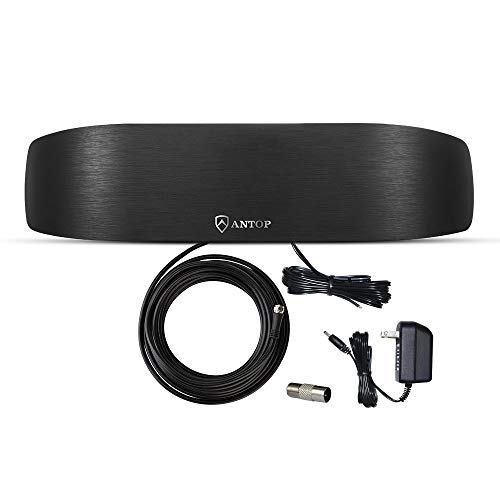
Antop High Gain Indoor Radio Antenna — Amplified AM FM Antenna
The Antop High Gain Indoor Radio Antenna is a multi-directional amplified AM FM antenna with a 50-mile range, an amplifier signal booster and a 4G filter, designed for home, RV and mobile use. It is the most powerful indoor antenna in this guide, built for weak-signal areas.
The Antop High Gain antenna is the most capable antenna in this guide for a weak signal. Its amplifier boosts the FM and AM signals, its 4G filter reduces interference from mobile phone signals, and its multi-directional design means it does not need to be aimed precisely at the station. Its claimed range of 50 miles is realistic for FM in flat terrain, and it is a good choice for a rural home, a valley or a building with thick walls.
In daily use the Antop is straightforward: place it near a window, plug in the amplifier, connect it to the receiver and adjust its position for the clearest signal. Its amplifier can be switched off or adjusted if the signal is too strong, which helps in an area where some stations are strong and others are weak. For a listener who wants the best chance of clear reception from an indoor antenna, it is the most powerful pick in this guide.
Key specs: Antop High Gain Indoor Radio Antenna, multi-directional amplified AM FM antenna, 50 miles, with amplifier signal booster and 4G filter; for stereo radio audio signals.
Strengths:
- Amplified signal with a 50-mile range
- Covers both AM and FM bands
- 4G filter reduces mobile interference
Trade-offs:
- Needs a power outlet for the amplifier
- Amplification can overload strong signals
- Larger than a simple dipole
The Antop High Gain antenna fits a listener in a weak-signal area who wants an amplified indoor antenna for both AM and FM, with a signal booster and a 4G filter.
Best for: Weak-signal areas and listeners who want both bands
Not suited for: Strong-signal city areas, or buyers who want the simplest antenna
Check price on Amazon: Antop High Gain Indoor Antenna

AEDIKO FM Radio Antenna — FM Coax and AM Loop Antenna Kit
The AEDIKO FM Radio Antenna is a kit with a 75 Ohm FM antenna, an FM coax antenna and an AM loop antenna, with three connectors for indoor home stereo receivers. It covers both FM and AM bands, making it a complete antenna solution for a stereo system.
The AEDIKO kit is the most complete antenna in this guide for a stereo receiver. It includes an FM antenna, an AM loop antenna and three connectors, which covers the common receiver types without needing extra adapters. The FM antenna is a 75 Ohm coax model that connects to the receiver's FM input, and the AM loop connects to the AM terminals, so both bands are covered with one purchase.
In daily use the AEDIKO kit is practical and flexible. The FM antenna can be placed near a window for the best FM reception, while the AM loop can be rotated for the clearest AM signal, since AM reception is directional. The three connectors mean the kit fits most receivers without an adapter, which saves a trip to the store. For a listener who wants both bands covered with one purchase, it is the best value in this guide.
Key specs: AEDIKO FM Radio Antenna 75 Ohm, FM antenna, FM coax antenna and AM loop antenna with 3 connectors; for indoor home stereo receiver AV audio home theater receiver.
Strengths:
- Covers both FM and AM bands
- Three connectors fit most receivers
- Good value as a complete kit
Trade-offs:
- Two pieces to place and connect
- AM loop needs rotating for the best signal
- No amplification for very weak signals
The AEDIKO kit fits a listener with a stereo receiver who wants both FM and AM covered, with connectors to suit most receivers, at a fair price.
Best for: Stereo receivers that need both FM and AM coverage
Not suited for: Very weak signals, or buyers who want a single-piece antenna
Check price on Amazon: AEDIKO FM and AM Loop Kit

Bingfu FM Radio Dipole Antenna — For Stereo Receiver Indoor
The Bingfu FM Radio Dipole Antenna is an indoor dipole antenna for a stereo receiver, designed for Pioneer, Onkyo, Yamaha, Marantz, Bose and similar home FM radio systems. It is a simple, inexpensive way to improve FM reception on a home stereo.
The Bingfu FM dipole is the simplest antenna in this guide, and often the most effective. It is a dipole antenna designed for a stereo receiver, with a 75 Ohm connection that fits most modern receivers. Its wire can be taped to a wall, hung from a curtain rail or draped behind a cabinet, and its position can be adjusted in seconds to find the clearest signal. For a listener in a city with strong FM signals, it is all that is needed.
The Bingfu dipole is compatible with the major receiver brands, including Pioneer, Onkyo, Yamaha, Marantz and Bose, which means it will fit the receiver most listeners own. Its low price makes it an easy experiment: if it improves reception, it has paid for itself many times over, and if the signal is still weak, an amplified antenna can be tried next. It is the antenna in this guide for a buyer who wants the simplest fix first.
Key specs: Bingfu FM Radio Dipole Antenna for stereo receiver indoor; for Pioneer, Onkyo, Yamaha, Marantz, Bose Wave music system, home FM radio AV audio video home theater receiver.
Strengths:
- Simple and inexpensive FM improvement
- Fits most major receiver brands
- Easy to position and adjust
Trade-offs:
- FM only, so AM reception is unchanged
- No amplification for weak signals
- Cable length may limit placement
The Bingfu FM dipole fits a listener with a stereo receiver in a strong-signal area who wants a simple, cheap way to improve FM reception.
Best for: Simple FM reception on a stereo receiver
Not suited for: AM reception, or very weak FM signals
Check price on Amazon: Bingfu FM Dipole Antenna
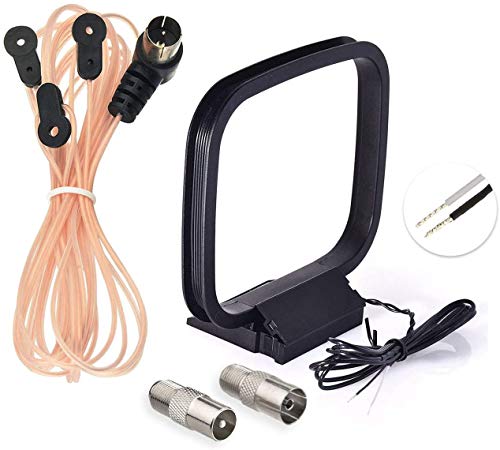
Bingfu FM Dipole and AM Loop Antenna — 75 Ohm Indoor Combo
The Bingfu FM Dipole and AM Loop Antenna is a combination with a 75 Ohm FM dipole and an indoor AM loop antenna, designed for Pioneer, Onkyo, Yamaha, Marantz and similar indoor home stereo receivers. It covers both FM and AM bands in one purchase.
The Bingfu FM and AM loop combination covers both bands in one purchase. Its FM dipole is a 75 Ohm model that connects to the receiver's FM input, and its AM loop antenna connects to the AM terminals, so both bands are improved at once. The dipole can be placed near a window for FM, while the loop can be rotated for the clearest AM signal, since AM reception is directional.
The combination is compatible with the major receiver brands, including Pioneer, Onkyo, Yamaha and Marantz, and it is designed for indoor use with a home stereo receiver. Its low price makes it a good value for a listener who wants both bands covered without buying two separate antennas. For a stereo system that is used for both music and talk radio, it is a practical choice.
Key specs: Bingfu FM Radio Dipole Antenna 75 Ohm, indoor AM loop antenna; for Pioneer, Onkyo, Yamaha, Marantz, indoor Bluetooth home stereo receiver AV audio video home theater receiver tuner.
Strengths:
- Covers both FM and AM bands
- Fits most major receiver brands
- Good value as a combination
Trade-offs:
- Two pieces to place and connect
- No amplification for very weak signals
- AM loop needs rotating for the best signal
The Bingfu FM and AM loop combination fits a listener who wants both FM and AM improved with one purchase, for a stereo receiver used for music and talk.
Best for: Listeners who want FM and AM from one purchase
Not suited for: Very weak signals, or buyers who want amplification
Check price on Amazon: Bingfu FM and AM Loop Combo
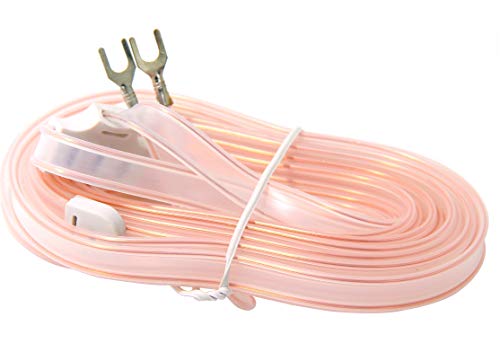
Ancable 300 Ohm FM Antenna — T Shape Dipole with Spade Terminal
The Ancable 300 Ohm FM Antenna is a T-shape dipole radio antenna with spade terminals, designed for indoor digital HD radio and vintage stereo tuners. It is a simple FM dipole for receivers with a 300 Ohm twin-lead input.
The Ancable dipole is a 300 Ohm FM antenna with a T-shape design and spade terminals, built for receivers with a 300 Ohm twin-lead FM input. Its T-shape can be taped to a wall or hung from a hook, and its wire is long enough to reach a good position from the receiver. For an older receiver or a vintage tuner, it is the right antenna, since it matches the input the receiver was designed for.
The Ancable dipole is also a good choice for a modern receiver with a 300 Ohm input, or for a receiver that has a 300 Ohm terminal alongside a 75 Ohm one. Its spade terminals connect securely, and its FM reception is clear and stable in a strong-signal area. It is a simple, inexpensive antenna that does one job well, and it is the pick in this guide for a buyer with an older receiver.
Key specs: Ancable 300 Ohm FM Antenna T Shape Dipole Radio Antenna with Spade Terminal; FM dipole antenna for indoor digital HD radio; for Yamaha, Sharp, JVC, Denon, Marantz, vintage stereo tuner receivers.
Strengths:
- Matches 300 Ohm receiver inputs
- Simple T-shape design, easy to hang
- Inexpensive and effective for FM
Trade-offs:
- 300 Ohm only, so modern receivers need an adapter
- No AM coverage
- T-shape needs wall space to hang
The Ancable dipole fits a listener with an older receiver or a vintage tuner that has a 300 Ohm FM terminal, who wants a simple T-shape dipole antenna.
Best for: Older receivers with a 300 Ohm FM terminal
Not suited for: Modern 75 Ohm receivers without an adapter, or AM reception
Check price on Amazon: Ancable 300 Ohm FM Dipole

Antop Amplified FM Radio Antenna — For Stereo Receiver Indoor
The Antop Amplified FM Radio Antenna is an AM FM antenna for a stereo receiver indoors, with an amplified FM signal for home AV audio and video receivers. It is a compact indoor antenna built for a receiver that needs a stronger FM signal.
The Antop amplified FM antenna is a compact indoor antenna for a stereo receiver, with an amplifier that boosts the FM signal for home AV audio and video receivers. It is designed for a receiver that needs a stronger signal than a passive dipole can provide, and its amplified design helps in a weak-signal area or a building with thick walls. Its compact size means it can sit on a shelf near the receiver.
In daily use the Antop amplified antenna is straightforward: connect it to the receiver, place it near a window, and adjust its position for the clearest signal. Its amplifier is built in, so there is no separate booster to place, and its cable is long enough to reach a good position. For a listener who wants an amplified antenna without the larger size of the Antop High Gain model, it is a good middle ground.
Key specs: AM FM Antenna for stereo receiver indoor; Antop amplified FM radio antenna for home AV audio video receiver.
Strengths:
- Amplified FM signal for weak areas
- Compact size suits a shelf near the receiver
- Simple setup with no separate booster
Trade-offs:
- Amplification can overload strong signals
- Needs a power outlet for the amplifier
- AM coverage is limited compared with a loop
The Antop amplified antenna fits a listener with a home stereo receiver who wants an amplified FM signal in a compact indoor antenna.
Best for: Home stereo receivers that need an amplified FM signal
Not suited for: Strong-signal areas, or buyers who want a passive dipole
Check price on Amazon: Antop Amplified FM Antenna
Best indoor AM FM radio antennas: what matters most
Connectors matter more than most buyers expect. A stereo receiver usually has a 75 Ohm F-type connector for FM and a bare wire or spring clip terminal for AM, while an older receiver may have a 300 Ohm twin-lead terminal. An antenna with the wrong connector will not fit, and an adapter will be needed. The AEDIKO kit in this guide includes three connectors, which covers the common cases.
Amplification is the second factor. An amplified antenna boosts a weak signal, which helps in a rural area, a valley or a building with thick walls. In a city with strong signals, amplification can overload the receiver and make reception worse, so a passive dipole is the better choice. The Antop amplified models in this guide suit a weak-signal area, while the Bingfu and Ancable dipoles suit a strong-signal area.
Placement is the third factor, and it matters more than the price of the antenna. An antenna near a window, high up and away from metal objects and electronics will outperform an expensive antenna in a poor position. A dipole can be moved in seconds, so experimenting with position is the cheapest way to improve reception.
Buying guide: choosing indoor AM FM radio antennas
Check the connectors before buying. Most stereo receivers use a 75 Ohm F-type connector for FM and a spring clip or bare wire terminal for AM, while some use a 300 Ohm twin-lead terminal. The AEDIKO kit in this guide includes three connectors, which covers the common cases, while the Bingfu and Ancable dipoles use the standard F-type and twin-lead connections. Check the back of the receiver before ordering.
Decide whether amplification is needed. An amplified antenna, such as the Antop models in this guide, boosts a weak signal and can help in a rural area or a building with thick walls. In a city with strong signals, an amplified antenna can overload the receiver and make reception worse, so a passive dipole is the better choice. If the stations are strong, start with a passive antenna.
Consider the room and the placement. An antenna works best near a window, high up and away from metal objects and electronics. A dipole can be taped to a wall or hung from a curtain rail, while an amplified antenna needs a power outlet for its booster. Choose an antenna with a cable long enough to reach a good position from the receiver.
Using and caring for your indoor AM FM radio antennas
Keep the antenna clean and dry, and avoid bending a dipole sharply, since a kinked wire can break the conductor inside. A telescopic antenna should be extended gently and collapsed when not in use, to avoid bending the sections.
Check the connections occasionally, since a loose connector is a common cause of poor reception. The F-type connector should be finger-tight, and the bare wire terminals should be secure and free of corrosion. A connection that has worked loose will make even a good antenna sound bad.
Move the antenna if reception changes, since a new piece of furniture, a new appliance or a change in the weather can affect the signal. A dipole can be repositioned in seconds, and a small move can make a large difference to the stations received.
Common mistakes to avoid
Buying an outdoor antenna for indoor use is a common mistake. An outdoor antenna is designed for roof mounting and needs a mast, a cable run and weatherproofing, which is unnecessary indoors. The indoor antennas in this guide are designed for a room, with a cable and connectors that suit a stereo receiver.
Choosing an amplified antenna where signals are already strong is another trap. Amplification boosts the signal, but it also boosts the noise, and in a strong-signal area it can overload the receiver and make reception worse. Start with a passive dipole, and only add amplification if the signal is still weak.
Forgetting the AM band is an easy oversight. Many listeners focus on FM and forget that AM needs a loop antenna, not a dipole. A kit that includes both, such as the AEDIKO in this guide, covers both bands, while a dipole-only antenna will leave AM reception unchanged.
Budget and value
An indoor AM FM antenna is one of the cheapest upgrades in home audio, and the simplest ones work well. A dipole antenna such as the Bingfu FM dipole or the Ancable 300 Ohm dipole costs very little and can transform reception on a stereo receiver, while an amplified antenna such as the Antop costs more but adds a signal booster for weak stations.
Spending more buys amplification, a better build and a wider range, but it does not always buy better reception. A simple dipole in a good position often outperforms an amplified antenna in a poor position, so the best value is a basic antenna placed well, with an amplified model reserved for a weak-signal area.
AM versus FM: why you may need both
AM and FM are different bands with different behaviour. FM offers higher sound quality and stereo, but its range is limited and it is blocked by hills and buildings. AM travels further and works better at night, but its sound quality is lower and it picks up more interference from electrical equipment. A good indoor antenna should cover both bands, which is why the AEDIKO and Bingfu AM loop combinations in this guide include an AM loop as well as an FM dipole.
For a listener who mainly wants music, FM is the priority, and a dipole antenna is usually enough. For a listener who wants talk radio, sport or distant stations, AM matters too, and a loop antenna helps. The Antop amplified antennas in this guide cover both bands, which makes them a good choice for a listener who wants everything.
How to position an indoor antenna for the best reception
Start near a window, as high as possible, and away from metal objects, mirrors and large appliances. FM signals are directional, so rotating a dipole or moving it a few centimetres can change which stations come in clearly. Try the antenna in several positions and listen to the weakest station, since that is the one that shows the difference most clearly.
For AM, the loop antenna should be rotated until the station is clearest, since AM reception is directional. Keep the loop away from televisions, computers and LED lights, which can cause interference. A small amount of experimentation with position is worth more than a more expensive antenna in a poor spot.
When an indoor antenna is not enough
An indoor antenna works well in most towns and cities, but in a rural area or a valley, the signal may be too weak for any indoor antenna. In that case, an outdoor antenna, mounted on a roof or a mast, is the next step. The Channel Master outdoor FM antenna that appeared in the search results is an example, although it is not an indoor antenna and was not included as a pick.
A streaming alternative is also worth considering. Many radio stations stream online, and a smart speaker or a phone can play them without an antenna at all. For a listener who wants a specific station that is weak over the air, streaming is often the simplest solution, although it needs an internet connection and a data allowance.
Connecting an indoor antenna to a stereo receiver
Connecting an indoor antenna to a stereo receiver is simple. For FM, push the F-type connector onto the receiver's FM input and tighten it finger-tight, or connect the twin-lead wires to the 300 Ohm terminals with the spade terminals. For AM, connect the loop antenna's wires to the receiver's AM terminals, which are usually spring clips or screws. The receiver's manual shows the exact terminals, and the process takes a few minutes.
After connecting, tune the receiver to the weakest station and move the antenna until the signal is clearest. A dipole can be taped to a wall or hung from a hook, while a loop antenna should be rotated until the station is clear. Save the best position by taping the antenna in place, since a moved antenna will need to be repositioned.
Final recommendation
For most listeners, the Antop High Gain Indoor Radio Antenna is the best indoor AM FM antenna in this guide, with amplification for weak signals and coverage of both bands. The AEDIKO FM and AM loop kit is the best value for a receiver that needs both bands, and the Bingfu FM dipole is the simplest and cheapest way to improve FM reception.
Start with a simple dipole, place it well, and only add amplification if the signal is still weak. A good indoor antenna costs little, installs in minutes, and can transform a stereo receiver from a frustrating buzz into clear, enjoyable radio.
Frequently asked questions
What is the difference between an FM dipole and an AM loop antenna?
An FM dipole is a wire antenna designed for the FM band, usually a T-shaped or straight wire that is hung or taped to a wall. An AM loop is a coil of wire designed for the AM band, which needs a different shape to pick up the longer AM wavelengths. A good indoor antenna kit, such as the AEDIKO in this guide, includes both, so it covers both bands.
Do amplified antennas work better than passive ones?
Not always. An amplified antenna boosts a weak signal, which helps in a rural area or a building with thick walls. In a city with strong signals, amplification can overload the receiver and make reception worse. A passive dipole is the better choice where signals are strong, while an amplified antenna suits a weak-signal area.
How far can an indoor AM FM antenna reach?
It depends on the station, the terrain and the building. The Antop amplified antenna in this guide claims a range of 50 miles, which is realistic for FM in flat terrain with a clear path, but hills, buildings and weather can reduce it. AM can travel further, especially at night, but its sound quality is lower. A realistic expectation for an indoor antenna is clear reception of local and regional stations.
Can I use a TV antenna for FM radio?
A TV antenna can pick up FM signals, since FM and television use nearby frequencies, but it is not designed for radio and its performance will vary. A dedicated FM antenna, such as the dipoles in this guide, is designed for the FM band and will usually work better. A TV antenna should not be used for AM, which needs a loop antenna.
Why does my FM reception get worse at certain times?
FM reception can change with the weather, the time of day and nearby interference. Atmospheric conditions can carry distant stations in and interfere with local ones, while electrical equipment, LED lights and appliances can cause noise. Moving the antenna, rotating it or moving it away from electronics can help, and a different position may work better at different times.
Do I need a 75 Ohm or a 300 Ohm antenna?
It depends on the receiver. Most modern stereo receivers use a 75 Ohm F-type connector for FM, while older receivers and some tuners use a 300 Ohm twin-lead terminal. The AEDIKO kit includes connectors for both, while the Ancable dipole is a 300 Ohm model with spade terminals. Check the back of the receiver before buying, and use a balun adapter if the antenna and the receiver do not match.
Can an indoor antenna help with a portable radio?
Yes, although a portable radio usually has its own telescopic antenna. An indoor antenna can be connected to a portable radio with an external antenna socket, or placed near it to improve reception. The Bingfu telescopic replacement antennas that appeared in the search results are designed for portable radios, although they were not included as picks in this guide.
Is an indoor antenna better than streaming?
It depends on the use. An indoor antenna is free after the purchase, needs no internet and works during an internet outage, which suits a listener who wants local radio. Streaming offers more stations and better sound quality, but it needs an internet connection and uses data. Many listeners use both: an antenna for local stations and streaming for everything else.
Can I use an indoor antenna with a vintage tuner?
Yes. A vintage tuner usually has a 300 Ohm twin-lead FM input and a bare wire AM input, which the Ancable 300 Ohm dipole and the AEDIKO kit in this guide can connect to. Check the back of the tuner for the input types before buying, and use a balun adapter if the antenna and the tuner do not match. A vintage tuner with a good antenna can sound excellent.
How do I know if my antenna is working?
Tune the receiver to a known station and listen for a clear signal with little noise. Compare the reception with and without the antenna connected: if the antenna is working, the station should be clearer with it connected. If there is no difference, check the connections, move the antenna to a better position, and try a different station.


