The best long range HDTV antennas pull in free over-the-air channels from towers that a basic indoor antenna cannot reach. This guide compares outdoor antennas rated for 100 miles or more, from motorised 200-mile models that aim themselves from the remote to fixed designs that simply sit on the roof and work for years.
Every antenna below is listed with the exact model and range from the retailer listing, so the model you buy is the model described here. Range figures are best-case numbers measured in open country, so the advice in this guide is to buy more range than you think you need and to mount the antenna as high as you can. The seven antennas below cover the full spread: motorised models that aim themselves, fixed models that never need attention, and an omni-directional model that needs no aiming at all. Each one is a genuine outdoor antenna, built for a roof or a mast, and each one is listed with the exact range and features from the retailer listing.
We ranked these antennas on range, reception pattern, amplifier quality, how many televisions they can feed and how well they are built for outdoor life. A long range antenna is only as good as its installation, so the buying guide below covers aiming, mounting and the mistakes that cost people channels.
In this guide
Quick picks: best long range hdtv antennas
| # | Product | Where to buy |
|---|---|---|
| 1 | Five Star 2026 Upgraded Outdoor TV Antenna | Check on Amazon |
| 2 | Five Star Outdoor HDTV Antenna 200 Mile | Check on Amazon |
| 3 | Five Star Outdoor Digital Amplified HDTV Antenna | Check on Amazon |
| 4 | Antennas Direct ClearStream 4V | Check on Amazon |
| 5 | 1byone Outdoor TV Antenna | Check on Amazon |
| 6 | McDuory Amplified Digital Outdoor HDTV Antenna | Check on Amazon |
| 7 | Five Star Outdoor HDTV Antenna 150 Mile | Check on Amazon |
How the picks were chosen
The shortlist started with outdoor antennas rated for 100 miles or more, because a long range antenna is defined by distance, not by marketing. Each candidate was judged on its stated range, its reception pattern, whether it includes an amplifier, how many televisions it can feed and whether it is built for outdoor mounting. Indoor-only antennas were excluded, because they cannot deliver genuine long range reception.
From that shortlist, each antenna was checked against its listing for the exact range claim, the rotation method, the mounting options and the supported signal types. A 200-mile claim with a motorised rotor beats a 200-mile claim with a fixed aim when the towers sit in several directions, and a dual-output antenna beats a single-output one for households with two televisions. Build quality mattered too, because an outdoor antenna lives in wind, rain and ice. The motorised models were judged on how precisely they rotate and whether the remote is easy to use, because a rotor that is hard to control is worse than a fixed aim. The fixed models were judged on build quality and on whether their reception pattern covers more than one direction without any adjustment.
Finally, every pick was checked against a current retail listing so that the exact model, range and features stated here match what you can buy. No antenna was included on the strength of an old review alone; if the model could not be found in the stated configuration, it did not make the list.
Quick comparison
| Product | Standout feature | Best for |
|---|---|---|
| Five Star 2026 Upgraded Outdoor TV Antenna, 200 Mile Range, Motorized 360 Degree Rotation | 200 mile range with motorised 360 degree rotation | homes far from the towers with stations in several directions |
| Five Star Outdoor HDTV Antenna up to 200 Mile Long Range, Attic or Roof Mount | 200 mile range in a simple fixed design | homes with towers in one direction that want a fixed antenna |
| Five Star Outdoor Digital Amplified HDTV Antenna, up to 200 Mile Long Range, 360 Degree Rotation | Amplified 200 mile reception with full rotation | homes with long cable runs and distant towers |
| Antennas Direct ClearStream 4V Outdoor TV Antenna, 20-Inch Mast, Reflectors, Hi-VHF Elements | Rugged fixed design with multi-directional reception | owners who want a durable fixed antenna with no maintenance |
| 1byone Outdoor TV Antenna, 360 Degree Omni-Directional Reception, 100 Plus Miles Range | Omni-directional reception with no aiming at all | suburban homes with towers all around |
| McDuory Amplified Digital Outdoor HDTV Antenna, 150 Miles Long Range, 360 Degree Rotation | 150 mile range with remote-controlled rotation | homes that want remote aiming at a mid-range range |
| Five Star Outdoor HDTV Antenna 150 Mile Long Range, 360 Degree Rotating, Dual TV Output | Dual TV output from a single 150 mile antenna | two-TV households that want one shared antenna |

Five Star 2026 Upgraded Outdoor TV Antenna, 200 Mile Range, Motorized 360 Degree Rotation
The Five Star 2026 Upgraded Outdoor TV Antenna is the strongest pick in this guide. It is rated for a 200 mile range with motorised 360 degree rotation, so it can aim itself at different tower clusters without anyone climbing on the roof. The 2026 model is the newest revision of Five Star long range line.
Key specifications: Five Star 2026 model, 200 mile range, motorised 360 degree rotation, outdoor HDTV antenna.
In daily use, the motorised rotation is the feature that matters most. Stations that sit in different directions can each be tuned in by rotating the antenna from the remote, instead of choosing one direction and losing the others. Once aimed, the picture is stable, and the amplified signal holds up through weather that makes lesser antennas drop channels.
Setup starts with the mast: mount the antenna on the roof or a tall pole, connect the coaxial cable, and power the amplifier. Aim the antenna with the remote, scanning for channels at several positions until the channel count stops improving. Write down the best position for each direction so you can return to it quickly.
Strengths
- The longest range in this guide at 200 miles.
- Motorised rotation aims at several tower directions from the remote.
- The newest 2026 revision of a proven design.
Trade-offs
- Moving parts need more care than a fixed antenna.
- Needs a power supply for the motor and the amplifier.
- Roof mounting takes more effort than an indoor antenna.
This suits rural homes and anyone whose stations sit in several directions.
Best for: homes far from the towers with stations in several directions / Not suited for: flats where only an indoor antenna is possible
Check price on Amazon: Five Star 2026 Upgraded Outdoor TV Antenna
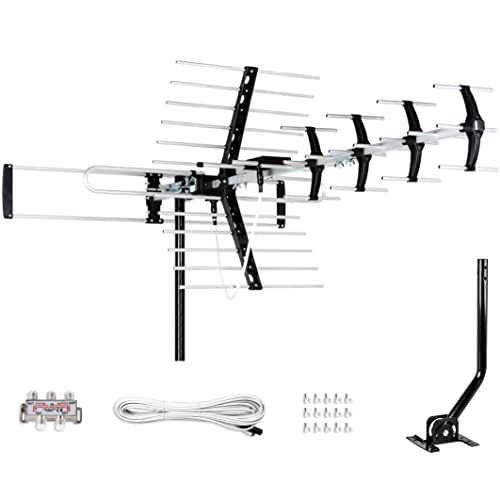
Five Star Outdoor HDTV Antenna up to 200 Mile Long Range, Attic or Roof Mount
The Five Star Outdoor HDTV Antenna is rated for up to 200 miles and can be mounted in the attic or on the roof. It is a digital over-the-air antenna for 4K and 1080p signals on VHF and UHF bands, and it suits homes that want the longest range without a motorised rotor.
Key specifications: Five Star, up to 200 mile range, attic or roof mount, 4K and 1080p, VHF and UHF.
In daily use, this antenna is the set-and-forget option. Once it is aimed at the tower cluster and fixed in place, it pulls in distant stations day after day with no remote and no moving parts to maintain. The attic option suits homes where a roof mount is not practical, though the roof position always receives a little more signal.
Setup is a fixed mount: choose the attic or the roof, fix the mast, aim at the towers using a compass direction from a tower map, and scan for channels. Try a couple of aim positions before tightening everything, because a few degrees can add or lose a station. Seal the cable entry against rain if the antenna is on the roof.
Strengths
- 200 mile range without any moving parts to maintain.
- Attic or roof mounting to suit the house.
- Handles both VHF and UHF stations.
Trade-offs
- Fixed aim means one direction only, unlike a motorised model.
- Attic mounting loses some signal to the roof.
- Aiming needs a ladder and patience the first time.
This suits homes with all their towers in one direction and owners who want no maintenance.
Best for: homes with towers in one direction that want a fixed antenna / Not suited for: homes with stations spread in several directions
Check price on Amazon: Five Star Outdoor HDTV Antenna 200 Mile
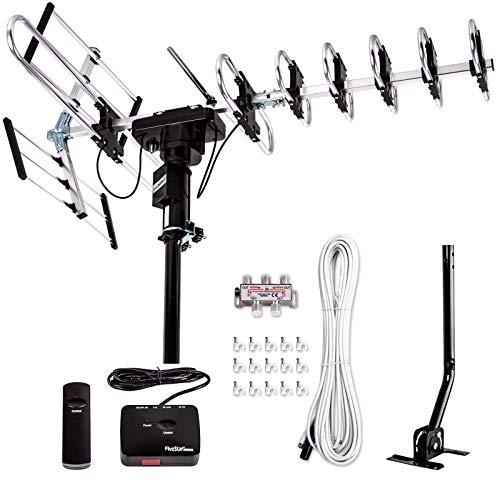
Five Star Outdoor Digital Amplified HDTV Antenna, up to 200 Mile Long Range, 360 Degree Rotation
The Five Star Outdoor Digital Amplified HDTV Antenna is rated for up to 200 miles with a built-in amplifier and 360 degree rotation. It handles high-definition 4K and 1080p signals, and the amplified design helps the signal survive a long cable run from the roof to the television.
Key specifications: Five Star, up to 200 mile range, amplified, 360 degree rotation, 4K and 1080p.
In daily use, the amplifier is what you notice: channels that are marginal on a passive antenna come in cleanly, and the picture holds up on long cable runs that would otherwise weaken the signal. The rotation lets you sweep for the best aim, and once it is set, the antenna needs no further attention.
Setup follows the usual outdoor pattern: mount, aim, connect the amplifier power supply and scan. Rotate slowly while scanning, because the tuner needs a few seconds at each position to find the channels. If the picture breaks up on a station that is close by, the amplifier may be over-driving the tuner, so try the antenna without amplification first.
Strengths
- Amplified signal survives long cable runs.
- 360 degree rotation for finding the best aim.
- 200 mile range for distant stations.
Trade-offs
- The amplifier needs a power outlet near the television.
- Over-amplification can hurt very close stations.
- Rotation is manual, not remote-controlled on this model.
This suits homes with a long cable run from the roof and distant stations to reach.
Best for: homes with long cable runs and distant towers / Not suited for: homes very close to the broadcast towers
Check price on Amazon: Five Star Outdoor Digital Amplified HDTV Antenna
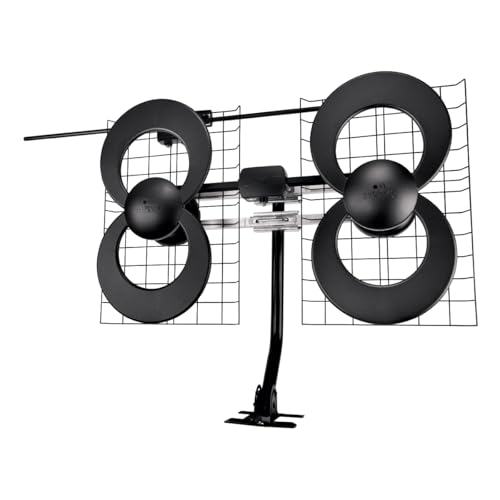
Antennas Direct ClearStream 4V Outdoor TV Antenna, 20-Inch Mast, Reflectors, Hi-VHF Elements
The Antennas Direct ClearStream 4V is the best-built fixed antenna in this guide. It comes with a 20 inch mast, reflectors and Hi-VHF elements, and it receives UHF and VHF signals with a multi-directional pattern. It has no amplifier and no moving parts, which is exactly the point: there is nothing to wear out.
Key specifications: Antennas Direct ClearStream 4V, 20 inch mast, reflectors, Hi-VHF elements, UHF and VHF, multi-directional.
In daily use, the ClearStream 4V is the quiet achiever. It does not claim the longest range on paper, but its clean design pulls in a strong, stable signal from its rated area, and the multi-directional pattern catches stations from more than one direction without any rotation. It is the antenna for people who would rather install once and forget about it.
Setup is the simplest here: assemble the mast and reflectors, mount it on the roof or a pole, aim it at the main tower cluster and scan. Because there is no amplifier, there is no power supply to place and no gain to adjust. Check the mounting hardware is tight, because a loose mast in a storm will cost you channels.
Strengths
- The sturdiest build in this guide, with no parts to wear out.
- Multi-directional pattern catches stations from several sides.
- No amplifier means no power supply and no added noise.
Trade-offs
- No amplifier, so long cable runs may need one added later.
- Shorter rated range than the 200-mile models.
- Fixed aim cannot be adjusted from indoors.
This suits owners who want a fit-and-forget antenna and a clean, strong signal.
Best for: owners who want a durable fixed antenna with no maintenance / Not suited for: homes that need the very longest rated range
Check price on Amazon: Antennas Direct ClearStream 4V

1byone Outdoor TV Antenna, 360 Degree Omni-Directional Reception, 100 Plus Miles Range
The 1byone Outdoor TV Antenna is an omni-directional model rated for 100 plus miles. It receives from all directions at once, it is 4K ready, and it handles enhanced VHF and UHF signals. It is the simplest choice for homes whose broadcast towers sit in several directions.
Key specifications: 1byone, 360 degree omni-directional, 100 plus miles range, 4K ready, VHF and UHF.
In daily use, the omni-directional pattern is the whole appeal: there is no aiming at all, so stations from every direction come in at once. That suits suburban homes surrounded by towers, and it suits anyone who does not want to climb on the roof to adjust an antenna. The trade-off is range: 100 miles is plenty for most suburbs, but not enough for deep rural locations.
Setup is the easiest here: mount the antenna, connect the cable, and scan. There is no rotor to align and no direction to choose, so the only decision is height. Mount it as high as you can, keep the cable short, and rescan after any change to the installation.
Strengths
- No aiming needed: receives from all directions at once.
- Simple installation with no moving parts.
- 4K ready with enhanced VHF and UHF reception.
Trade-offs
- 100 mile range is the shortest in this guide.
- Less gain in any one direction than a directional antenna.
- Not the best choice for deep rural locations.
This suits suburban homes with towers in several directions and owners who want no aiming.
Best for: suburban homes with towers all around / Not suited for: rural homes far from every tower
Check price on Amazon: 1byone Outdoor TV Antenna
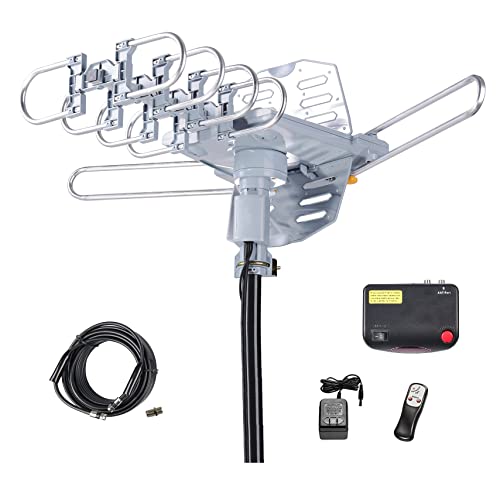
McDuory Amplified Digital Outdoor HDTV Antenna, 150 Miles Long Range, 360 Degree Rotation
The McDuory Amplified Digital Outdoor HDTV Antenna is rated for 150 miles with a built-in amplifier and 360 degree rotation controlled by infrared remote. It is a tools-free installation design, which makes it the easiest motorised antenna in this guide to put up.
Key specifications: McDuory, 150 miles range, amplified, 360 degree rotation, infrared remote, tools-free installation.
In daily use, the remote rotation is genuinely useful: a station in one direction and a station in another can both be tuned in without leaving the sofa. The 150 mile range covers most rural and semi-rural homes, and the amplifier keeps the picture stable on the cable run down from the roof.
Setup is tools-free for the antenna itself, though the mast still needs fixing to the roof or a pole. Connect the amplifier power, use the infrared remote to rotate slowly, and scan at several positions. Keep the remote somewhere safe, because it is the only way to re-aim the antenna without a ladder.
Strengths
- Remote rotation aims the antenna from indoors.
- 150 mile range covers most rural homes.
- Tools-free assembly speeds up installation.
Trade-offs
- Infrared remote needs line of sight to the control box.
- 150 miles is less than the 200-mile models.
- The motor adds a part that can eventually wear out.
This suits homes that want remote aiming without paying for a 200-mile model.
Best for: homes that want remote aiming at a mid-range range / Not suited for: homes needing the maximum possible range
Check price on Amazon: McDuory Amplified Digital Outdoor HDTV Antenna
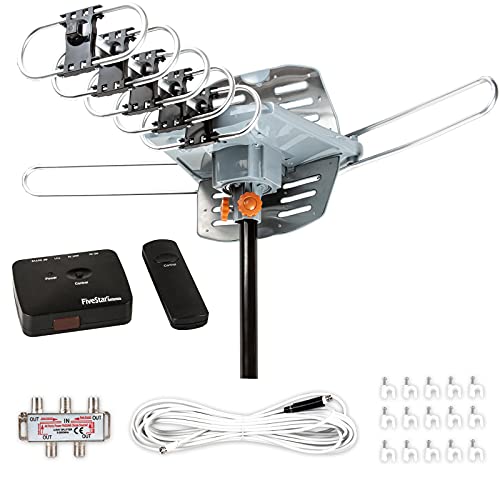
Five Star Outdoor HDTV Antenna 150 Mile Long Range, 360 Degree Rotating, Dual TV Output
The Five Star Outdoor HDTV Antenna is rated for 150 miles with 360 degree rotation, a built-in amplifier and dual TV output, so one antenna can feed two televisions. It comes with a remote control for rotation, and it is the best pick in this guide for a two-television household.
Key specifications: Five Star, 150 mile range, 360 degree rotation, amplifier, dual TV output, remote control.
In daily use, the dual output is the feature that pays for itself: two televisions share one antenna and one installation, with no splitter to buy and no second amplifier to power. The rotation finds the best aim for each direction, and the amplifier keeps both sets fed with a clean signal.
Setup is like the other motorised models: mount, connect the amplifier, rotate with the remote and scan. Run a channel scan on both televisions after aiming, because each tuner behaves slightly differently. If one set is fine and the other is not, check that television cable and its connections first.
Strengths
- Dual TV output feeds two televisions from one antenna.
- 150 mile range with rotation and amplification.
- Remote control for aiming from indoors.
Trade-offs
- Feeding two sets splits the signal, so a weak station may suffer.
- Needs power for the amplifier and the rotation.
- 150 miles is less than the 200-mile models.
This suits households with two televisions that want one antenna to serve both.
Best for: two-TV households that want one shared antenna / Not suited for: homes feeding three or more televisions
Check price on Amazon: Five Star Outdoor HDTV Antenna 150 Mile
Best Long Range HDTV Antennas: What Matters Most
Range is the headline number, but it is measured in ideal conditions. The useful question is not how far the box claims, but how far your towers are and what sits between you and them. A 200-mile antenna in flat open country will outperform a 150-mile antenna behind a hill, and a 150-mile antenna on a tall roof will outperform a 200-mile antenna in a valley. Buy more range than you need and mount it high.
The reception pattern decides whether you get all your stations or only some of them. A directional antenna concentrates its sensitivity in one direction and reaches further, while an omni-directional antenna listens in all directions and suits homes with towers on several sides. If your stations cluster in one direction, directional is the clear choice; if they surround you, an omni-directional or motorised antenna saves you from choosing.
The amplifier and the build decide how the antenna behaves over years, not weeks. A low-noise amplifier helps a long cable run without adding interference, and a sturdy mount with weatherproof connections survives storms that destroy cheap hardware. An antenna is a piece of outdoor equipment, so the metal, the plastic and the connectors matter as much as the electronics inside.
Finally, think about the whole system, not just the antenna. The mast, the mount, the cable and the grounding all affect the result as much as the antenna itself. A great antenna on a wobbly mast with a corroded connector will lose to a decent antenna installed properly. Budget for the installation hardware at the same time as the antenna, and treat the grounding wire as part of the purchase rather than an optional extra.
Buying guide: choosing a long range HDTV antenna
Start with the distance to your broadcast towers. The range printed on the box is a best-case figure measured in open country, so a 200-mile antenna does not guarantee 200 miles of reception at your house. Check a tower map for the distance and direction of the stations you want, then buy an antenna rated for at least that distance with some margin to spare.
Decide between a directional antenna and an omni-directional one. A directional antenna aims at one tower cluster and pulls a weaker signal from further away, while an omni-directional antenna receives from all sides and suits homes with towers in several directions. If all your towers sit in one direction, directional wins; if they surround you, omni-directional is simpler.
Think about where the antenna will live. Roof and attic mounts beat indoor placement for long-range reception, because height and a clear line of sight matter more than anything else. An outdoor antenna needs a mast, a mount and weatherproof cable, while an attic antenna avoids weather but loses some signal to the roof itself.
Look for a built-in amplifier and a low-noise design. An amplifier helps a long cable run, but it can also amplify noise, so an amplifier with a low noise figure is worth more than a high gain number on its own. If you live close to a cell tower, a filter that blocks LTE interference keeps your picture clean.
Check how many TVs one antenna can feed. Some antennas in this guide have dual outputs for two televisions, which saves buying a splitter and a second amplifier. If you plan to feed three or more sets, look for an antenna with a strong amplifier and plan on a distribution amplifier as well.
Consider the motorised rotation feature carefully. A motorised antenna lets you aim at different tower clusters from the remote control without climbing on the roof. It adds moving parts, so it suits people whose stations sit in two or more directions; if all your towers are in one direction, a fixed aim is simpler and more reliable.
Finally, remember the weather. An outdoor antenna must survive wind, rain and ice, so check the build quality and the mounting hardware before you buy. A cheap mount that fails in the first storm costs far more than the antenna itself, in repairs and in lost reception.
Check the channel list before you commit to a design. A tower map shows not only the distance to each station but also which band it broadcasts on, VHF or UHF. Some antennas favour one band, so confirm that the model you choose covers the bands your wanted stations actually use. The antennas in this guide cover both bands, but cheaper models sometimes do not, and a UHF-only antenna will simply miss VHF stations.
Plan the cable route before you buy the antenna. The shortest route from the antenna to the television gives the strongest signal, and every extra metre of cable and every splitter in the path costs signal. If the television is far from the roof, an amplified antenna or a distribution amplifier is worth the money. Measure the route, count the connections, and buy the cable in one length rather than joining short pieces together.
Do not forget the second television when you plan the system. If two sets will share one antenna, the dual-output models in this guide save a splitter and keep both signals strong. Count the televisions now, including any set you might add later, because adding a third set to a system designed for one usually means buying a distribution amplifier as well.
Using and caring for your long range HDTV antenna
Mount the antenna as high as practical, with a clear view towards the towers. A roof mount beats an attic mount, and an attic mount beats a window. Before you fix anything permanently, try the antenna in a temporary position and scan for channels, because a few feet of height or a few degrees of aim can change the channel count.
Aim the antenna using a tower map, not by guessing. Find the compass direction of the stations you want, point the antenna that way, and scan. For motorised models, use the remote to sweep slowly and scan at several positions, noting which aim gives the most channels. Write the best position down so you can return to it after a storm.
Keep the cable run short and the connections dry. Use outdoor-rated coaxial cable, seal outdoor connections against rain, and keep the cable away from power lines. A corroded connector is the most common cause of channels that slowly disappear, and it costs almost nothing to prevent.
Rescan your television after any change. Aiming the antenna, adding an amplifier or moving the mast all change what the tuner sees, so run a fresh channel scan each time. Keep a note of which channels you receive at each aim position so you can spot when something has shifted.
Check the installation once a season. Look at the mast for looseness, the cable for wear where it rubs against the roof edge, and the connectors for corrosion. Tighten what has worked loose and replace any connector that has gone green. A ten-minute check in spring and autumn prevents the slow loss of channels that people blame on the antenna itself.
Common mistakes to avoid
Buying an antenna rated for exactly the distance to your towers, with no margin. Hills, trees and weather all cut real-world range, so buy more range than the map suggests you need.
Mounting the antenna indoors and expecting long range results. Walls and roofs absorb signal, and an indoor antenna will never match the same model on a roof or in an attic.
Aiming once and never checking again. Wind shifts masts, trees grow, and stations move transmitters, so a rescan and a re-aim every few months keeps the channel list full.
Over-amplifying a strong signal. An amplifier on a short cable run near the towers can overload the tuner and make reception worse, not better. Use the amplifier the antenna was designed for and no more.
Forgetting the LTE filter. Mobile signals can interfere with television reception, and a filter that blocks them costs little and prevents pixelation on channels that were fine before.
Skipping the ground wire. An outdoor antenna needs proper grounding for lightning protection, and a mast that is not grounded is a risk to the whole house.
Mounting the antenna next to a metal roof vent or a solar panel. Metal near the antenna distorts the reception pattern and can block whole directions, so keep the antenna clear of large metal objects by at least a metre.
Using indoor cable outdoors. Indoor coaxial cable absorbs water and degrades quickly in sunlight, so the signal fades over months. Outdoor-rated cable costs little more and lasts for years.
Budget and value
The smartest money in this guide goes to the middle of the range: a 150-mile motorised antenna costs little more than a basic 100-mile model and handles most real-world situations. The 200-mile models cost more, but they buy the margin that matters when the towers are far away or the terrain is hilly.
Running costs are almost zero: there are no subscriptions for over-the-air television, and a well-built outdoor antenna lasts for years. Budget for a mast, a mount, outdoor-rated cable and a grounding wire at purchase, because the antenna itself is only part of the installation.
Final recommendation
If you want the strongest all-round long range antenna, the Five Star 2026 motorised 200-mile model is the pick: it aims itself from the remote, pulls in distant stations and handles two televisions. If you want a fixed antenna with no moving parts, the Antennas Direct ClearStream 4V is the better buy. Either way, mount the antenna high, aim it carefully and rescan your channels: the best long range HDTV antennas reward a good installation far more than any feature on the box. Start with a tower map, buy more range than the map says you need, and mount the antenna high with good cable and proper grounding. Do that, and free television from far away is yours for years.
Frequently asked questions
What is the best long range HDTV antenna?
For most homes, a directional antenna with a 150 to 200 mile rating mounted on the roof gives the best results. The Five Star 200-mile motorised model in this guide is the strongest all-rounder, while the Antennas Direct ClearStream 4V suits viewers who want a fixed, no-moving-parts design.
Do 200-mile antennas really reach 200 miles?
Range figures are measured in ideal conditions with a clear line of sight. Hills, trees, buildings and weather all reduce real-world range, so buy an antenna rated for more distance than your towers actually are, and mount it as high as you can.
Should I get a directional or omni-directional antenna?
A directional antenna receives best from one direction and pulls weaker signals from further away. An omni-directional antenna receives from all sides but with less gain in any one direction. Choose directional when your towers cluster in one direction, omni-directional when they surround your home.
Does an amplifier help a long range antenna?
Yes, an amplifier helps when the cable run is long or when one antenna feeds several televisions. It will not create a signal that is not there, and a poor amplifier can add noise, so a low-noise amplifier matters more than a big gain number.
Can I use a long range antenna indoors?
The cheapest option is an indoor antenna near a window, but indoor placement loses a lot of signal to walls and roofs. For genuinely long range, a roof or attic mount is worth the effort, and the antennas in this guide are all designed for that kind of installation.
Why did my antenna suddenly lose channels?
Check the aim first: a motorised antenna may need re-aiming after a storm, and a fixed antenna may have shifted on its mast. Then check the cable connections and the amplifier power supply, and rescan for channels on the television. If only one station is missing, it may have moved its transmitter.
Can one antenna feed two TVs?
Most antennas in this guide support two televisions directly, and with a distribution amplifier one antenna can feed a whole house. Check the number of outputs on the model you choose before you buy.
Can a long range antenna pick up stations from another city?
Yes, when the signal is strong enough. A good long range antenna with a clear line of sight can pull in stations from neighbouring cities, which is the main reason people buy antennas rated for 150 miles or more.
How high should I mount a long range antenna?
As high as practical, with a clear view towards the towers. A roof mount beats an attic mount, and an attic mount beats a window. Even a few extra feet of height can add channels, because the signal is blocked less by trees, roofs and hills.
More guides from KajuanDouglas
Best TV Antennas for RV Best Rabbit Ear Antennas Best 4K Indoor TV Antennas


