In a small-form-factor build, the CPU cooler is the one component chosen by a single measurement. Case manufacturers publish a maximum cooler height, and everything else about a cooler — its heat pipes, its fan, the density of its fin stack — only matters inside that vertical envelope. A tower cooler that misses the limit by two millimetres is not a slightly worse cooler; it is a cooler that does not fit, discovered at the worst possible moment, with the side panel in one hand. This guide is therefore organised by height first and by everything else second.
Kaju and Douglas may earn an affiliate commission when you buy through links on this page. That commission funds the research behind guides like this one and never changes the price you pay. Every figure quoted below — installed heights, socket lists, fan dimensions, the makers’ own thermal guidance — is taken from the manufacturers’ specification pages and manuals rather than from retail listings, because in this category the listing copy is precisely where the errors live: heights quoted without the fan, socket lists copied from a sibling model, and thermal figures with no stated source.
The six picks fall into four height tiers, and the tiers matter more than the brands. At 37 mm sit the slimmest coolers that still carry a real fin stack, built for console-style and sandwich-layout cases that allow almost nothing above the socket. At 45 to 47 mm, a second tier fits the large family of mini-ITX cases capped near 50 mm and begins to offer genuine thermal headroom. At 57 mm, a 120 mm fan enters the picture and the coolers start to suit processors with real ambition. At 67 mm, the tallest pick here approaches small-tower cooling hardware while still clearing the lids of cases that no tower could enter. All six share one layout: they are down-draft designs that blow air down through the fin stack toward the motherboard, which also moves air across the voltage regulators and memory — a secondary benefit that tower coolers, blowing front to back, do not provide.
One piece of housekeeping governs every number in this guide. Heights are installed heights: the heatsink measured with its fan fitted, exactly as the manufacturers publish them. A cooler described by its bare heatsink height is fourteen or fifteen millimetres taller once its fan is on, and that gap is the single most common cause of a compact cooler failing to fit. Where a maker publishes a thermal figure — a TDP value or Noctua’s NSPR scale — it is reported as that maker’s figure, in that maker’s terms, because the brands do not measure under shared conditions and their numbers cannot be lined up against each other as if they were one scale.
What to look for in a compact CPU cooler
Installed height is the only height that matters
The first discipline of this category is knowing which height is being quoted. Every cooler here is two components stacked: a fin stack and a fan. The Noctua picks pair a 23 mm heatsink with a 14 mm fan. The Thermalright AXP90-X47 pairs a 32 mm heatsink with a 15 mm fan. Retail listings do not always say which of the three numbers — heatsink alone, fan alone, or the assembly — their headline figure describes, and the difference decides whether a side panel closes. The figures in this guide are assembly heights, the dimension a case limit actually refers to, taken from the manufacturers’ own dimension lines: 37, 37, 45, 47, 57, and 67 mm.
The practical habit follows from that. Take the case maker’s published CPU cooler limit as the ceiling, take the cooler’s published installed height as the claim against it, and treat an exact match as a risk rather than a fit: case limits are nominal, socket and standoff tolerances vary slightly between boards, and a panel lined with acoustic material sits closer than a bare one. A couple of millimetres of headroom is the difference between a specification that works on paper and a build that closes without pressure on the fan frame. Builders who know their case allows, say, 47 mm exactly should read the 45 mm pick below with more comfort than the 47 mm one, whatever the thermal hardware suggests.
Measuring the case yourself settles arguments the spec sheet cannot. With the motherboard installed, stand a ruler on the socket’s mounting surface and read the distance to the underside of the side panel; that figure, minus a small safety margin, is your true ceiling.
Four height tiers, four different cases
The tiers are not a smooth ladder; each one corresponds to a recognisable family of cases. The 37 mm tier serves the slimmest enclosures in the hobby — console-style cases that lay the graphics card beside the motherboard, sandwich-layout designs a few litres in volume, and home-theatre cases styled to sit under a television. In that company, the cooler is competing for airspace with everything else in the build, and its job is honest cooling of a sensibly chosen processor rather than heroics. The 45 to 47 mm tier serves the mainstream of mini-ITX: cube and shoebox cases with a stated limit near 50 mm, where the extra centimetre over the first tier buys a third or fourth heat pipe and a meaningfully larger fin stack.
The 57 mm tier is where the category changes character. Ten more millimetres admit a 120 mm slim fan in place of the 92 mm fans below it, and a larger fan moves a given volume of air at lower rotational speed — the mechanical basis for quieter operation at equal airflow. Cases in this band are the roomier small-form-factor designs, typically with limits stated between 55 and 65 mm. The 67 mm tier, finally, serves cases capped near 70 mm that sit one step below tower territory: the fin stacks grow deep enough, and the heat pipe counts high enough, that the limiting factor stops being the cooler and becomes the case’s own ability to supply it with fresh air. Choosing a tier is therefore really choosing a case family, and the cooler decision should be made after the case limit is known, not before.
Socket support splits the list in two
Four of the six picks mount on both current platforms; two of them, deliberately, do not. Noctua builds its smallest coolers as separate Intel and AMD products — the NH-L9i-17xx for LGA1700 and LGA1851, the NH-L9a-AM5 for AM5 alone — because at 37 mm there is no spare metal for universal mounting compromises, and each version’s base and hardware are shaped around one platform’s socket geometry and backplate. The consequence for buyers is absolute: the Intel pick does not fit an AMD board, the AMD pick does not fit an Intel board, and no adapter changes that. A builder who has not yet fixed the platform should fix it before ordering either Noctua.
The dual-platform picks carry their own subtler version of the same check. Socket lists are revised over a model’s production life: Intel’s LGA1851 appears on current listings of some models here and is absent from the documentation of others, and AMD’s AM5 joined several ranges after launch. be quiet!’s published list for the Pure Rock LP, for instance, covers LGA1700 and its predecessors plus AM5 and AM4, with no LGA1851 entry — a Core Ultra builder reading a retail headline that says “Intel and AMD” would be misled. The rule is to read the socket list on the manufacturer’s page for the exact model, in the exact version being bought, and to treat any listing that summarises compatibility in a slogan as unverified.
The footprint decides memory and slot clearance
Height is the famous constraint; footprint is the quiet one. Mini-ITX boards place the memory slots and the single PCIe slot close to the socket on every side, and a cooler that overhangs either can block a DIMM slot or lean over the graphics card’s backplate. The 92 mm class of coolers — the two Noctuas at 95 by 95 mm and 92 by 92 mm, the be quiet! at 92 by 92 mm, the AXP90-X47 at 94.5 by 95 mm — is drawn to sit inside the keep-out zone around the socket, which is why those four can promise memory clearance almost by geometry: nothing extends far enough to reach the slots. Their fans are 92 mm for the same reason.
The two 120 mm picks trade that geometric safety for airflow. A 120 by 120 mm footprint cannot fit inside the keep-out zone, so the IS-55’s fan overhangs the memory area on many mini-ITX boards, and tall memory heat spreaders can foul its frame; low-profile memory is the documented-safe pairing, and the exact clearance depends on the individual board’s slot placement. The AXP120-X67, at 123.5 by 120 mm, overhangs further still and asks the same question on the slot side as well. Neither overhang is a defect — it is the price of the larger fan, paid knowingly — but it converts memory and board layout from afterthoughts into specifications to check before ordering, using the board maker’s dimensions and the cooler’s published footprint rather than hope.
Heat pipes, fan size, and what maker thermal figures can tell you
Within a tier, the hardware tells a consistent story. Heat pipe counts climb with height across this list — three in the 45 mm be quiet!, four in the 47 mm Thermalright, five in the 57 mm IS-55, six in the 67 mm AXP120-X67 — because taller fin stacks give pipes somewhere useful to go. Material climbs too: the AXP90-X47 Full Copper builds its entire fin stack from copper where rivals use aluminium fins on a copper base, which is why it is the heaviest cooler here relative to its size. Thermalright’s AGHP heat pipes, fitted to both its picks, are designed to keep heat transport steady whether the board sits vertically in a tower-style case or horizontally in a home-theatre box — orientation genuinely affects ordinary heat pipes, and in this category both orientations are common.
Maker thermal figures require more careful reading. be quiet! publishes a 100 W TDP figure for the Pure Rock LP; Noctua publishes an NSPR value of 61 for both L9 models and maintains per-processor guidance for them. These are honest numbers inside each maker’s own framework and meaningless as a cross-brand league table, because the test processors, ambient conditions, and failure thresholds behind them are each maker’s own. Used properly, they answer one question: does the maker itself position this cooler for the class of processor in the build? A flagship chip run at unrestricted power sits outside the published envelope of the 37 mm tier by Noctua’s own positioning, whatever any listing implies; a mid-power processor in a living-room machine sits comfortably inside the Pure Rock LP’s published figure. Firmware power limits, set on the board, are the bridge between the two — a legitimate and common way to pair a strong processor with a small cooler, at a known cost to sustained all-core performance.
Mounting hardware and the board underneath
The last buying criterion is the one that only appears with the motherboard in hand. Low-profile coolers mount close to the board and interact with its furniture: backplates, retention frames, VRM heatsinks, and the M.2 covers that now crowd the socket area on many mini-ITX designs. The AMD picks here work with the platform’s backplate arrangements — Noctua’s NH-L9a-AM5 is built around the AM5 backplate specifically, one reason it cannot serve AM4 — while the be quiet! uses the stock AMD retention backplate on both AM4 and AM5. Intel mounting on LGA1700 and LGA1851 follows each maker’s bracket system, documented in their manuals with the board out of the case; none of these six is a cooler to install as an afterthought inside a finished build, because the working room in a small case rarely allows it.
There is one compensating pleasure. A down-draft cooler’s fan blows through the fin stack and across the board surface, so the voltage regulators and memory beside the socket receive moving air that a tower cooler never gives them. In a small case with limited case-fan provision, that wash of air is a real part of the thermal design, and it is one reason the low-profile format survives on merit rather than nostalgia even in cases that could fit a small tower. It also means the cooler’s fan curve does double duty — a curve set purely for processor temperature is also, incidentally, the board’s cooling plan.
The case has to feed the cooler
A low-profile cooler does not bring its own air supply. Its fan draws from the few centimetres between the fin stack and the case panel, and what it can do is capped by how freely that space is replenished. Slim cases differ enormously here: some place a perforated panel directly above the cooler, giving the fan a short path to outside air; others close the socket area behind a solid panel and expect the fan to scavenge whatever drifts through the interior, including air the graphics card has already warmed. The same cooler, on the same processor, is a different product in those two cases — which is why this guide treats case limits as the first specification and case ventilation as the second. A builder comparing two slim cases for the same cooler should compare the intake path over the socket as carefully as the height figure, and a builder whose case starves the socket area should expect the fan to run faster, and be heard doing it, at any given load.
Slim fans are standard frames — plan for the second year
One quiet advantage of this category is that its fans are not exotic. The 92 mm units here are standard square frames in 14 or 15 mm thicknesses, and the 120 mm units are the standard 120 by 120 by 15 mm frame, all on ordinary 4-pin PWM connections — so a fan that wears, or a builder who simply prefers a different maker’s fan, is a like-for-like swap away, provided the replacement keeps the same thickness and the height arithmetic is redone honestly. Dust is the other second-year fact: a slim case concentrates its intake through small areas, fin stacks load faster than in a tower, and the coolers here sit close enough to their panels that cleaning access should be considered at purchase rather than discovered later. None of this appears in headline marketing, and all of it decides whether a compact build stays pleasant to own.
In this guide
The six picks
The six coolers are ordered by installed height, shortest first, because that is the order in which a case limit eliminates them. Read each pick’s socket line before its thermal story: a cooler that does not mount on the board in the build is not a candidate at any height. Heights, footprints, and fan dimensions throughout are the manufacturers’ published figures for the exact versions named.
Noctua NH-L9i-17xx — the 37 mm answer for Intel boards
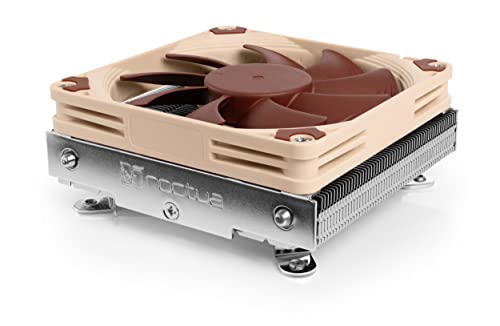
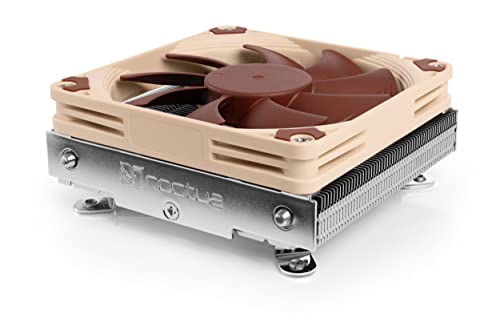
The NH-L9i-17xx is the reference point of the slimmest tier: a 23 mm heatsink carrying a 14 mm NF-A9x14 fan for a 37 mm installed height, inside a 95 by 95 mm footprint drawn to stay clear of memory slots and the PCIe slot on mini-ITX boards. It serves exactly one platform family — Intel LGA1700 and LGA1851 — and that focus is the design. The base, the SecuFirm2 mounting, and the fan are all optimised for a single socket geometry rather than adapted to several, which is how the cooler keeps its height and its footprint simultaneously.
Noctua publishes an NSPR figure of 61 for this model and maintains processor guidance that positions the L9 line for low-power and home-theatre-class chips rather than unrestricted flagship parts. That positioning should be read as the product’s honest shape: within it, the cooler offers Noctua’s usual completeness — a low-noise adapter in the box for builders who want to cap the fan’s speed, the maker’s thermal compound, and documentation that treats a 37 mm installation with the seriousness the clearances demand. The fan itself is a 92 mm unit only 14 mm thick, and that thinness is load-bearing: fitting a standard 25 mm fan in its place would lift the assembly to roughly 48 mm and out of the tier entirely. Noctua publishes the fan itself at up to 2,500 rpm with a maximum noise figure of 22.8 dB(A), and the included low-noise adapter trims both speed and noise for builders who value quiet over the last of the headroom — a choice the maker builds into the box rather than leaving to fan-curve improvisation.
The build experience follows from the size. Everything about the cooler is reachable, nothing overhangs, and the mounting works with the board outside the case in the normal way. What the buyer must bring is a processor choice that respects the envelope — a mid-power Intel chip, or a stronger one deliberately run at a firmware power limit the builder has chosen with open eyes. Asked to cool a flagship processor at full sustained power, the NH-L9i-17xx is not failing; it is being used outside the brief its maker published for it.
Strengths
- 37 mm installed height fits the slimmest case family in the hobby.
- 95 by 95 mm footprint stays inside the socket keep-out zone, clearing memory and the PCIe slot.
- Maker-published NSPR figure and per-processor guidance set honest expectations.
- Low-noise adapter included for builders who want a capped, quieter fan curve.
Trade-offs
- Intel LGA1700 and LGA1851 only — it cannot mount on any AMD board.
- The published thermal envelope excludes flagship processors at unrestricted power.
- The 14 mm fan is integral to the height; a standard-thickness fan swap erases the 37 mm figure.
- Sits at the premium end of its tier, as Noctua’s completeness usually does.
Who it suits: the NH-L9i-17xx belongs to the Intel build in a case that allows almost nothing — a console-style enclosure, a sandwich-layout design, a home-theatre box under a screen — running a processor chosen inside the maker’s published envelope. If that is the build on the desk, this is the configuration to check price on Amazon.

Noctua NH-L9a-AM5 — the same 37 mm, for AMD’s current socket
The NH-L9a-AM5 is the mirror image of the Intel pick: the same 37 mm installed height, the same 14 mm NF-A9x14 fan, a slightly smaller 92 by 92 mm footprint, and the same published NSPR figure of 61 — built exclusively for AMD’s AM5 socket. It exists as a separate product because AM5’s mounting geometry and fixed backplate differ from both Intel’s sockets and from AM4, and Noctua chose to engineer for that backplate directly rather than adapt an older design. The older NH-L9a-AM4 is a different cooler for a different socket; despite the family resemblance, neither version fits the other’s platform.
That single-platform focus cuts both ways, and the article is better for stating it plainly. An AM5 builder gets a cooler whose base and mounting were drawn for the board actually in the build, with the same completeness as its Intel sibling — low-noise adapter, thermal compound, and processor guidance published by the maker that places the L9 line with low-power and home-theatre-class chips. An AM4 builder gets nothing from this listing at all and should be looking at the dual-platform picks below instead. A chromax.black version of the cooler exists for builders who want the same hardware in black; it is a finish variant of this product, not a different specification.
In a slim AM5 build the same arithmetic applies as on the Intel side. The cooler clears memory and slot by geometry, installs without drama on a board outside the case, and asks in return that the processor be chosen — or power-limited — to live inside the envelope Noctua publishes. Ryzen processors with modest power draws are natural partners; the efficiency of the platform means the 37 mm tier covers more of the AMD range in spirit than the raw figure suggests, but the maker’s guidance, not optimism, is the document to plan against.
Strengths
- 37 mm installed height, engineered specifically around the AM5 backplate.
- 92 by 92 mm footprint clears memory slots and the PCIe slot by geometry.
- Published NSPR figure and processor guidance from the maker, as with the Intel version.
- A black chromax variant exists for builders matching a colour scheme.
Trade-offs
- AM5 only — it fits neither AM4 nor any Intel socket, and no kit changes that.
- The thermal envelope is the L9 envelope: mid-power chips, or stronger ones deliberately power-limited.
- Easy to confuse with the older NH-L9a-AM4 at retail; the socket suffix is the specification.
- Premium positioning within the tier.
Who it suits: the NH-L9a-AM5 is for the slim AM5 build — a small Ryzen machine in a case capped near 40 mm, with the processor picked to suit the cooler’s published guidance. If the board is AM5 and the case allows almost nothing above it, this is the cooler to check price on Amazon.

be quiet! Pure Rock LP — 45 mm, and both platforms in one box
The Pure Rock LP answers the question the two Noctuas refuse to: what cools a near-minimum-height build when the platform is not yet fixed, or is AMD on a budget, or Intel without the premium? At 45 mm installed — a 92 by 92 mm assembly with three 6 mm heat pipes and a 15 mm-thick 92 mm fan — it mounts on Intel LGA1700, LGA1200, and the LGA115x family, and on AMD AM5 and AM4, with the full hardware set in the box. be quiet! publishes a 100 W TDP figure for it, the clearest maker-stated envelope in this half of the list.
The design brief shows in the details. The fan is the maker’s own slim unit, published at up to 2,500 rpm with a maximum noise figure of 30.6 dB(A) — a spec-sheet number, quoted here as the maker states it, that marks the cost of moving air with a small fan at full speed; at the moderated speeds of a living-room machine, the brand’s entire reputation rests on staying unobtrusive. The finish is brushed aluminium in black, the thermal paste arrives pre-applied, and on AMD boards the mounting uses the platform’s stock backplate, which keeps the installation shorter than most. At 358 g it is also light, a small mercy in cases that travel.
Two limits deserve the same plainness. The published 100 W envelope is a ceiling to plan against, not a target: processors above it belong to the taller tiers of this list. And be quiet!’s socket list, checked against the maker’s own page, carries no LGA1851 entry — the newest Intel platform is the one gap in an otherwise broad list, and a Core Ultra builder should not let a retail headline talk them out of that fact. Within those lines, the Pure Rock LP is the most flexible cooler in the first three picks: one box, both camps, and a height that fits the great middle of mini-ITX cases.
Strengths
- 45 mm installed height with genuine dual-platform support — Intel and AMD hardware in one box.
- Maker-published 100 W TDP figure gives a clear envelope to plan a build against.
- 92 by 92 mm footprint keeps clear of memory slots, in keeping with the 92 mm class.
- Pre-applied thermal paste and use of the stock AMD backplate shorten the installation.
Trade-offs
- No LGA1851 support on the maker’s published socket list.
- The 100 W published envelope caps processor choice below the taller tiers’ reach.
- Three heat pipes is the fewest here — the design spends its budget on fit and flexibility.
- The slim fan’s published maximum noise figure reflects how hard small fans work at full speed.
Who it suits: the Pure Rock LP suits the builder whose case allows about 45 mm and whose plans value flexibility — an AM4 machine being kept alive, an AM5 or LGA1700 build on a sensible processor, a home-theatre PC that must stay out of earshot. If one cooler has to cover either platform at this height, this is the one to check price on Amazon.

Thermalright AXP90-X47 Full Copper — 47 mm of copper, and nothing wasted
Two millimetres above the be quiet! sits the densest cooler in this guide. The AXP90-X47 Full Copper pairs a 32 mm heatsink with a 15 mm TL-9015 fan for a 47 mm installed height, and the heatsink is copper throughout — fins as well as the nickel-plated C1100 base — where every rival here uses aluminium fins. Four 6 mm heat pipes with Thermalright’s AGHP treatment move heat into that stack, and the whole assembly weighs 520 g, a figure that tells its own story about how much metal is packed into a 94.5 by 95 mm footprint. Copper’s conductivity is the point: at a fixed, tiny volume, the full-copper stack is the way to buy thermal capacity that aluminium cannot match in the same space.
The supporting figures are the maker’s: the TL-9015 fan is published at up to 2,700 rpm and 42.58 CFM, with a stated noise ceiling of 22.4 dB(A). Socket support covers Intel LGA1700, LGA1200, and the LGA115x family, plus AMD AM4 and AM5, with metal mounting hardware for each platform in the box. The footprint, like the other 92 mm-class coolers here, is drawn to stay clear of the memory slots on mini-ITX boards — Thermalright presents the design as free of memory limitation worries, and the geometry backs the claim. The AGHP pipes earn a specific mention in this tier because slim cases are as often horizontal as vertical, and the pipes are designed to perform in either orientation. One installation note belongs with the footprint: on boards where the memory slots sit especially close, the cooler’s mounting orientation is worth deciding before the paste comes out, because a square cooler over a crowded socket gives the builder more than one way to arrange the fin stack’s relationship to the slots, and the manual’s hardware allows the deliberate choice.
The cautions are about buying, not cooling. Thermalright sells this cooler in three versions that listings blur together: the standard AXP90-X47 with aluminium fins, this Full Copper version, and a Black version that is aluminium under its finish — the copper construction belongs to the Full Copper alone, and the title of the listing has to say so. The 47 mm height is also an exact-fit proposition in cases limited to 47 mm: the guidance earlier in this guide about leaving a margin applies with full force, and a case limited to 50 mm is the comfortable home. Judged inside those lines, this is the pick for the builder whose case stops just short of 50 mm and who wants the strongest documented hardware that fits beneath the line.
Strengths
- Full-copper fin stack and base — the most thermal material available at 47 mm.
- Four AGHP heat pipes keep performance steady in vertical or horizontal cases.
- 94.5 by 95 mm footprint stays within the socket keep-out zone, clearing memory.
- Dual-platform support across current Intel and AMD sockets, hardware included.
Trade-offs
- 520 g is heavy for its size — the copper is the point, and the weight is its price.
- Version confusion at retail is real: the standard and Black versions are aluminium, not copper.
- An exact 47 mm case limit leaves no fitting margin; it is happiest under a 50 mm ceiling.
- The small fan’s published ceiling speed is high, as 92 mm fans at this duty tend to be.
Who it suits: the AXP90-X47 Full Copper suits the performance-minded small build with just under 50 mm to spare — a gaming mini-ITX machine or a compact workstation where the processor choice is ambitious for the case size. If the case allows 47 mm and the brief is maximum hardware inside it, this is the cooler to check price on Amazon.

ID-COOLING IS-55 — the 57 mm tier, where the 120 mm fan arrives
The IS-55 is the hinge of this list: the shortest cooler here with a 120 mm fan, and the point where compact coolers stop being purely about survival. The assembly stands 57 mm — a fin stack with five heat pipes and a copper base, topped by a 120 by 120 by 15 mm PWM fan that ID-COOLING publishes at 54.6 CFM. Socket support is the broadest in the guide: Intel LGA1851, LGA1700, LGA1200, and LGA115x, plus AMD AM5 and AM4. For a builder whose case allows the high fifties, this is the first pick that pairs a genuinely large fan with a genuinely wide platform list.
The physics of the fan swap explain the tier. A 120 mm fan moves the IS-55’s published airflow at lower rotational speed than a 92 mm fan needs for the same volume, which is the mechanical route to quieter cooling at equal work — the maker’s published noise range runs from 13.8 dB(A) at low speed to 31.2 dB(A) at the top of the fan’s range, figures quoted as ID-COOLING states them. The five heat pipes spread the processor’s output across a fin stack that is meaningfully larger than anything in the 92 mm class, and the whole cooler weighs about 450 g. In specification terms, this is the tier where mid-power gaming processors stop being a compromise the cooler imposes.
The 120 mm fan is also the pick’s one structural demand. A 120 by 120 mm footprint cannot stay inside the socket keep-out zone, so the fan overhangs the memory area on many mini-ITX boards; low-profile memory is the safe pairing, and builders with tall heat-spreader kits should measure their board’s slot placement against the footprint before ordering. The slim fan is a standard 120 mm frame, so where a case has roughly ten millimetres more than 57 mm, a standard-thickness 120 mm fan is a physical possibility — at which point the build has simply moved up a tier and should be compared with the next pick. One buying caution belongs here too: an ARGB version of this cooler is sold alongside the plain model, and it is a different listing; the pick described here is the standard IS-55.
Strengths
- 120 mm slim fan at 57 mm — the largest fan available under the 60 mm line.
- Five heat pipes and a copper base give the fin stack real capacity.
- The broadest socket list here, including LGA1851 alongside AM5 and AM4.
- Published airflow and noise figures from the maker describe a wide, usable fan range.
Trade-offs
- The 120 mm footprint overhangs the memory area on many mini-ITX boards — low-profile memory is the safe pairing.
- Board layout checks are mandatory; VRM heatsinks and slot placement vary by board.
- An ARGB sibling shares the model name’s shelf space and is a separate listing.
- At full fan speed the published noise ceiling is audible, as with every slim fan here.
Who it suits: the IS-55 suits the small build that has outgrown the 92 mm class — a gaming mini-ITX machine with a case limit in the high fifties and a mid-power processor from either platform, current sockets included. If the case stops at 57 mm but the ambitions for the build do not, this is the pick to check price on Amazon.

Thermalright AXP120-X67 — 67 mm, and the deepest hardware on this page
The tallest pick is the one that ends arguments about what a low-profile cooler can contain. The AXP120-X67 stands 67 mm — a 52 mm heatsink under a 15 mm TL-C12015 fan — with six 6 mm AGHP heat pipes, a pure copper nickel-plated base, and a 120 mm fan published at 59 CFM with a noise ceiling of 26.1 dB(A), the lowest maximum figure among the 120 mm picks here. Its dimensions, 123.5 by 120 mm, make it the largest cooler in the guide in every direction, and its hardware list reads like a small tower cooler’s: this is the pick for cases capped near 70 mm whose builders declined to compromise anywhere else.
The fan deserves its sentence. The TL-C12015 turns at up to 1,800 rpm — a lower ceiling than the IS-55’s fan and far below the 92 mm units — because a 120 mm fan at that speed already moves the published 59 CFM; lower rotational speed for equal air is the whole acoustic argument of the 120 mm class, and this is its fullest expression in the guide. The six AGHP pipes keep the design orientation-proof, as with its smaller sibling, and the fin stack they feed is deep enough that the case’s own intake arrangement, rather than the cooler, becomes the limiting factor in most builds that can house it.
Two checks define the purchase. The footprint is the largest here, so the memory and first-slot questions from the buying guide apply at full strength: measure the board, choose low-profile memory, and confirm the overhang against the specific mini-ITX layout. And Thermalright’s socket documentation for this model has varied across its production life — AM4 and LGA1700 are constant, while AM5 and LGA1851 appear on current revisions and listings — so the socket list of the exact unit being bought must be read, not assumed. Black and white ARGB variants also exist alongside the standard model described here. None of this diminishes the pick; it simply asks the buyer to verify the version with the same care the hardware rewards.
Strengths
- Six AGHP heat pipes and the deepest fin stack here, under a 67 mm ceiling.
- 120 mm fan published at 59 CFM with the lowest maximum noise figure of the 120 mm picks.
- Copper base and full electroplated construction, in keeping with the tier.
- Orientation-independent heat pipes suit vertical and horizontal cases alike.
Trade-offs
- The 123.5 by 120 mm footprint demands board-level clearance checks on every side.
- Socket lists vary by production revision — AM5 and LGA1851 must be confirmed on the exact listing.
- ARGB colour variants share the model name; the standard version is the one described here.
- At 67 mm it competes with the smallest tower coolers wherever a case could fit one instead.
Who it suits: the AXP120-X67 suits the build whose case allows roughly 67 mm and whose owner wants the question of CPU cooling closed — a strong processor in a slim case, with the board measurements done and the memory chosen low. If the case gives this much room and no more, this is the cooler to check price on Amazon.
The six coolers side by side
The table collects the published figures that decide fit — installed height, socket support, fan, and heat pipes — with each maker’s own positioning stated in words. Thermal figures are deliberately not tabulated across brands, for the reason given in the buying guide: the makers do not measure them under shared conditions.
| Cooler | Installed height | Socket support | Fan | Heat pipes | Best for |
|---|---|---|---|---|---|
| Noctua NH-L9i-17xx | 37 mm | Intel LGA1700 / LGA1851 | 92 mm, 14 mm thick | — | The slimmest Intel builds |
| Noctua NH-L9a-AM5 | 37 mm | AMD AM5 | 92 mm, 14 mm thick | — | The slimmest AM5 builds |
| be quiet! Pure Rock LP | 45 mm | Intel LGA1700 / 1200 / 115x; AMD AM5 / AM4 | 92 mm, 15 mm thick | 3 | Either platform at near-minimum height |
| Thermalright AXP90-X47 Full Copper | 47 mm | Intel LGA1700 / 1200 / 115x; AMD AM5 / AM4 | 92 mm, 15 mm thick | 4 | Maximum hardware under 50 mm |
| ID-COOLING IS-55 | 57 mm | Intel LGA1851 / 1700 / 1200 / 115x; AMD AM5 / AM4 | 120 mm, 15 mm thick | 5 | Mid-power builds under 60 mm |
| Thermalright AXP120-X67 | 67 mm | Varies by revision — AM4 and LGA1700 constant | 120 mm, 15 mm thick | 6 | The strongest hardware near 70 mm |
Matching the cooler to the case
The matching exercise itself is short, and it is worth doing in the right order. Start from the case maker’s published cooler limit, not from a cooler that caught the eye. A limit under 40 mm leaves exactly the two Noctuas, and the platform decides between them. A limit in the high forties opens the dual-platform tier, where the choice is between the be quiet!’s flexibility and published envelope and the Thermalright’s copper. A limit in the high fifties admits the IS-55 and its 120 mm fan, subject to the memory check. A limit near 70 mm admits the AXP120-X67, subject to every check in this guide at once. At each step the processor is the second input: the stronger the chip and the longer its sustained loads, the further up the tiers the honest answer sits — or the more deliberate the firmware power limit must be.
Two of these decisions have guides of their own on this site for readers who find the cooler was not their real question. A builder who keeps returning to the case itself — measuring the desk, re-reading volume figures, wondering whether the whole machine should shrink — is really shopping the small-form-factor category across every brand, and our guide to best gaming keyboards for pc small form factor PC cases takes that question from the beginning. And a builder whose compact machine is planned around a specific small Corsair chassis should check the case side of the pairing as carefully as the cooler side: our guide to montech mkey review a keyboard made by a pc case company Corsair PC cases covers the clearances and radiator limits of that range, including its mini-ITX entry, in the manufacturer’s own figures.
Mistakes that catch compact cooler buyers out
The first mistake is buying on a heatsink-only height. A listing that advertises a 32 mm cooler is describing the AXP90-X47’s fin stack without its fan; the assembly that must fit under the side panel is 47 mm. Every height in this guide is the assembly figure, and any figure found elsewhere should be interrogated until it admits which of the two it is. The second mistake is assuming platform flexibility that the product does not have — most expensively with the Noctua pair, where the Intel and AMD versions share a family name, a height, and a fan, and fit absolutely nothing of each other’s. The socket suffix in the model name is not a variant detail; it is the product.
The third mistake is treating memory as an afterthought under a 120 mm fan. The IS-55 and AXP120-X67 overhang the memory area by design, and a tall heat-spreader kit bought for its looks can turn a correct cooler choice into a build that cannot be assembled; low-profile memory is a line item to settle before the cooler ships, not after. The fourth is reading maker thermal figures as a league table. A 100 W figure from one maker and an NSPR value from another are each honest inside their own frameworks and incomparable across them; the question they answer is whether the maker positions the cooler for the processor class in the build, and a builder who needs more than that should be reading the maker’s per-processor guidance where it exists. The fifth, quietest mistake is the exact fit: a cooler bought to the millimetre of a case limit, leaving nothing for tolerances, panel linings, or the slightly taller standoff. A couple of millimetres of headroom costs nothing and forgives everything.
Frequently asked questions
How much spare room should I leave above a cooler’s stated height?
A small margin — a couple of millimetres — is the sensible allowance. Case limits are published as nominal figures, board and socket tolerances vary slightly, and side panels with acoustic lining sit closer than bare panels. An exact match between a cooler’s installed height and a case’s stated limit is a risk to manage consciously, not a fit to assume; where the tier below offers a cooler two or three millimetres shorter, that headroom is usually worth more than the marginal hardware it gives up.
Can a 37 mm cooler handle a high-end processor?
Within the maker’s published envelope is the only honest frame for the answer. Noctua positions its L9 line for low-power and home-theatre-class processors and publishes per-processor guidance to that effect; a flagship chip at unrestricted sustained power sits outside that positioning. What builders legitimately do is set a firmware power limit on the board, trading some sustained all-core performance for a processor that lives inside the small cooler’s envelope — a known, reversible compromise, chosen in advance rather than discovered under load.
Why are the two Noctua picks not interchangeable between Intel and AMD?
Because at 37 mm there is no spare material for universal hardware. Each version’s base and mounting are engineered around one platform’s socket geometry and backplate — the AM5 version around that socket’s fixed backplate specifically — so the Intel cooler cannot mount on an AMD board and the AMD cooler cannot mount on an Intel one, and no adapter kit bridges them. Builders who need one cooler to cover either platform should look at the other four picks, which are designed dual-platform from the start.
Is a 120 mm slim fan quieter than a 92 mm fan?
As a mechanical principle, a larger fan moves a given volume of air at lower rotational speed, and lower speed is the main route to lower noise — the published figures here follow that shape, with the 120 mm fans’ maximum speeds and noise ceilings stated by their makers in lower terms than the hardest-working 92 mm units. In daily use the fan curve matters as much as the fan: any of these coolers can be made intrusive by an aggressive curve and civilised by a patient one, and the down-draft layout means the curve is also cooling the board around the socket.
Can I fit a standard 25 mm fan to one of these coolers?
Physically, on the 120 mm picks, the slim fan is a standard 120 mm frame, and a 25 mm-thick replacement adds roughly ten millimetres to the installed height — moving the cooler into the next tier, where it should be compared against the coolers designed for that height. On the 37 mm Noctuas the arithmetic is fatal to the concept: a standard fan lifts the assembly to roughly 48 mm and deletes the entire reason the product exists. The slim fans are not a compromise these designs tolerate; they are part of the specification.
The bottom line
Stated as defaults, the ladder resolves cleanly. At 37 mm the platform chooses between the two Noctuas. At 45 mm the be quiet! is the flexible answer, and at 47 mm the full-copper Thermalright is the performer’s. At 57 mm the IS-55 is the all-rounder of the list, and at 67 mm the AXP120-X67 is simply the most cooler that still counts as low-profile. Every one of those defaults can be displaced by a specific fact — a socket list, a memory kit, an exact-fit case — which is what the pick sections above are for.
Compact CPU coolers are the most honestly specified category in PC building, because the deciding figure is printed on both the case and the cooler and either matches or does not. Fix the case limit first, let it name the tier, check the socket line before the thermal story, and measure the board where a 120 mm fan is involved — and the six coolers here cover the whole ladder from 37 mm to 67 mm without a weak rung. Measure the gap before falling for the hardware, and this becomes the simplest decision in the entire build.