Disclosure: As an Amazon Associate, kajuandouglas.com earns from qualifying purchases. Links to Amazon on this page are affiliate links; they cost you nothing extra. Listing details such as price and availability change often, so check the current Amazon listing before you buy.
Where to buy
Confirm current stock and delivery timing on Amazon for the linked receivers and amplifiers in this outdoor-speaker guide. Entries marked prose-only describe a category and its shopping specification, because the right choice depends on your garden’s layout and zones.
- Yamaha RX-V385 5.1-Channel AV Receiver — the one-soundtrack hub for room plus patio
- Zone 2 AV Receiver Setup (Prose-Only Pick) — a category for patios that play their own source
- Streaming Amplifier (Prose-Only Pick) — a category for phone-led streaming households
- Atmos-Capable AV Receiver (Prose-Only Pick) — a category for theaters still adding channels
- Fosi Audio BT20A Pro Mini Stereo Amplifier — compact power for a single outdoor pair
- Fosi Audio BT20A Mini Stereo Amplifier — the entry route to sound on the patio
The reasoning behind the shortlist follows, then the same examination applied to every candidate.
Outdoor listening reverses the usual amplifier problem. Indoors, the room helps: walls return the sound, the audience sits close, and modest power sounds generous. Outdoors the help vanishes. Sound escapes into open air, the audience spreads across a patio or a lawn, wind and distance tax every decibel, and the electronics — this is the part buyers forget — must stay inside the house while their music goes out into the weather. The receiver question for outdoor speakers is therefore really an architecture question wearing a product’s clothes.
Picture the household this guide serves. A living room system exists or is planned. A pair of weather-rated speakers waits to be mounted under the eaves, aimed at the patio table. Between them lies the true project: a cable run through a wall, possibly along a fence or under a path, measured in tens of meters and dug exactly once. The receiver must organize all of it — sources, zones, volume — from its indoor shelf, for years, without being visited by the weather it entertains.
So the shortlist is sorted by architecture rather than by brand. A mainstream receiver covers the household that lives in one audio place at a time. A Zone 2 category covers the household that genuinely lives in two. A streaming amplifier covers the phone-led household, an Atmos category the growing theater, and two compact amplifiers cover the single-pair patio in its purest form. Every linked model passed this site’s verification audit; the categories that depend on your garden’s geography are described by specification instead.
One boundary before the digging starts: everything electronic in these pages lives indoors. Only speakers and burial-rated cable go outside. Any product or plan that suggests otherwise is selling you a replacement schedule, and this guide will flag the mistake again in its proper chapter.
Key Takeaways
- Outdoors, architecture outranks appliance: zones and sources decide the system before brands do.
- Every electronic component stays indoors — only speakers and burial-rated cable face the weather.
- The RX-V385 covers the one-soundtrack household; genuine two-zone living justifies the Zone 2 category.
In this guide
Quick Picks
Six candidates follow, each the best answer to a different outdoor architecture. The badge beside a name here returns at the head of its full review below.
| Buyer type | Pick | Why it stands out | Link |
|---|---|---|---|
| Best Overall | 5.1 AV receiver | The indoor hub that runs a patio pair as its second act | Check price on Amazon |
| Best Two-Zone Receiver Setup | Zone 2 receiver setup | One receiver runs the living room and the patio | Prose-only — see review |
| Best for Streaming Control | Streaming amplifier | Streaming built in — no separate streamer box | Prose-only — see review |
| Best Future-Proof | Atmos-capable AV receiver | Powers height channels for Atmos and DTS:X layouts | Prose-only — see review |
| Best Compact Alternative | Zone 2 AV receiver | Independent sources for genuinely separate spaces | Check price on Amazon |
| Best Budget Alternative | Streaming stereo amp | Phone-led control for streaming households | Check price on Amazon |
Prices and star scores are absent from the grid deliberately. Both drift too quickly to print in good faith, and neither survives contact with a garden anyway. Badges, specifications and the reviews carry the decision.
How These Picks Were Chosen
Outdoor systems fail in the field more often than in the showroom, so the selection began with the failure modes: receivers asked to power pairs they could not divide safely, indoor cable buried in wet soil, volume shared between rooms with opposite needs, electronics left to weather they were never built for. The picks were chosen to make those failures structurally difficult, which is a different filter from the one a purely indoor guide applies.
We then sorted households by architecture. The single-soundtrack household, whose patio is an extension of the living room. The two-zone household, genuinely living in both places at once. The streaming household, whose phone is the source and the remote. And the theater household whose outdoor pair is a side project of a growing indoor system. Each surviving pick owns one architecture; respectable receivers that blurred the categories were cut.
Linked models cleared the verification audit used across this site’s speaker coverage: the Amazon listing confirmed through the Creators API, the returned title matching the reviewed product, published figures agreeing with those cited here. Categories whose right example depends on the garden’s geography stayed prose-only with their shopping specifications — the correct format when the variable is a trench rather than a feature list.
Zones, selectors and impedance: how receivers really run outdoor pairs
A receiver runs outdoor speakers in one of three ways, and the differences govern everything. The simplest borrows the main channels or a speaker selector: the patio hears what the room hears, at a related volume, and the arrangement suits households that live in one place at a time. The second way is a powered Zone 2 — dedicated amplifier channels assigned to the outdoors, with independent volume and, on better implementations, an independent source. The third way hands the outdoors to a separate compact amplifier fed from the receiver or a streamer, trading integration for simplicity.
Underneath all three sits the impedance arithmetic that outdoor installs ignore at their peril. Speakers wired in parallel divide their impedance: two 8-ohm pairs present 4 ohms to the amplifier, three pairs approach 2.7. Receivers are rated for a floor, and below that floor they run hot, protect themselves or expire. Selector boxes with impedance protection exist precisely to keep multi-pair gardens on the right side of the arithmetic, at a small cost in power. Count the pairs, do the division, and let the result choose the architecture — before the garden chooses it for you, in August.
One room or two: deciding what your household actually does
The pivotal question in this guide is sociological, not electrical. Watch your household for a week. When the patio is occupied, is the living room empty — one gathering, migrating with the sun? Or do the two spaces genuinely host different lives at the same hour: a match indoors, a long lunch outside, teenagers in one and grandparents in the other? The first household needs one soundtrack with an outdoor outlet. The second needs independence, and independence is an architecture, bought once, in the receiver.
Be honest, because the two architectures cost differently and the wrong one chafes daily. A shared system in a two-life household means negotiations over the playlist. An independent system in a one-life household means money spent on a zone that plays the same thing as the other zone, forever. Neither error is tragic, but both are avoidable with a week of observation that costs nothing.
The Best Audio Receiver for Outdoor Speakers
Each candidate below faces one examination: the household architecture it serves, the verified data beneath it, three strengths, three compromises, one limitation in plain language, and a verdict. Outdoors, the architecture is the argument.

Yamaha RX-V385 5.1-Channel AV Receiver
Badge: Best Overall
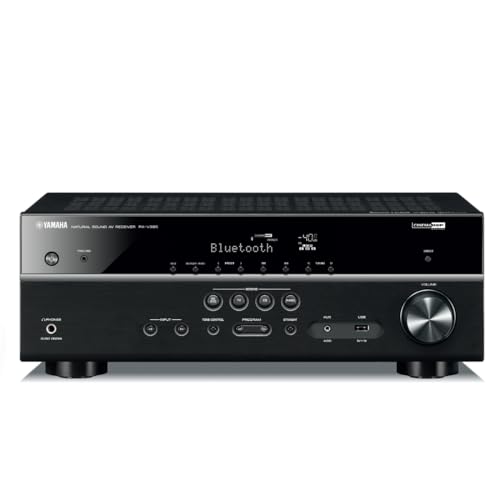
The overall pick earns its badge by matching the commonest outdoor architecture in existence: one household, one soundtrack, two places to hear it. The RX-V385 is a 5.1-channel receiver — 4K HDMI pass-through with HDCP 2.3, Dolby Audio and DTS-HD decoding, Bluetooth streaming, YPAO room calibration — that runs the indoor system as its day job and the patio pair as its second act, through its speaker outputs and the household’s existing habits.
Its virtues indoors are the established ones. Calibration tames the living room for film dialogue; HDMI switching gathers every source into one hub; a single remote governs volume for the whole evening. Outdoors, the same virtues translate: the film’s score follows the cook to the grill, the match commentary reaches the patio table, and nobody learns a second system to make it happen.
Power is mainstream receiver output, and the outdoor arithmetic should be done honestly: open air taxes loudness, so the farthest chairs hear less than an indoor seat would. For a domestic patio with speakers aimed at the seating, the output suffices with room to spare — provided the cable run uses the gauge the distance demands, as the setup chapter insists.
Key specifications
| What it is | A five-channel receiver for AV duty |
| Screens | 4K Ultra HD pictures via HDMI, HDCP 2.3 |
| Setup help | YPAO measures the room; microphone bundled |
| Sound formats | DTS-HD alongside Dolby Audio |
| Going wireless | Streaming by Bluetooth |
| Added value | Cinema DSP processing |
Strengths
- One soundtrack, indoors and out, one remote
- Calibration and switching for the indoor system
- Bluetooth covers casual patio streaming
Trade-offs
- No independent source for the patio
- Five channels is the whole layout
- Outdoor reach depends on your cable run
Ownership’s dividend is the single remote and the single ritual: film indoors, the same soundtrack drifting to the patio for the cook, volume behaving identically everywhere. Households migrating between indoors and outdoors through an evening — which is most of them — feel this as the system’s central luxury.
Setup deserves its half hour, with an outdoor coda. Run YPAO for the indoor layout in a quiet house, inspect its decisions, and then set the outdoor pair’s level from the farthest patio chair, not from the doorway. The two calibrations — the receiver’s indoors, yours outdoors — together are the commissioning this category deserves.
Name the boundaries plainly: five channels, one soundtrack’s architecture in its simplest form, and no independent outdoor source. Households that live in two audio places at once belong in the Zone 2 category. Households that live in one place with an outdoor annex — the majority — will never touch these boundaries.
Ventilation, as with every receiver: open air above the unit in its indoor home, nothing stacked on the vents. The garden’s weather never reaches it, which is the entire point of the architecture.
For the one-soundtrack household, this is the receiver decision made correctly and once.
Best for: one-soundtrack households with a patio annex. Not suited for: two-zone independence or Atmos plans.
Zone 2 AV Receiver Setup (Prose-Only Pick)
Badge: Best Two-Zone Receiver Setup
The two-zone household is not a hypothetical; it is any home where Saturday afternoon means a match on the indoor screen and a long lunch outside, with neither party willing to hear the other’s soundtrack. For that household this category — an AV receiver with powered Zone 2 outputs — is the correct architecture, described by specification because models divide on exactly the details that matter here.
The specification’s headline is independence. Zone 2 must be powered, not merely a line output awaiting another amplifier, and it must be able to play a different source from the main room — a clause to verify in the listing’s own words, because ‘zone’ is marketed loosely. Inputs follow the household’s life: HDMI for the indoor television, streaming or analog for the patio’s music. The outdoor speakers still need their weather-rated wire runs; the zone changes the electronics, not the garden.
One structural warning belongs in the shopping list: on many designs, Zone 2’s power is borrowed from the main layout’s channels. Confirm whether the patio’s music costs the theater its surround channels, and decide whether that trade fits your rooms before it surprises you during a film.
Key specifications
| Description | AV receiver whose Zone 2 is powered |
| Hunt for | Zone 2 running a source of its own |
| How sources arrive | HDMI for the main room; streaming for zone two |
| Check first | Whether zone duty borrows main-room channels |
| Note well | Garden pairs still demand weather-rated cable |
Strengths
- Two soundtracks, two spaces, simultaneously
- Independent volume where it matters
- The indoor theater keeps its receiver
Trade-offs
- Zone power may borrow theater channels
- Setup and control learning curve is real
- Pricier than a shared-soundtrack system
The channel cost deserves repeating because it surprises buyers: on many receivers, powering Zone 2 borrows amplifier channels from the main layout, so a 5.1 theater becomes 3.1 while the patio plays — or the design dedicates channels and the theater was never going to use them. Read which arrangement a model uses and plan the indoor layout around the truth.
Control is the category’s daily test. Zone volume and source selection should be reachable from the patio — by app, by a second remote, by anything except a walk indoors. Verify the control path in the listing and the manual before the trench is dug; it is the feature the household will touch every single day.
Installed and understood, this is the architecture that makes a house feel larger: two gatherings, two soundtracks, no negotiations. Households that truly live that way consider it the best money in the system.
Best for: households genuinely living in two audio places. Not suited for: one-gathering homes or simple patios.
Streaming Amplifier (Prose-Only Pick)
Badge: Best for Streaming Control
The streaming-led household experiences music as an app, and for that household the receiver’s front panel is a museum piece. This category answers with a compact stereo amplifier whose network streaming is built in: the services live natively in its control app, the phone is the remote from anywhere the Wi-Fi reaches, and the patio pair becomes a room in the household’s streaming map rather than an appliance by the back door.
Shop it by platform before power. Confirm that your services are supported natively in its app — not via a workaround you will tire of — and that its multi-room ecosystem matches any streaming speakers already in the house, because expansion follows ecosystems. Inputs typically cover Wi-Fi and Ethernet streaming, with HDMI ARC on television-friendly models, and a subwoofer output appears on many for households whose outdoor film nights are real.
No model is linked because platforms divide households more decisively than specifications do; the right amplifier is the one whose ecosystem your music already inhabits. Arrive with your services list and the choice narrows to one or two names.
Key specifications
| Description | Stereo amp, compact, streaming native |
| Hunt for | Your services living inside its app |
| How sources arrive | Streaming over Wi-Fi or Ethernet; HDMI ARC on some |
| How signal leaves | A subwoofer output on many |
| Check first | The multi-room family, if growth is likely |
Strengths
- The phone runs everything, from the patio
- Streaming services native, no workarounds
- Multi-room growth follows the ecosystem
Trade-offs
- You marry a platform, not just an amplifier
- App quality varies and matters daily
- Theater ambitions outgrow it quickly
The ecosystem question deserves its weight. A streaming amplifier joins a platform — its app, its multi-room family, its voice assistant loyalties — and leaving that platform later costs more than the amplifier did. Choose the platform your household already half-lives in, and the amplifier will feel like an upgrade to the house rather than a new regime.
Check the subwoofer output if film nights happen outdoors, and the HDMI ARC variant if the television is a source. Streaming amplifiers divide into music-first and TV-friendly branches; the patio’s habits decide the branch.
Installed indoors, cabled properly, and governed from the phone in the host’s pocket, this category delivers the most modern outdoor experience in the guide. Households whose music already lives in an app will wonder why receivers ever had front panels.
Best for: streaming-first households and app-led patios. Not suited for: platform skeptics or growing theaters.
Atmos-Capable AV Receiver (Prose-Only Pick)
Badge: Best Future-Proof
For one recognizable household, the outdoor speakers are not the main project at all. The main project is the theater growing indoors — center channel this year, heights eventually — and the patio pair is a beloved side quest the receiver must also serve. This category, a receiver of seven channels or more with Dolby Atmos and DTS:X decoding, is that household’s single purchase: enough channels and processing to grow the theater while its zone provisions run the garden.
Shop it by two documents: the indoor layout you genuinely intend, stated as a configuration — 5.1.2 is the common milestone — and the zone behavior, confirmed in the listing’s words rather than its implications. Check that calibration covers the height channels, that 4K HDMI switching carries current HDCP, and what assigning zone channels costs the main layout, because on many designs the patio borrows channels the theater wanted.
The category stands without a linked model because the spread of layouts, calibration systems and ambitions defeats any single recommendation. Arrive at the listings with the layout plan and the zone requirement written down; the field narrows to a name quickly.
Key specifications
| Description | AV receiver, seven channels upward |
| Hunt for | Atmos with DTS:X; 5.1.2 supported and beyond |
| Room tuning | Automatic calibration, microphone in the box |
| Video side | 4K switching over HDMI, current HDCP |
| Check first | Output per channel into your speakers’ ohms |
Strengths
- The theater and the patio from one chassis
- Height channels ready for the indoor plan
- Calibration grows with the layout
Trade-offs
- The priciest architecture in this guide
- Zone channels may borrow from the theater
- Complexity compounds with every feature
Budget the staircase honestly at the start: center, surrounds, subwoofer and heights each carry a bill, and the outdoor pair competes with all of them for the same fund. The receiver is bought once precisely so the rest can arrive gradually.
Calibration re-runs at every stage — treat it as the system’s maintenance ritual, not a setup chore. The receiver’s willingness to re-measure the growing room is a large part of what the category’s price buys.
If the theater future dissolves on inspection — the room stays a living room, the patio stays the priority — step down to the simpler picks without a backward glance. This category rewards genuine plans and taxes imaginary ones.
Best for: growing theaters with a patio side project. Not suited for: patio-first households or simple briefs.
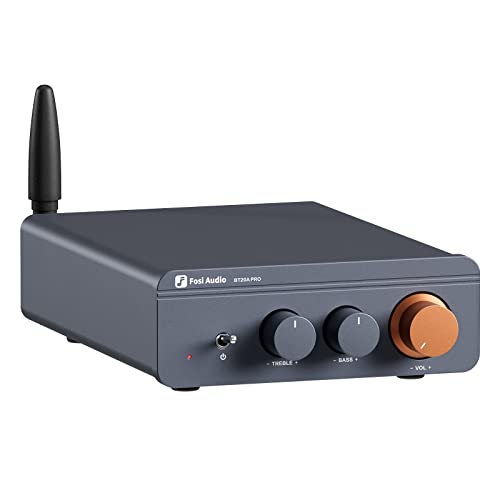
Fosi Audio BT20A Pro Mini Stereo Amplifier
Badge: Best Compact Alternative
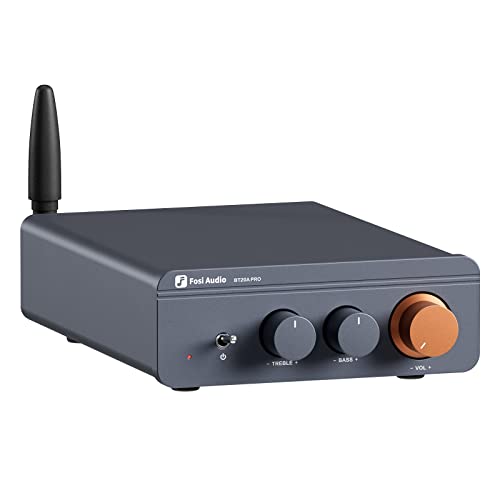
Not every outdoor system wants a receiver’s architecture. The household with one patio pair, a phone full of music and no theater ambitions needs a driver, not a headquarters — and the BT20A Pro is the strongest compact driver in this guide. Its TPA3255 chip delivers clean headroom that open air appreciates, because outdoor listening has no walls to flatter the sound and distortion carries across a garden with nothing to stop it.
The arrangement is simple to the point of elegance: the Pro lives indoors — on a shelf near the patio wall — and burial-rated cable carries its output through the wall to the speakers. Bluetooth 5.0 makes the phone on the patio table the source and, within range, the remote. RCA admits a streamer for households that prefer one. Bass and treble knobs sit on the front for the adjustments outdoor listening occasionally wants against wind and open sky.
Its pre-out is the one luxury aboard, and outdoors it usually goes unused — which is fine. It costs nothing in size or complexity, and if a powered subwoofer ever joins a pergola cinema, the socket is waiting. Buy the Pro when the brief is one pair, played properly.
Key specifications
| What it is | A Class D stereo mini, integrated |
| Chipset | TPA3255 |
| Advertised maximum | 300W per side |
| How sources arrive | Bluetooth 5.0 wirelessly, RCA by wire |
| How signal leaves | Pre-out aimed at powered subs or another amp |
| Handling | Three knobs across the front: volume, bass, treble |
Strengths
- Clean headroom that open air rewards
- Phone becomes source and remote by Bluetooth
- Indoors footprint, garden-sized output
Trade-offs
- No zones or independent outdoor source
- Ceiling wattage presumes ideal conditions
- Control range ends at the patio door, roughly
Its boundaries are the mini-amp boundaries: stereo only, no zone intelligence, no surround decoding, and control that lives at the box or the Bluetooth source. Households needing the patio to live independently of the indoors should step up to the Zone 2 or streaming categories, where that independence is the product.
Housed indoors with the cable run done properly, the Pro asks for nothing else: a socket, a breath of air, and levels set once from the far chair. Its pre-out, if the garden ever gains a powered subwoofer for film nights under the pergola, is ready — an extravagance this guide mentions without recommending.
The chip’s virtues travel outdoors well. The TPA3255’s efficiency means little heat in a hallway cabinet; its composure under load means the far end of the patio hears the same cleanliness as the near end.
Pair the order with the burial-rated cable the run requires, measured generously. In outdoor systems the cable is not an accessory; it is half the product.
Best for: one-pair patios with phone-led listening. Not suited for: two-zone households or theater integration.

Fosi Audio BT20A Mini Stereo Amplifier
Badge: Best Budget Alternative
The budget alternative strips the outdoor brief to its skeleton: one pair of patio speakers, a phone or a streamer as the source, and an amplifier that lives indoors driving them through the wall. The standard BT20A supplies exactly that — TPA3116 amplification rated at 100W per channel, Bluetooth 5.0 and an RCA input, tone knobs on the front, power supply in the box — at the gentlest cost in this guide.
Understand what the simplicity excludes. Volume control lives at the amplifier or the phone’s Bluetooth setting, not in an app with zones. A second pair of speakers has no architecture to join. And the subwoofer question, rarely urgent outdoors, has no pre-out to answer it. Within the single-pair brief, none of that is a flaw; it is the brief, honored.
Buy it for a modest patio, a workshop yard or a first outdoor season whose success will justify architecture later. It is also the natural second amplifier in larger gardens — the garage pair’s own driver, independent and unbothered.
Key specifications
| What it is | A Class D stereo mini, integrated |
| Chipset | TPA3116 |
| Advertised maximum | 100W per side |
| How sources arrive | Bluetooth 5.0 wirelessly, RCA by wire |
| Handling | Three knobs across the front: volume, bass, treble |
| In the carton | A power supply, so it runs immediately |
Strengths
- The gentlest cost in the guide
- Indoor footprint of almost nothing
- Bluetooth covers the patio phone directly
Trade-offs
- No zones, no app, no expansion path
- Volume control stays near the amplifier
- One pair is its whole world
Its role is narrow and it fills it completely: one pair, one source or two, honest volume across a domestic patio. There is no zone logic, no app, no pre-out for expansion — and for the household whose brief ends there, those absences are the price working as intended.
Keep the installation discipline the setup chapter prescribes: the amplifier indoors, the cable rated for its burial, polarity verified, levels set from the far chair. Little amplifiers collect the blame for installation shortcuts; outdoor shortcuts are the least forgiving kind.
If the garden later grows a second pair or a second life, this box retires to the garage pair or the workshop and keeps working. Its succession plan is part of its value.
For anything beyond the single-pair brief — zones, streaming polish, theater company — the picks above it in this guide exist. Match the box to the brief and it will not disappoint.
Best for: single-pair patios and first outdoor seasons. Not suited for: multi-pair gardens or two-zone households.
Comparison Table
Read the grid as a set of architectures rather than a ranking. Each row organizes a household’s indoor and outdoor sound differently, and the specification column names the trait the architecture stands on. Confirm the row against its review before committing.
| Pick | Type | Key specification | Link |
|---|---|---|---|
| Yamaha RX-V385 | 5.1 AV receiver | Passes 4K Ultra HD pictures, HDCP 2.3 aboard | Check price on Amazon |
| Zone 2 receiver setup | Zone 2 AV receiver | Zone 2 able to play its own source | Prose-only |
| Streaming amplifier | Streaming stereo amp | Your streaming services native in its app | Prose-only |
| Atmos-capable AV receiver | 7-channel AV receiver | Decodes Atmos and DTS:X; runs 5.1.2 or more | Prose-only |
| Fosi Audio BT20A Pro | Mini Class D stereo amp | Built on the TPA3255 device | Check price on Amazon |
| Fosi Audio BT20A | Mini Class D stereo amp | Built on TPA3116 silicon | Check price on Amazon |
How do you choose the right amplifier or receiver for outdoor listening?
Choose the architecture before the appliance. Question one: how many pairs of speakers, now and in the garden’s honest future? Question two: must the outdoors hear something different from the indoors, ever? Question three: where will volume be controlled from — a phone on the patio, a remote indoors, a knob on a wall? The answers select the category almost mechanically: one pair and one soundtrack points to the receiver pick or a compact amp; independent zones point to the Zone 2 category; phone-led listening points to the streaming amplifier.
Then do the outdoor arithmetic. Distance from the receiver to the farthest speaker sets the cable gauge. Distance from the speakers to the farthest listener sets the power requirement, with open air taxing loudness far more than any room does. Impedance across multiple pairs sets the stability requirement. Only after architecture and arithmetic agree should brand names enter the conversation — outdoors, they are the least important variable in the system.
What should you check on the listing before you order for an outdoor system?
Read the zone clause first, in the manufacturer’s own words: does the second zone exist, is it powered or merely a line output needing another amplifier, and can it play a different source from the main room? Those three answers divide this entire category, and listings that blur them are telling you which side of the division they are on. Then the impedance clause: the lowest load the receiver accepts, checked against the parallel arithmetic of your planned pairs.
Finish with the unglamorous audit — HDMI and input inventory against your indoor sources, dimensions and ventilation against the receiver’s intended home, and the returns policy, because the decisive test happens with your garden wired and your household listening. A listing that answers plainly deserves the order; one that gestures at lifestyle photography deserves the skepticism.
How to set up outdoor speakers from an indoor amplifier, step by step
Plan on paper before touching a spade. Sketch the house, the receiver’s position, the wall exit point, the cable route and both speaker positions; measure the route with a string if the garden curves. This sketch decides the cable length, the gauge and the shopping list, and it is the step whose absence fills forums with mid-project hardware runs.
Install in the dry order. Mount the speakers first, under eaves or soffits where the architecture offers shelter, angled toward the seating. Run the burial-rated cable second — through conduit where it crosses open ground, with a drip loop where it enters the wall, sealed at the penetration. Connect indoors third, observing polarity on every pair, and label both ends of every run while you still remember which is which.
Commission the system like a professional: receiver indoors, ventilation respected, outdoor levels set from the farthest chair rather than from beside the speaker, zone volumes balanced so neither space ambushes the other. Then walk the boundary of your own property and listen. What the fence hears is part of the specification, and adjusting aim now is free.
The specifications that matter, in plain language
Zone architecture first, because it governs the system’s social life: how many independent areas, playing the same source or different ones, at whose volume. Impedance handling second, because multiple outdoor pairs divide the load — two 8-ohm pairs in parallel present 4 ohms — and the receiver must remain stable there. Power third, read honestly as RMS into a stated load, remembering that open air taxes loudness more than any room: there are no walls outdoors to hand the sound back.
After those, the specifications turn to survival: cable gauge against the run’s length, the receiver’s ventilation in its indoor home, and the control path — phone, remote or wall knob — that the household will actually use from the patio. A specification page that answers the survival questions plainly is describing a system that will still be working in five summers.
Where does this system go next? A sane upgrade path
Outdoor systems grow by coverage before they grow by power. The second pair of speakers — placed near the listeners it serves rather than asked to shout across the garden — is the upgrade owners praise most. A dedicated zone or streaming control follows, when the household’s two-space life outgrows a shared soundtrack. The indoor system improves in parallel: the center channel, the subwoofer, the theater chapters this guide’s Atmos category anticipates.
What does not belong on the path is a bigger receiver bought to bully distance. Distance is beaten by placement and pairs, not by wattage. Owners who grow coverage-first spend less, disturb neighbors less, and end with systems that sound generous at volumes a conversation can ride over.
Common Buying Mistakes
Running indoor cable outside
Indoor speaker cable buried or stapled along a fence fails on a schedule: its jacket is not rated for ultraviolet or moisture, and a season or two turns it brittle, green and intermittent. Burial-rated or CL2/CL3 in-wall cable costs modestly more and lasts the life of the installation. The trench is dug once; dig it for the cable that only has to be buried once.
One pair played at its limit
A single pair asked to cover a whole garden gets driven to its ceiling, where distortion lives, and blamed for the architecture’s failure. The correct answer to a large space is rarely a louder pair; it is a second pair, closer to the far listeners, each working comfortably. Receivers and zone planning in this guide exist to make that answer available before the first pair is punished for the garden’s size.
No level discipline after dark
Outdoor sound carries farther at night, when the ambient floor drops and cooler air refracts it toward the neighbors. The volume that was neighborly at seven becomes a broadcast at ten. Households with outdoor systems develop the habit of stepping the level down as the evening deepens — or choose equipment whose phone control makes the step effortless. Discipline is a feature; buy the setup that makes it easy.
Mounting speakers fully exposed
A speaker rated for outdoor use survives weather; it does not enjoy it. Direct sun degrades cabinets and cones, driving rain finds seams, and a fully exposed mount ages a five-year speaker in two. The eave, the soffit and the covered pergola exist in most gardens — mount under them, angle the speaker toward the seating, and the same hardware lasts twice as long while sounding better under shelter from wind.
Skipping polarity checks across pairs
With one pair, reversed polarity thins the bass and smears the image. With two pairs, one reversed pair fights the other across the whole garden, and the dead zones wander as you walk. Outdoor installs multiply the opportunity for the error — long runs, fading light, a helper holding the other end. Check each pair’s polarity at commissioning, from the listening seats, before the trench is backfilled and the mistake becomes archaeology.
Leaving the amplifier outdoors
It is the most expensive shortcut in this category. Covers trap condensation, insects colonize warm chassis, and connectors corrode in a single wet season — while the warranty, reasonably, excludes weather. Every electronic component belongs indoors; only the speakers and their rated cable were built for the garden. If the amplifier must live near the patio, it lives inside the wall the patio leans against.
Forgetting the wire run is the project
Buyers budget for a receiver and speakers, then meet the real project in the garden: trenching, conduit, wall penetrations, and cable measured in tens of meters. The wire run decides the system’s reliability for a decade and its cost more than any single component decision. Plan it first, price it honestly, and choose components afterward — the order professionals use, because the trench does not care which receiver you bought.
Aiming across the fence
Outdoor sound obeys no property lines, and a pair aimed across the yard delivers your playlist to the neighbors’ patio at conversational clarity. Aim speakers inward, toward your own seating, and downward where the mounts allow; keep the system’s best seats inside your own fence. The adjustment costs nothing, preserves relations, and — because listeners sit closer to the speakers — actually improves the sound at lower volume.
Value, tiers and where the money actually goes
Outdoor tiers buy architecture. The entry tier buys one soundtrack competently delivered to one outdoor pair — the majority’s whole requirement. The middle tier buys independence: a second zone with its own source and volume, which is the moment the system starts serving two gatherings at once. The upper tier buys growth and integration — theater channels indoors, streaming ecosystems, control polish.
Notice where the tiers do not reach: the garden itself. Cable, conduit, mounts and an afternoon of trenching sit outside every tier and decide the installation’s lifespan. Budget them as first-class citizens. The household that spends a little less on the receiver and a little more on the wire run owns the better system in year three, every time.
Final Recommendation
For the single-space household — one room, one patio, one soundtrack — the RX-V385 is the recommendation: it runs the outdoor pair as its second act without new architecture. Households that genuinely live in two audio places at once should buy the Zone 2 category and its independent source. Streaming-led households take the streaming amplifier. In every branch, spend at least as much thought on the wire run as on the receiver; outdoors, the installation is the product.
What to check before you order
Walk the route before the order, literally. Stand where the receiver will live, walk the cable’s path to each speaker position with a tape measure, and note the wall penetration, the conduit stretches and the total length. Then settle the control question — whose phone, which remote, from which chair — and the zone question one final time. Outdoor systems are returned for failures of geography and architecture, rarely for failures of sound, and both are visible on that walk.
One more consideration
Think about who else uses the system. Outdoor setups serve gatherings, which means guests, teenagers and visiting grandparents will all operate them. The architecture that a guest can run from a phone without instruction will be used; the one requiring a tutorial at the receiver will be admired and left alone. Operability by the least technical user is a genuine specification outdoors, where the host is busy hosting.
Weather also writes the calendar. The household that installs in spring, commissions at leisure and troubleshoots in daylight owns a system that simply works by the first gathering. The household that installs on the morning of the barbecue owns a story. Outdoor audio rewards the early start more than any other category in this guide, because every one of its lessons — the route, the gauge, the levels, the aim — is cheaper to learn before the guests arrive.
Frequently Asked Questions
How many outdoor speakers can one amplifier zone run?
One pair comfortably, two pairs with arithmetic. Each additional pair divides the load and lowers the impedance the amplifier sees; two 8-ohm pairs in parallel present 4 ohms, which most receivers tolerate, while three pairs invite impedance-matching volume controls or a dedicated distribution approach. Count your pairs before choosing the receiver, and if the garden plan includes four speakers, let that fact — not the showroom — select the architecture.
What cable should I run to outdoor speakers?
Cable rated for the burial or in-wall duty it will actually perform — look for direct-burial or CL2/CL3 markings — in a gauge matched to the run: longer runs demand thicker cable to keep resistance from taxing the sound, with very long garden runs arguing for the heaviest gauge you can pull. Measure the route honestly, add slack for the wall entry and the drip loop, and buy the length the tape says rather than the length optimism suggests.
Can I leave the amplifier outside if it is under a cover?
No — and the cover is the dangerous part of the idea, because it traps the humidity it was meant to exclude. Consumer amplifiers and receivers are indoor devices: their boards, switches and connectors are not sealed against moisture, insects or temperature swings. The correct architecture keeps every electronic component indoors and sends only the speakers and their burial-rated cable into the weather. That is not caution; it is how these systems survive their second summer.
How loud should outdoor speakers be?
Loud enough for the farthest of your own chairs to hear clearly at conversation’s expense of nobody else. Outdoors, clarity at modest level beats volume: aim the speakers at your seating, keep listeners close to them, and let proximity do what wattage would otherwise be asked to. A system that sounds generous at the table and faint at the fence is not underpowered — it is correctly designed, and your neighbors’ silence on the subject is the review that matters.
Will the TV’s remote control the outdoor volume?
Indoors, usually yes when the receiver and television cooperate over HDMI. Outdoors, the honest answer is: only if the architecture was chosen for it — a Zone 2 system with app control, or a streaming amplifier governed by phone, puts volume in the patio listener’s hand. A basic shared system leaves volume indoors, which is why the control question appears in this guide’s choosing chapter before any model names do.
Can outdoor speakers play something different from the TV inside?
With the right architecture, yes — and it is the feature that justifies the Zone 2 category in this guide. A receiver whose second zone accepts its own source can send the match commentary indoors and music to the patio simultaneously. Simpler setups share one source everywhere. Decide whether your household genuinely lives in two audio places at once; if it does, that independence, not wattage, is what your money should buy.
Can one receiver run indoor and outdoor speakers at the same volume?
It can, and households quickly discover why they rarely want it to. The level that suits a patio conversation overwhelms a living room, and vice versa, because outdoor sound escapes while indoor sound accumulates. Independent zone volume exists precisely for this mismatch. If your receiver shares one control across both spaces, treat simultaneous use as a party trick rather than a daily arrangement, and let the quieter room set the ceiling.
Do outdoor speakers need a more powerful receiver than indoor ones?
Somewhat, and for physics rather than appetite. Outdoors there are no walls to return the sound, so loudness falls away with distance across open air, and wind and ambient noise raise the floor the music must clear. The same speakers at the same distance need more power outside than in. Size the receiver for the farthest chair on your patio, not for the pair’s indoor behavior, and the arithmetic in the choosing chapter will land honestly.