Disclosure: As an Amazon Associate, kajuandouglas.com earns from qualifying purchases. Links to Amazon on this page are affiliate links; they cost you nothing extra. Listing details such as price and availability change often, so check the current Amazon listing before you buy.
Where to buy
Use the Amazon listings for the six linked picks here to check price on Amazon, confirm whether each model is sold singly or as a pair, and verify delivery details before ordering; orders are placed on Amazon, and qualifying purchases may earn this site a commission. Loud speakers are heavy, bulky and frequently bought in twos, so the listing checks that matter most are quantity, weight and what stands or cables the box does not include.
- QSC K12.2 Active Powered Loudspeaker (Single) — best overall pick in this guide.
- Mackie Thump215XT 15-Inch Powered Loudspeaker (Single) — best for parties pick in this guide.
- JBL Xtreme 4 Portable Bluetooth Speaker — best portable pick in this guide.
- Soundcore Motion Boom Plus Portable Speaker by Anker — best value outdoor pick in this guide.
- JBL Charge 5 Portable Bluetooth Speaker — best all-day portable pick in this guide.
- Klipsch R-51M Bookshelf Speakers (Pair) — best for home loud pick in this guide.
The reviews, method and setup steps follow below.
Loudest and best are two different questions that share a shopping basket, and confusing them wastes money in both directions. Loudest is arithmetic: clean output at the listener, in a named space, sustained without distortion. Best is judgement: whether that output serves a wedding, a warehouse workout, a beach afternoon or a living room. A speaker can win the arithmetic and lose the afternoon, which is why this guide assigns every pick a territory first and a volume second, then refuses to rank a patio portable against a professional PA cabinet as though they were contestants in the same sport.
The territories map real listening. Professional powered PA covers events and venues where a voice must reach the back wall. A party loudspeaker covers birthdays and club nights where bass is felt as much as heard. Two tiers of battery portable cover gardens, beaches and playing fields far from a socket. A bookshelf pair covers the home, where efficiency turns a modest amplifier into more loudness than most households will ever request. Six picks, four territories, no filler.
All six picks are linked models verified through this site’s API cross-check, the standard applied across our speaker coverage, so the model reviewed is the model listed is the model delivered. The choosing sections then explain loudness in plain language, because a reader who understands sensitivity and headroom can judge any future speaker, including ones not yet released, without another guide’s permission.
Loud, in these pages, means clean output at the listening position in the space named, sustained for the length of a real event. It does not mean a peak figure achieved for a millisecond in a laboratory, a distorted shout that empties a room, or competition-vehicle pressure that exists to win trophies rather than play songs. It also excludes hearing-critical studio monitoring, where loudness is a by-product rather than the brief.
Key Takeaways
- Loudness multiplies clean power by efficiency and divides by distance, so no single wattage figure can rank speakers.
- Each of the six picks owns a territory: pro PA, party, two portable tiers, and the efficient home pair.
- Distortion, not maximum volume, marks the ceiling you actually own; headroom is the real purchase.
- Hearing and neighbours are budgets too, and distance plus restraint spend them wisely.
- Check quantity, stands and pairing families on the listing, because loud speakers are often sold one at a time.
In this guide
Quick Picks
Six picks, each assigned the job it is genuinely best at. Badges match the detailed reviews that follow.
| Buyer type | Pick | Why it stands out | Link |
|---|---|---|---|
| Best Overall | QSC K12.2 | Professional output and headroom for real venues | Check price on Amazon |
| Best for Parties | Mackie Thump215XT | 15-inch woofer produces genuine event bass | Check price on Amazon |
| Best Portable | JBL Xtreme 4 | Fills outdoor spaces that swallow smaller speakers | Check price on Amazon |
| Best Value Outdoor | Soundcore Motion Boom Plus | 80W stereo output built for outdoor coverage | Check price on Amazon |
| Best All-Day Portable | JBL Charge 5 | Up to 20 hours of playtime between charges | Check price on Amazon |
| Best for Home Loud | Klipsch R-51M | High efficiency — loud and dynamic on modest amplifiers | Check price on Amazon |
The shortlist is deliberately short. Six speakers that fit real versions of loud beat twenty that fit a spreadsheet, because every additional pick would duplicate a territory already covered or dilute a recommendation already earned.
How These Picks Were Chosen
The shortlist was built backwards, from rooms and crowds toward products. We first fixed the situations this keyword actually describes, a hall to fill, a party to power, a garden to cover, a room to energise, then asked what clean output each situation demands at its farthest listener. Only speakers whose verified specifications met a territory’s demand with headroom to spare were considered, and each was then assigned the territory it serves best rather than a place on a single ladder.
Verification was mechanical and strict. Linked picks are models whose Amazon listing was confirmed through the Creators API on this site, the returned title matched against the product named, so a K12.2 here is that exact powered loudspeaker and not a sibling model. Specifications quoted in the reviews are the manufacturers’ published figures for those confirmed models.
Badges, finally, were assigned by job rather than by rank. Best Overall means the most complete answer to the most demanding territory, not the speaker every reader should buy. A garden listener who purchases the professional pick has bought magnificently and wrongly, and the reviews say so in their verdicts.
A word on the numbers quoted in this guide: power figures are given as the manufacturers publish them, and where a rating describes a system’s total or a peak rather than a continuous figure, the review’s context says how to read it. Output claims across brands are not perfectly commensurable, which is why the guide leans on sensitivity, design class and territory fit rather than pretending a single column of watts can referee every contest in the category.
Prices are deliberately absent from these pages. Loudspeaker prices move with sales, bundles and model-year changeovers, and a printed figure would be wrong more often than right by the time it was read.
The loudness equation: power, efficiency and distance
Volume comes from a multiplication, not a single specification. A speaker’s sensitivity states how much sound one watt produces at one metre; power then adds output logarithmically, so doubling watts buys a modest step rather than a doubling of loudness, while distance subtracts relentlessly, with every doubling of metres costing a large, fixed slice. Picture a garden party: the speaker that seems heroic at the patio table is merely adequate at the fence, not because it changed but because the multiplication did.
Distortion draws the usable ceiling, and it arrives earlier than the specifications suggest. Every system has a level where the sound hardens, compresses and starts to shout rather than sing; that level, not the maximum, is the loudness you actually own. The picks in this guide were chosen for headroom, the clean reserve above your loudest realistic moment, because headroom is what separates a system that sounds powerful from one that merely sounds strained.
Hearing, neighbors and the long game of loud
A guide to loud speakers carries a responsibility other guides do not, so it gets its own section rather than a footnote. Hearing damage from sustained high levels is permanent, cumulative and painless at the moment it happens, which makes it easy to collect unknowingly at exactly the events these speakers serve. The defences are unglamorous and effective: distance, breaks, and levels set for the farthest listener rather than the nearest.
Neighbours are the outdoor version of the same discipline. Sound that is reasonable at the speaker carries surprisingly far on a still evening, and bass in particular travels through gardens and walls with no respect for fences. Aim speakers inward at your own gathering, keep the late hours gentler than the early ones, and treat a friendly word beforehand as part of the setup equipment.
The Best and Loudest Speakers for Music
Each pick is reviewed on the same terms: who it suits, what the verified specifications say, where its limits honestly lie, and what else you will need to own before it can do its job.

QSC K12.2 Active Powered Loudspeaker (Single)
Badge: Best Overall
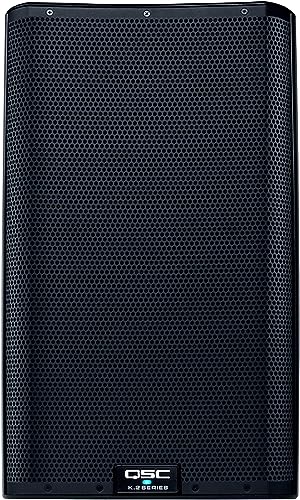
When loud must also mean clean, controlled and professional, the K12.2 is the answer: a 2000W powered 12-inch loudspeaker, sold singly, built for venues and events where failure is not an acceptable feature.
The K12.2 is what loud means when professionals use the word. Its internal 2000-watt Class D amplification drives a 12-inch two-way design as one engineered system, so the power, the drivers and the onboard processing were voiced together rather than matched by a hopeful owner. The result is output with discipline: announcements intelligible at the back of a hall, music that stays composed at levels where lesser cabinets begin to bark.
That combination of output, control and build explains why K-series speakers live in rental fleets, the harshest compliment in professional audio. Rental equipment is chosen by people who pay for failures, and they choose cabinets that survive van rides, venue stairs and operators of varying genius while sounding identical every Saturday. An owner buying one K12.2 is buying into that same risk calculation: the speaker is engineered to be unremarkable in its reliability so that its sound can be the remarkable part.
Key specifications
| Type | Active 12-inch 2-way powered loudspeaker, sold individually |
| Amplifier | 2000W Class D module |
| Processing | Onboard DSP with application presets and EQ |
| Cabinet | Rugged ABS enclosure; pole-mount socket |
| Roles | Main PA speaker or floor monitor |
Strengths
- Professional output and headroom for real venues
- DSP presets for mains, monitor and speech duties
- Rental-grade build with a long reliability record
Trade-offs
- Pro tier, and sold individually — a pair is the real purchase
- Pro-style connections assume a mixer or DJ controller
- Far more speaker than a living room can use
It is professional equipment: sold one at a time, priced in the pro tier, and voiced to fill venues rather than to flatter a sofa. Buyers seeking a living-room speaker should keep reading; buyers seeking certainty for events should stop here.
K12.2 ownership is a logistics pleasure disguised as an audio purchase. The cabinet shrugs off the knocks of loading and storage, the controls are recessed where accidents cannot reach them easily, and the whole unit asks for nothing between engagements except a cable and a stand. Owners who run events develop a particular affection for equipment that never becomes the story of the night, and this speaker’s career is built on such unstoried nights: set up, sound-checked, loud, clean, packed away, forgotten until the next booking.
Pairing note: feed it from a proper mixer or controller output, not a headphone jack at full stretch, and budget for a second cabinet when the venue or the stereo image genuinely requires one.
Inspect the K12.2’s details and the professional intent shows in the small print: onboard DSP with presets voiced for distinct duties, so the same cabinet can serve as a main, a monitor or a standalone announcement system without external processing; protection that intervenes gracefully rather than audibly panicking; and a rigging and mounting story designed by people who expect the speaker to be flown, poled and stacked by strangers. Each detail answers an event that has actually happened to somebody, which is the difference between professional equipment and consumer equipment wearing black.
You will also need a stand or pole, proper signal cables from your mixer or controller, and a mains supply where the speaker will work; none of it is exotic, and all of it should be in the van before the speaker is.
Best for: events, venues and serious outdoor coverage where clean output is the job. Not suited for: casual home listening or buyers who need a pair within a portable budget.

Mackie Thump215XT 15-Inch Powered Loudspeaker (Single)
Badge: Best for Parties
The Thump215XT brings the bass weight parties actually feel, with Bluetooth control, a microphone input and voicing modes for different duties, in a powered 15-inch cabinet sold singly.
The Thump215XT approaches loud from the bass upward: a 15-inch woofer with 1400 watts behind it, in a powered cabinet whose whole personality is momentum. Where the QSC is a professional instrument, the Mackie is a celebration engine, tuned so a dancefloor feels the kick drum in its ribs. Bluetooth streaming and app control suit the way parties actually source music now, from a phone passed around a room, and the enhanced feature set lets the same cabinet handle speeches between songs without a mixer in sight.
For DJs, hosts and small venues the appeal is setup speed: stands up, Bluetooth paired, microphone plugged in, party. That speed is a genuine feature in rooms where the alternative is a hired rig and an engineer, and it explains the Thump’s following among mobile entertainers who measure equipment in minutes saved per gig.
Key specifications
| Type | Active 15-inch powered loudspeaker, sold individually |
| Amplifier | 1400W |
| Wireless | Bluetooth streaming and system control |
| Features | Voicing modes, feedback control, built-in mixer inputs |
| Inputs | Microphone and line sources |
Strengths
- 15-inch woofer produces genuine event bass
- 1400W with Bluetooth streaming and app control
- Voicing modes and a mic input built in
Trade-offs
- Large cabinet, and sold individually
- A pair plus stands is the realistic event setup
- Bluetooth control adds app steps some users skip
Size is the deal you make: a 15-inch cabinet is a two-hand carry with real weight behind it, and one speaker is mono, so the party that wants stereo imaging is buying a second unit and should budget for the pair from the start.
The Thump215XT’s ownership story is written in setup times. Arrive, stands up, paired, playing: owners repeat some version of that sentence with the satisfaction of people who have previously spent an hour untangling a component system in front of early guests. Between events it stores without ceremony and travels without fragility, and its voicing modes mean the same box serves a children’s party at noon and a fortieth at night with a preset rather than a prayer.
Pairing note: a second Thump215XT is the intended stereo partner, and its system control keeps the pair behaving as one instrument rather than two acquaintances.
The Thump215XT’s details are party-practical: voicing modes that reshape the speaker for music, speech or monitoring duties; Bluetooth system control that lets levels be adjusted from the room instead of behind the cabinet; and inputs arranged for the real sources of an event, a phone, a microphone, a controller. None of these features photographs as impressively as a wattage figure, and all of them matter more by the second song.
You will also need a stand, and a second cabinet when stereo matters; a microphone and its cable complete the event kit, along with a power source where the dancing will happen.
Best for: parties, DJs and small venues needing real bass and fast setup. Not suited for: quiet rooms, small spaces, or one-speaker stereo expectations.

JBL Xtreme 4 Portable Bluetooth Speaker
Badge: Best Portable
The Xtreme 4 is the loudest answer that still counts as portable: huge output for a battery speaker, waterproofing for real weather, and a shoulder strap that admits what it weighs.
The Xtreme 4 is the portable end of the loudness argument, a large IP67-sealed Bluetooth speaker built to project JBL’s pro-style sound across open spaces without a socket in sight. Up to 24 hours of playtime, with six more available through Playtime Boost, means its loudness is not a party trick that fades by the second evening; it is a weekend’s worth of authority.
In a backyard or on a beach it does what smaller portables cannot: it stays composed at volumes where they begin to plead. Bass holds its shape outdoors, voices carry across a gathering, and the whole presentation has the headroom to survive a raised chorus of guests without hardening. That composure, sustained on battery power far from home, is exactly the territory this pick owns.
Key specifications
| Type | Large portable Bluetooth speaker with shoulder strap |
| Playtime | Up to 24 hours, plus Playtime Boost |
| Rating | IP67 waterproof and dustproof |
| Pairing | Auracast multi-speaker pairing; Bluetooth 5.3 |
| Extras | Built-in powerbank; replaceable battery |
Strengths
- Fills outdoor spaces that swallow smaller speakers
- Up to 24 hours of playtime and a replaceable battery
- Auracast pairing and a powerbank function
Trade-offs
- Big and heavy — a deliberate two-hand carry
- Premium tier for a portable speaker
- Overkill for desks and small rooms
Everything about it is scaled up, including the price tier and the carrying effort. Solo listeners in small rooms are buying a festival engine for a candlelit job and should look at the Charge 5 or the bookshelf pair instead.
The Xtreme 4 becomes the gathering’s furniture: carried in on its strap, set down, and loud enough that nobody suggests fetching anything bigger. Owners describe it migrating between households, borrowed for birthdays, christenings and beach weeks, accumulating the social mileage of a good coolbox. Its waterproofing changes behaviour in a subtle way: nobody rushes to rescue it when rain starts, so the music survives weather that ends lesser gatherings.
Pairing note: Auracast opens it to multi-speaker setups with compatible JBL speakers for genuinely large spaces, turning one festival engine into a distributed system.
Look at the Xtreme 4’s details and the design brief is clear: everything scaled for distance from a power socket. The strap is load-bearing equipment, not decoration. The sealing assumes immersion accidents, not splashes. The battery is replaceable because the maker expects the speaker to outlive its first cell, and the Playtime Boost mode trades a little maximum output for hours of extra service when the event runs long.
You will also need very little: its strap is the transport, its battery is replaceable when years pass, and a charging cable covers the rest of the ownership kit.
Best for: outdoor gatherings that need portable output at near-PA presence. Not suited for: desks, small rooms, or light-pack travel.

Soundcore Motion Boom Plus Portable Speaker by Anker
Badge: Best Value Outdoor
Soundcore’s 80W boombox-class speaker delivers genuine outdoor volume and app-tunable EQ at a friendlier tier than the big JBL, with IP67 sealing for the same weather.
Soundcore built the Motion Boom Plus for the spaces between portable and PA: 80 watts of stereo output, IP67 protection, and a boombox stance that plants it on grass, gravel or a tailgate and gets on with the job. Stereo from a single box is its quiet distinction, giving a small gathering a sense of width the mono portables cannot, and the app EQ lets its voice be tuned to a patio’s reflections or a pitch’s open air rather than accepting one factory compromise everywhere.
Against the bigger JBL it trades some refinement and ultimate output for value and a lighter carry; against pocket speakers it is not a contest at all. The honest summary is that this is the loudest sensible answer for buyers whose gatherings number in dozens rather than hundreds, and whose budget would rather also cover the food. Value picks earn their badges by knowing exactly where their ceiling sits, and this one’s ceiling, genuine outdoor authority for a garden full of people, sits higher than its tier suggests.
Key specifications
| Type | Portable outdoor Bluetooth speaker with handle and strap |
| Output | 80W stereo sound |
| Rating | IP67 waterproof |
| Features | BassUp low-end enhancement; custom EQ in the Soundcore app |
| Extras | USB-C charging; built-in power bank |
Strengths
- 80W stereo output built for outdoor coverage
- IP67 waterproof with handle and strap for carrying
- App EQ plus BassUp for space-by-space tuning
Trade-offs
- Bulky for everyday carry
- Smaller speakers sound more refined at low indoor volume
- BassUp enthusiasm needs taming indoors
It is voiced for the outdoors, where its output and bass lift make sense; at quiet indoor levels its enthusiasm can overwhelm a small room, and listeners seeking living-room refinement should end their search at the Klipsch instead.
Motion Boom Plus owners tend to develop a circuit: garden, garage, pitch, patio, wherever the week’s gathering forms. The speaker’s handle and weight make that circuit effortless, its sealing makes it thoughtless, and its app presets make it quick, so it becomes the default answer to ‘who is bringing music’ in a way heavier equipment never manages. Equipment that gets used weekly beats equipment that gets admired monthly, and by that arithmetic this may be the hardest-working pick in the guide relative to what it cost its owner.
Pairing note: save an EQ preset per regular location in the app, because patio, pitch and garage want different voices from the same speaker.
The Motion Boom Plus’s details are tuned to its territory: the app EQ exists because outdoor spaces differ more than living rooms do; the handle is positioned for a genuine one-hand carry over distance; the sealing assumes the speaker will be caught in weather and set down in wet grass as a matter of routine. Even its stereo layout serves the territory, spreading sound across a picnic rather than concentrating it at one end.
You will also need the Soundcore app for its EQ, and a bag or a free hand for the carry; handle and strap options vary, so check the listing for what ships in the box.
Best for: backyard and beach hosts who want outdoor volume at a value tier. Not suited for: refined low-volume indoor listening or daily commuting carry.

JBL Charge 5 Portable Bluetooth Speaker
Badge: Best All-Day Portable
The Charge 5 trades peak size for endurance: 20 hours of playtime, a powerbank function for the phone, and enough clean output for a garden gathering without any carrying drama.
Not every loudspeaker needs a mains socket or a shoulder strap. The Charge 5 pairs a long-excursion driver with a separate tweeter in a sealed, IP67-rated body a little over two pounds in weight, and produces the kind of honest, room-and-garden volume that covers most people’s actual loudest moments. Twenty hours of playtime means it is charged when the moment arrives, which is the least glamorous and most decisive specification in portable audio.
PartyBoost pairing lets a second compatible JBL join for stereo or wider coverage, so the Charge can grow with its owner’s ambitions instead of being replaced by them. Its honest limits deserve equal print: it will not fill a field, energise a hall or substitute for the Xtreme at a beach party of fifty, and asking it to will produce exactly the strained sound this guide exists to prevent.
Key specifications
| Type | Portable Bluetooth speaker |
| Drivers | Long-excursion driver, separate tweeter, dual bass radiators |
| Playtime | Up to 20 hours |
| Rating | IP67 waterproof and dustproof |
| Extras | Built-in powerbank; PartyBoost pairing; Bluetooth 5.1 |
Strengths
- Up to 20 hours of playtime between charges
- Built-in powerbank tops up a phone
- IP67 sealing shrugs off pools, sand and rain
Trade-offs
- Heavier than pocket speakers — a bag carry, not a pocket carry
- Slow to recharge; plan overnight charging
- No aux input for wired sources
At a little over two pounds it is not the speaker you clip to a belt, and its battery refills slowly compared with its discharge; owners who need pocket portability or rapid turnaround should weigh those two facts honestly.
Charge 5 ownership is measured in seasons rather than sessions: it lives by the door or in the beach bag, comes out for everything, and asks only for an occasional charge in return. The powerbank function quietly doubles its usefulness on long days, reviving the phone that is supplying the music. Owners replace these speakers eventually, usually with another of the same family, which is the market’s way of writing a review.
Pairing note: PartyBoost partners must be compatible JBL models, so check the pairing family before buying a second speaker as a gift for your first.
The Charge 5’s details explain its endurance reputation: a driver layout that mirrors the smaller Flip family’s proven architecture, scaled for more output; sealing that treats dust and immersion as routine; and a battery sized for days rather than evenings. Even its shape is a detail, stable on a table, grippy in a hand, indifferent to being knocked off a picnic bench onto grass. Nothing about it chases a record.
You will also need nothing but its charging cable and a bag it fits; the powerbank function even covers the phone’s emergencies, which is the whole ownership proposition in one sentence.
Best for: long days outdoors where battery life and durability lead the brief. Not suited for: pocket carry, wired sources, or filling large event spaces.

Klipsch R-51M Bookshelf Speakers (Pair)
Badge: Best for Home Loud
Indoors, efficiency beats brute force: the R-51M pair turns a modest amplifier into room-filling, dynamic music, with the horn-loaded tweeter that defines the Klipsch sound.
Efficiency is a loudness strategy, and the R-51M is its proof: a horn-loaded tweeter and 5.25-inch woofer in each cabinet produce striking output from the kind of wattage a small amplifier considers a warm-up. In a living room, that translates to dynamics with genuine startle in them, drums that leap, voices that project, at levels most households will approach rarely and enjoy completely.
As a passive pair it needs an amplifier or receiver, which is also its flexibility: it can start on a inherited receiver in a student’s room and end on a serious integrated amplifier in a settled home, improving at each step without being replaced. That upgrade path distinguishes it from every powered pick here, whose electronics and drivers age as one unit. Buyers who enjoy building a system over years will find this the most rewarding pick in the guide; buyers who want music by Friday with no further decisions should take a powered one.
Key specifications
| Type | Passive bookshelf speakers, pair |
| Drivers | 5.25-inch spun-copper IMG woofer; horn-loaded tweeter |
| Design | High-efficiency Reference design; rear-ported bass reflex |
| Needs | An amplifier or receiver (not powered) |
Strengths
- High efficiency — loud and dynamic on modest amplifiers
- Horn tweeter gives films and rock real bite
- Distinctive spun-copper woofer design
Trade-offs
- Forward, lively voicing is not every listener’s taste
- Rear port needs breathing room from the wall
- Passive — an amplifier is a separate purchase
The R-51M’s lively, forward character is the Klipsch signature; listeners who prefer a laid-back presentation should audition mentally with care, because at the volumes this guide discusses, character is not a detail but the whole experience.
R-51M ownership divides listeners within the first album, which is a compliment: the Klipsch presentation is a position, not a compromise, and people tend to know immediately whether it is theirs. Those it suits describe an alertness to familiar records, a sense of performers leaning into the room, that keeps listening sessions longer than planned. Those it does not suit usually wanted a smoother cushion of sound and should follow that instinct to a different bookshelf design.
Pairing note: it is the efficiency partner every small amplifier hopes for, and a natural front pair in a growing stereo or home-cinema system.
The R-51M’s details are the Klipsch formula in miniature: a Tractrix-style horn shaping the tweeter’s output for efficiency and controlled dispersion; a spun-copper woofer cone that is as much visual signature as engineering; and a cabinet built to be placed, on stands or shelves, where its controlled directivity can aim the performance at the listeners rather than the walls. The formula’s age is the point.
You will also need an amplifier or receiver and speaker wire, since this is a passive pair, and stands or a solid shelf complete the installation the design assumes.
Best for: home listeners who want genuine loudness and dynamics from modest amplification. Not suited for: listeners who prefer a laid-back presentation, or anyone without an amplifier.
Comparison Table
The table below compresses the six picks into the facts that separate them: what each one is, the space it owns, and the route to its loudness, so the territories can be compared before the reviews are revisited.
| Pick | Type | Key specification | Link |
|---|---|---|---|
| QSC K12.2 | Active 12-inch 2-way powered loudspeaker, sold individually | 2000W Class D module | Check price on Amazon |
| Mackie Thump215XT | Active 15-inch powered loudspeaker, sold individually | 1400W | Check price on Amazon |
| JBL Xtreme 4 | Large portable Bluetooth speaker with shoulder strap | Up to 24 hours, plus Playtime Boost | Check price on Amazon |
| Soundcore Motion Boom Plus | Portable outdoor Bluetooth speaker with handle and strap | 80W stereo sound | Check price on Amazon |
| JBL Charge 5 | Portable Bluetooth speaker | Long-excursion driver, separate tweeter, dual bass radiators | Check price on Amazon |
| Klipsch R-51M | Passive bookshelf speakers, pair | 5.25-inch spun-copper IMG woofer; horn-loaded tweeter | Check price on Amazon |
How do you choose a speaker that is genuinely loud enough?
Loud is a system property, not a product property. It comes from three multipliers: how much clean power is available, how efficiently the speaker converts it, and how far the listeners sit from the result. A purchase is genuinely loud enough when those three, multiplied in your actual space, clear your loudest realistic moment with headroom left over. That definition explains the guide’s structure: each pick wins its territory because its particular multiplication balances there, and loses elsewhere because one of its factors, portability, efficiency or sheer output, stops fitting the room.
Decide your loud by the space, not by the advertisement. A bedroom, a backyard and a hall need different answers by orders of magnitude, and the honest exercise is to name the farthest listener and the noisiest moment: the back row during the speeches, the fence line during the chorus, the far end of the pool during swimming lessons.
What should you check on the listing before you order a loud speaker?
Check what the output figure actually describes: a powered speaker’s amplifier rating, a portable’s total system power, or a passive pair’s handling, three different statements wearing similar numbers. Then find sensitivity where it is published, the single figure that predicts loudness most honestly, and note whether output claims are continuous or peak. A listing that states its basis is a listing that expects to be believed; a listing that hides behind the largest available number is telling you how to read the rest of its claims.
Then check the practical facts: whether the speaker is sold singly or as a pair, what stands or mounts the design assumes, what inputs your sources will actually use, and, for portables, the playtime at realistic volume rather than at the laboratory’s whisper. Weight matters more than any of these on paper and less in the shop than on the stairs, so read it twice.
How to set up loud speakers without distortion, step by step
Position before volume: get speakers aimed at the listening area, raised toward ear height where the design allows, and spread for the coverage the space needs. A speaker on the ground firing at knees wastes the output you paid for and invites the volume dial to compensate, which it will do with distortion.
Feed the system the cleanest signal you have: a proper line-level source rather than a headphone output at its limit, Bluetooth from a reasonable distance rather than through two walls, files or streams of decent quality for material you care about. Clipping introduced at the source cannot be removed downstream; it can only be amplified faithfully, which is the cruellest sentence in audio.
Raise the level in steps with demanding material, full-range music with real bass and real peaks, and stop at the step where the sound first hardens, compresses or loses its ease. That step is your system’s honest maximum; mark it mentally and run the event one step below it, where the music will sound more powerful all evening than a strained system sounds for one song. Headroom is not wasted capacity.
Finally, document your working setup: photograph the settings, note the levels that worked for the space, and keep any stands, cables and adapters together as a kit. Loud systems are usually event systems, assembled under time pressure by people who have forgotten last time’s lessons, and a photographed baseline converts setup from archaeology into routine.
The specifications that matter, in plain language
Sensitivity is the master number for loudness: the sound pressure a speaker produces from one watt at one metre, from which everything else can be estimated. Because power adds output slowly, ten times the watts for a clear step up, a speaker a few decibels more sensitive is effectively a much larger amplifier that never runs hot and never clips. When comparing picks across this guide’s territories, sensitivity explains most of the surprises, including why the modest bookshelf pair can startle a room while a brute-force portable can struggle in a field.
Power figures divide by kind, and the kinds must not be compared as equals. A powered speaker’s rating describes its internal amplifier as a system matched to its drivers. A portable’s figure describes its total output under its maker’s chosen conditions. A passive pair’s handling describes what it can accept, not what it produces, which depends on the amplifier you supply. Maximum or peak variants of any kind describe survival, not service.
Where does loud go next? Scaling a system honestly
Loud systems scale by addition, not by turning up. The second loudspeaker is the first upgrade: it adds coverage, a few decibels of output, and the stereo image a single cabinet cannot draw, all while each unit works further from its limit and therefore more cleanly. The same logic extends to distributed portables around a large garden, each loafing at moderate level. Owners tempted to solve a coverage problem with the volume dial should hear this section as the guide’s firmest advice: add a source of sound nearer the listeners, and let every speaker stay in its comfortable voice.
At home, the scaling answer is different: efficiency and placement first, then the room. An efficient pair, well positioned, extracts everything a modest amplifier owns; the next gains come from seating distance, soft furnishings that tame reflections, and a subwoofer partnership if deep bass is the actual frontier. Chasing loudness at home with ever-larger amplification misunderstands the territory, where the limit is usually the household’s tolerance rather than the equipment’s ability.
Common Buying Mistakes
Equating wattage with loudness
Wattage is one multiplier of three. Efficiency and distance matter as much or more; a sensitive speaker on moderate power routinely out-plays an insensitive one on a large amplifier, especially across a real space.
Running everything at maximum
Stacked volume controls, phone at full, source at full, speaker at full, guarantee clipping somewhere in the chain. Set each stage to a healthy middle and let one control, the last, do the work.
Buying one speaker for a stereo job
A single loudspeaker is mono, however powerful. Events and music listening both expect coverage and, where the material offers it, a stereo image; one cabinet, however loud, draws neither across a wide space.
Ignoring distortion as the real limit
Systems stop being enjoyably loud when distortion arrives, long before they stop getting louder. Headroom, the clean reserve above your working level, is the true measure of a loud system.
Placing speakers on the floor in a crowd
Bodies block high frequencies first. Speakers at floor level in a standing crowd lose their clarity to the audience’s legs and torsos, then get turned up to compensate, compounding the error.
Chasing bass with EQ instead of speakers
Boosting deep bass on a small speaker spends its excursion and the amplifier’s power on heat and distortion. If the event needs bass weight, it needs cone area; buy or add the speaker that owns it.
Judging loud in an empty room
Furnishings and people absorb sound. A system that seems overwhelming in an empty space can be merely adequate in the same space full, so judge and set levels with the audience’s effect in mind.
Forgetting hearing is the budget that matters
Sustained high levels at close range damage hearing permanently, and the damage is cumulative. Distance and breaks are part of the equipment list for any regularly loud system, not an afterthought.
Value, tiers and where the money actually goes
Loud value is output per unit of regret, and the tiers buy different kinds of it. The portable tier buys freedom from sockets and weather anxiety, priced by the hour of playtime and the size of the gathering it can honestly cover. The party and professional tiers buy certainty: coverage, headroom and survival across a season of events, priced in single cabinets that expect partners.
The home tier inverts the logic entirely, buying efficiency instead of output: loudness through cleverness, a horn and a sensitive design turning modest amplification into a room’s worth of dynamics. Its value compounds over years, because the passive pair improves with every amplifier upgrade instead of expiring with its own electronics. Across all tiers the pattern holds: money spent matching the speaker to its true space returns itself at every event, while money spent chasing a number returns itself once, in the shop, to the person who sold it.
Final Recommendation
If one pick must be named, it is the QSC K12.2: the loudest clean sound in this guide, in the class of equipment professionals trust with other people’s weddings. It is the answer when the event matters, the room is real and failure would be remembered. Name it as the benchmark without hesitation, and then, with equal honesty, note how many readers’ loudest moments happen in gardens and living rooms where its virtues would be wasted and its virtues’ price unforgotten.
Outdoor listeners should choose between the Xtreme 4’s maximum portable output and the Motion Boom Plus’s value, by the size of their gatherings and the weight of their arms. Home listeners should take the Klipsch and its efficiency. Party hosts who want bass in their ribs should take the Mackie.
What to check before you order
One last check before ordering any speaker in this guide: decide the loudest realistic moment it must survive, the farthest listener, the noisiest song, the longest speech, and confirm the pick owns that moment with headroom rather than hope. If the moment involves a second cabinet, order the pair now rather than after the first event teaches the lesson publicly.
Hearing is the other budget. If your loudest moments are regular, build in the habits now: distance between speakers and ears, breaks in long exposures, and levels set for the back of the space rather than the front. The systems in this guide can all exceed what ears should accept at close range, which is a compliment to their engineering and a responsibility for their owners.
One more consideration
A note on measuring your own space belongs here, because readers routinely misjudge it in both directions. Small rooms are declared barns and barns are declared cosy, usually by pacing them empty and imagining the crowd’s absorption as an afterthought. Measure instead: pace the distance to the farthest listener, note the ceiling and the surfaces, and count the bodies honestly. Then match the territory in this guide to the measured space rather than the remembered one. A hall that seats eighty is a professional problem; a garden that gathers twenty is a portable’s home ground; a living room is an efficiency contest.
A note on measuring your own results
Owners curious about their actual levels can measure them with a phone SPL application at the listening position, treated as an estimate rather than a laboratory reading. Measure during the loudest realistic passage, note the figure and the settings that produced it, and keep the note with the setup photographs recommended earlier. Over a season those notes become a map of your spaces: which needed what, where the system’s honest ceiling sits, and when the second cabinet stopped being optional.
Frequently Asked Questions
What actually makes a speaker loud?
Three things multiplied together: clean power, efficiency, and distance. A speaker converts watts into sound at the rate its sensitivity dictates, power adds output logarithmically, and every doubling of distance to the listener subtracts a large fixed amount. That is why a modest, efficient speaker near its audience can out-perform a powerful one across a field, and why the honest question is never how loud a speaker is, but how loud it is where your listeners actually stand.
Is a bigger wattage number always louder?
No. A sensitive speaker on moderate power routinely out-plays an insensitive one on a big amplifier, and a peak wattage figure can describe a millisecond’s survival rather than an evening’s output. Compare sensitivity first, then the kind of power figure being quoted, continuous or peak, system or per channel, and only then the number itself.
How loud is too loud for a home or garden?
If you must raise your voice to be heard at arm’s length for more than a short stretch, it is too loud for the ears enduring it, whatever the room thinks. Outdoors, add the neighbour test: if the music is clearly intelligible inside the next garden, the evening is borrowing goodwill it will eventually have to repay.
Do I need two loudspeakers or is one enough?
Coverage is the practical argument: two speakers spread sound across a space at lower individual effort, which sounds better everywhere in it and strains nothing. Stereo is the musical argument: a pair draws the image that recordings were mixed to produce. One excellent speaker remains the right answer for announcements, small gatherings and mono duties, and several picks here are sold singly for exactly those jobs.
Why does my loud speaker distort at high volume?
Something in the chain is clipping: the source output, the input stage, the amplifier or the speaker’s own limits, in roughly that order of frequency. Reduce any stacked volume controls to healthy middles, feed the cleanest signal available, and raise only the final control; if distortion persists at the same level, the system has announced its honest ceiling.
Can a bookshelf speaker really be loud?
In a living room, an efficient bookshelf system at full song is louder than most households will tolerate, because rooms return the sound to the listeners instead of letting it escape to the sky. The Klipsch in this guide exists to prove the point: horn efficiency turns modest amplification into genuine dynamics. Bookshelf loud is a real category, bounded by the room’s size and the neighbours’ patience rather than by the speakers, and for home listening it is usually the smartest loudness money can buy.
Can I connect two portable speakers for more volume?
Within their pairing families, yes: JBL’s PartyBoost and Auracast and similar systems exist for exactly that, linking compatible portables into stereo pairs or distributed coverage. Two speakers add coverage and a few decibels of output, and they share the work so each stays cleaner at the same total level.
Why is no soundbar in a loudest-speakers guide?
Soundbars optimise for television dialogue and convenience in a fixed position, not for maximum clean music output. The territories in this guide, events, outdoors, rooms full of music, reward output, efficiency and placement freedom, which are precisely the qualities a soundbar’s design trades away for its shape. A household whose loudest moments are films should shop that category happily; a household whose loudest moments are songs, speeches and celebrations will find its answers among the six picks above.