Disclosure: As an Amazon Associate, kajuandouglas.com earns from qualifying purchases. Links to Amazon on this page are affiliate links; they cost you nothing extra. Listing details such as price and availability change often, so check the current Amazon listing before you buy.
Where to buy
Use Amazon to confirm today’s stock and delivery window for each linked model named in this tower-speaker amplifier roundup. Anything flagged prose-only describes a category to shop by specification, since the correct unit hinges on the particular towers standing in your room.
- Fosi Audio BT20A Pro Mini Stereo Amplifier — our first call for most floorstanding pairs
- Yamaha RX-V385 5.1-Channel AV Receiver — the theater-centered choice when films share the room
- High-Current Stereo Power Amplifier (Prose-Only Pick) — a category pick for genuinely power-hungry flagships
- Full-Size Stereo Integrated Amplifier (Prose-Only Pick) — the classic full-width route for a traditional rack
- Fosi Audio BT20A Mini Stereo Amplifier — the low-spend route into honest stereo sound
- Atmos-Capable AV Receiver (Prose-Only Pick) — a category pick for rooms that will gain height channels
Everything after this box explains how the shortlist was assembled and how to match it against your own speakers.
A tall cabinet creates a stubborn mental shortcut. The speaker looks imposing, so the amplifier apparently must be imposing too, preferably heavy, preferably expensive, preferably with a wattage figure that sounds like a motorcycle. That shortcut empties wallets. Inside those cabinets sit wildly different drivers: some floorstanders sip power because their designers chased efficiency, while a minority gulp current because their crossovers and woofers demand it. Height reveals neither trait. Two numbers printed in every manual — sensitivity and nominal impedance — reveal both.
Picture the usual scene instead. A pair of towers flanks a television in a combined living and viewing room, perhaps fourteen feet from a sofa, playing records on Sunday morning and streaming films on Friday night. The owner does not need a laboratory instrument. They need enough clean output for dialogue to stay intelligible at modest volume and for a symphony’s loud passages to arrive without the sound hardening. That requirement, translated through sensitivity, often lands on surprisingly modest electronics.
So this shortlist behaves like a fork in a path rather than a podium. The first branch serves the efficient majority with compact amplification that is honestly sufficient. The second branch hands theater households a receiver that can calibrate and switch everything. Only the third branch, reserved for the genuinely difficult flagship towers, justifies separates and serious current. Walking the wrong branch is the expensive error this page exists to prevent.
One boundary before we start: everything here drives passive loudspeakers in a domestic stereo or front-stage role. Powered towers with built-in amplification, whole-house ceiling zones, and exotic separates beyond the single high-current category pick sit outside the remit, although the matching logic in the choosing chapter transfers to all of them.
Key Takeaways
- A tower’s height predicts nothing about its appetite; sensitivity plus impedance set the amplifier budget.
- For efficient floorstanders the BT20A Pro covers daily listening and leaves a subwoofer door open.
- Towers doubling as a film front stage belong on the RX-V385, where calibration outweighs raw wattage.
In this guide
Quick Picks
Half a dozen candidates follow, each one handed the single job it performs best. The badge beside a name here reappears atop its full review further down.
| Buyer type | Pick | Why it stands out | Link |
|---|---|---|---|
| Best Overall | Mini Class D stereo amp | TPA3255 silicon that stays composed when the music swells | Check price on Amazon |
| Best for Home Theater Towers | 5.1 AV receiver | A complete 5.1 hub passing 4K pictures to the screen | Check price on Amazon |
| Best for Demanding Towers | High-current stereo power amplifier | Drives low-impedance and inefficient speakers without strain | Prose-only — see review |
| Best Traditional Stereo | Full-size stereo integrated amplifier | Remote control and a full input selection | Prose-only — see review |
| Best Budget | Stereo power amplifier | Built to bully low-impedance, low-sensitivity flagships | Check price on Amazon |
| Best for a Growing System | Atmos-capable AV receiver | Powers height channels for Atmos and DTS:X layouts | Prose-only — see review |
Two familiar guide furnishings are missing from that grid on purpose: prices and star scores. Both mutate too quickly to print responsibly, and neither would steer the decision anyway — badges and reviews do the steering.
How These Picks Were Chosen
We began at the loudspeaker end of the cable and worked backwards. For the class of system this search phrase describes, we pinned down three electrical facts first: the load an amplifier will actually face, the efficiency that determines how far a watt travels, and the seating distance that converts both into loudness at the couch. Amplifier categories entered the conversation only after those facts were fixed, and several fashionable categories were discarded at that point for solving problems tower owners do not have.
Verification stayed deliberately boring. Every linked model earned its place because its Amazon listing came back confirmed through this site’s Creators API cross-check: the returned title agrees with the product reviewed below, and the figures quoted are the ones that listing and the manufacturer publish. Where no model could be confirmed with that confidence, the slot became a prose-only category carrying target specifications instead of a name. Nothing below carries an invented identifier.
Finally, each survivor had to justify itself in a real room rather than on a spreadsheet. Could a non-technical owner wire it in an evening? Does it leave a sane next step — a subwoofer, a center channel, a better source — without forcing a replacement? Picks that failed the evening test or the growth test were cut, however impressive their brochures looked.
Tower size is not power need: the sensitivity arithmetic
Sensitivity compresses a whole loudspeaker into one honest figure: the loudness it returns for a single watt, measured a meter away. Floorstanders scatter across a broad band, roughly the mid-80s to the mid-90s in decibels, and that scatter matters enormously because decibels are logarithmic. Ten decibels of extra sensitivity is worth a tenfold reduction in required power. A tower rated near the top of that band reaches couch-filling volume on a trickle; one near the bottom wants a river for the identical result.
Run the arithmetic on a plausible pair. At 90 dB sensitivity, one watt already produces serious loudness at a meter; allow for the sofa sitting three meters back and for musical peaks riding above the average level, and a clean few dozen watts covers almost everything a household asks. Drop the sensitivity to 85 dB and the same peaks suddenly demand several times the power. The cabinet never changed size. Only the number did — which is why this guide keeps returning to it.
When towers meet television: the front-stage question
Plenty of tower pairs lead double lives. Weekday evenings they are a stereo; weekends they become the left and right shoulders of a film soundtrack, anchoring explosions and carrying scores while a television supplies the picture. Amplification should respect both jobs. Pure stereo duty rewards simplicity — one volume knob, one source, nothing between the listener and the music. Film duty rewards infrastructure: HDMI switching so sources gather in one place, decoding for the soundtrack formats discs and streamers actually send, and calibration that tames the room’s effect on dialogue.
That is why the receiver pick below is not a consolation prize for people who could not decide. For a theater-leaning household it is the correct tool, and its automatic calibration frequently improves real-world sound more than a doubling of amplifier wattage would. Conversely, a music-first household gains nothing from paying for five channels it will never wire. Decide which household yours is before comparing a single specification.
The Best Amp for Tower Speakers
Each candidate below is interrogated identically: the household it suits, the verified figures behind it, three strengths, three compromises, one candid weakness, and a verdict you can act on without reading anything else.
Fosi Audio BT20A Pro Mini Stereo Amplifier
Badge: Best Overall
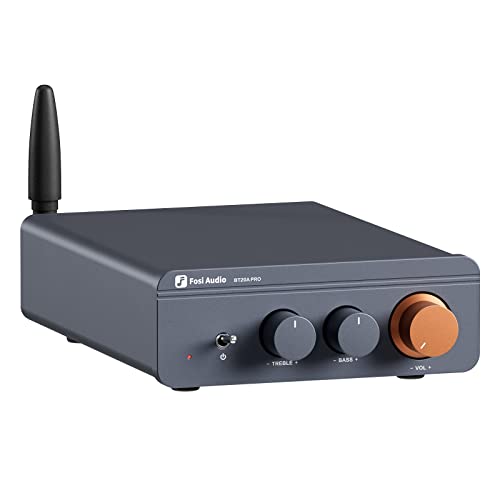
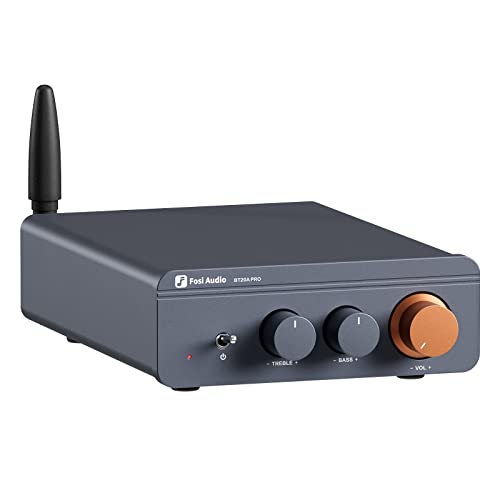
Start with the uncomfortable truth this little box embodies: most modern floorstanders are efficient enough that a flagship amplifier would spend its life idling. The BT20A Pro exists for that majority. Its TPA3255 chip belongs to a newer, cleaner generation than the silicon in budget mini amps of a few years ago, and the result is headroom that stays graceful when a recording gets loud rather than turning brittle at exactly the moment the music matters.
Fosi quotes the Pro at up to 300W per channel maximum, a figure to treat as a ceiling rather than a promise, yet the honest portion underneath it is ample for towers of typical sensitivity in typical rooms. Connections stay refreshingly plain: Bluetooth 5.0 for the phone that holds everyone’s playlists, an RCA input for a streamer or disc player, and physical bass and treble knobs on the front for the listener who prefers turning something to opening an app.
The socket that elevates the Pro above its cheaper sibling is the pre-out. It lets a powered subwoofer join the system correctly, relieving the towers of the deepest bass and converting a good stereo into a convincing 2.1. Alternatively it can feed a second amplifier elsewhere. That single output is why the Pro, not the standard model, gets the recommendation whenever speakers are large, less sensitive, or expected to play at enthusiastic levels.
Key specifications
| Category | Compact two-channel Class D integrated amp |
| Silicon at its heart | TPA3255 chip |
| Ceiling figure | 300W into each channel, maximum |
| Ways in | Bluetooth 5.0 wireless plus RCA |
| Ways onward | Pre-out suited to a powered subwoofer or a further amplifier |
| Hands-on controls | Volume, bass and treble knobs across the front |
Strengths
- Pre-out welcomes a powered subwoofer the proper way
- Wireless and wired inputs beside real tone knobs
- Shelf-friendly footprint despite its output class
Trade-offs
- That headline wattage assumes the right supply and load
- No remote control and no digital sockets
- The pre-out is line level, so passive subs still need power
What it will not do is run a home theater. There is no decoding here, no HDMI, no remote to lose down the sofa. Households whose towers flank a television and expect surround sound should weigh the Yamaha below before this box’s simplicity seduces them.
Ownership, though, is where the Pro quietly wins people over. It occupies a corner of a shelf, asks for a little breathing room and a wall socket, and then disappears from conscious thought. Its spare headroom registers as an absence: no strain on the loud passage, no nagging sense that an upgrade is owed. Within a year the pre-out usually acquires its subwoofer, and the system steps up a class without the amplifier changing at all.
There is also a neat second act available. Because the unit is small and inexpensive in amplifier terms, a duplicate can drive a second pair of speakers in another room later, fed from the first one’s pre-out — a growth path few full-size amplifiers offer so cheaply.
Underneath the convenience sits a genuine engineering argument. The TPA3255’s datasheet virtues — efficiency, distortion behavior under load, tolerance of awkward impedances — are precisely the qualities a demanding loudspeaker exposes. Nothing on the chassis is decorative. Every gram of the budget went into amplification, wearing a modest metal coat.
Budget for one accessory alongside it: decent speaker cable, plus a subwoofer lead if that pre-out will be working from day one rather than someday.
Best for: tower owners whose speakers have an appetite and whose plans include a subwoofer. Not suited for: traditionalists wedded to a big-box rack or anyone building surround sound.

Yamaha RX-V385 5.1-Channel AV Receiver
Badge: Best for Home Theater Towers
When the towers flank a television, the buying question quietly changes. You no longer need merely power; you need a headquarters. The RX-V385 is that headquarters in mainstream form: a 5.1-channel receiver that decodes film soundtracks, switches 4K HDMI sources, and calibrates itself to the room with Yamaha’s YPAO system and its supplied microphone. For the theater-leaning tower owner, those abilities outweigh any wattage contest.
Calibration deserves emphasis because living rooms are acoustically unruly — glass on one side, a sofa swallowing the other, towers closer to corners than any manual recommends. YPAO measures what the room does to the sound and compensates, and on dialogue clarity especially, the improvement is the sort visitors notice without knowing why. Add Cinema DSP programs for widening film sound and Bluetooth for casual phone streaming, and the receiver covers the household’s whole week, not just movie night.
Power, meanwhile, is simply adequate in the best sense: mainstream receiver output driving mainstream towers to levels that will have someone reaching for the remote during action scenes. The towers’ sensitivity does the heavy lifting, exactly as the arithmetic chapter promised.
Key specifications
| Category | AV receiver with five amplified channels |
| Picture handling | 4K Ultra HD pass-through over HDMI, HDCP 2.3 |
| Room setup | YPAO auto calibration, microphone in the box |
| Soundtrack support | Dolby Audio alongside DTS-HD |
| Wireless | Bluetooth onboard for streaming |
| Extras | Cinema DSP processing programs |
Strengths
- Calibrates the front stage to your actual room
- One hub for every HDMI source you own
- Center and surround channels ready when wanted
Trade-offs
- Five channels only — no height speakers later
- Bigger and warmer than any mini amp
- Menus take an evening to learn properly
Living with a receiver means accepting a different daily rhythm. One remote governs volume for everything, the television and the amplifier wake together, and guests can operate the system without a tutorial. That domestic convenience is a genuine feature, and it is the main reason theater households should not be talked into a stereo amplifier plus workarounds.
Set it up with patience. Run YPAO with the microphone at the main seat, at ear height, in a quiet house; check the speaker sizes and crossover it chose; then live with its decisions for a week before overriding them. Owners who skip calibration own a noticeably worse receiver than the one they paid for.
The honest limitation is the ceiling. Five channels means the layout stops at 5.1, and anyone already dreaming of overhead Atmos effects should step directly to the prose-only Atmos category further down rather than buying this twice.
Ventilation matters more here than with the mini amps. A receiver of this class wants open air above it, not a sealed cabinet and never another hot component stacked on top. Give it a shelf with clearance and it will repay you in years.
In short: if your towers earn their keep on film nights, this is the pick. If they never meet a television, its talents are wasted and the stereo options above and below make more sense.
Best for: households whose towers anchor a television setup. Not suited for: stereo purists or anyone planning height channels soon.
High-Current Stereo Power Amplifier (Prose-Only Pick)
Badge: Best for Demanding Towers
Some towers genuinely are difficult. Their sensitivity sits in the mid-80s, their impedance dives toward four ohms or below in the bass, and their manuals read less like documentation and more like a dare. For those speakers — a minority, but a real one — this prose-only category is the correct answer, and nothing else on this page is. No single model is linked because the right unit depends on the exact load, so shop the specification instead.
Shop for current, not wattage theatre. The listing you want quotes a stable rating into 4 ohms with both channels driven, and ideally shows output rising substantially as impedance halves — the signature of a power supply that can actually deliver current when a woofer demands it. Inputs are typically RCA, with balanced XLR on many models, and the unit will need a partner: a preamplifier, or a receiver with pre-outs, since a power amplifier alone has no volume control or source selection.
Gain matching deserves a sentence of its own. The power amplifier’s gain must suit your preamp’s output so that the volume control works across a sensible range rather than going from silence to deafening in a quarter turn. Reputable listings state gain; reputable sellers answer questions about it.
Key specifications
| Category | Stereo power amp — partner it with a preamp or pre-outs |
| Shop for | A 4-ohm rating that holds steady, with real current behind it |
| Ways in | RCA everywhere; balanced XLR on plenty of models |
| Verify | Gain that plays nicely with your preamp or receiver |
| Remember | Power figures should describe both channels working |
Strengths
- Drives spiteful impedances without breaking composure
- Separates the upgrade paths of preamp and power
- Built for decades rather than product cycles
Trade-offs
- Needs a preamp partner before it makes sound
- Heavy, hot and hungry for shelf space
- Costs more than the rest of this page combined, often
Be certain you need it. The diagnostic is written in your speakers’ specifications and in your current system’s behavior: if a competent amplifier already plays your towers cleanly at your loudest level, a high-current power amp buys bragging rights, not sound. If, instead, the bass turns vague and the whole presentation tightens its shoulders at volume, current is the missing ingredient and this category earns its price.
Heat and weight are part of the contract. These amplifiers are dense with transformer and heatsink, they warm the room measurably, and they deserve a stand or shelf rated for them. Plan the furniture before the purchase, not after the delivery driver leaves.
Second-hand examples tempt many buyers, and the category tolerates it better than most: simple, well-built power amplifiers age gracefully. Even so, factor in a service check on older units, and confirm the binding posts accept your cable terminations.
Paired correctly, the payoff is a particular kind of ease. Difficult towers stop sounding difficult. Bass lines gain pitch definition, loud passages stay open instead of congesting, and the system plays quieter better too, because control at low level is the same virtue wearing a different hat.
Best for: owners of low-sensitivity, low-impedance flagship towers. Not suited for: efficient speakers, small rooms or anyone seeking a one-box answer.
Full-Size Stereo Integrated Amplifier (Prose-Only Pick)
Badge: Best Traditional Stereo
There is a reason the full-width integrated amplifier has survived every fashion in hi-fi. One chassis holds a preamp, a power stage, a remote control, a proper row of inputs and, on many models, a moving-magnet phono stage for a turntable — the complete stereo, behaving like furniture instead of a science project. For the tower owner who wants that traditional completeness, this prose-only category is the destination, and the model to buy is the one whose specification reads conservatively.
Conservative is a compliment here. Look for an RMS rating into 8 ohms with both channels driven, quoted with its distortion figure attached. Manufacturers of this class habitually under-promise, which is why a modest number on the page can outplay a gaudy number on a mini amp’s box. Multiple RCA inputs cover legacy sources, optical or coaxial digital inputs on many models take the television’s sound properly, and a headphone output handles late-night listening.
No single model is linked because this class spans a wide price ladder and the right rung depends on your sources — particularly whether vinyl is in the picture. Shop the checklist, audition where possible, and let the remote’s feel in your hand break ties; you will touch it daily.
Key specifications
| Category | Full-width integrated amp for stereo |
| Shop for | A cautious RMS figure into 8 ohms, both channels working |
| Ways in | Several RCA pairs; optical or coaxial on many units |
| Handling | Remote control included; headphone socket on the front |
| Frequently aboard | Moving-magnet phono stage; subwoofer output on some |
Strengths
- Every source you own finds a socket
- Remote and ergonomics suited to daily life
- Conservative ratings that understate real ability
Trade-offs
- Takes a full shelf width and depth
- No Bluetooth on the more traditional models
- The good ones cost proper money
In a tower system this amplifier’s virtues compound quietly. The towers get honest current, the television gets a digital input instead of a headphone-jack workaround, the turntable gets its phono stage, and the household gets one remote. Systems assembled this way tend to stay assembled for a decade, which is its own kind of value.
Placement still applies. Full-size Class AB designs breathe through vents on top; give them clearance, keep them out of sealed cabinetry, and resist stacking a streamer directly on the warm lid whatever the product photos suggest.
One shopping trap: paying for inputs belonging to sources you do not own and will not buy. Count your actual sources, add the one plausible arrival — usually a streamer — and buy for that system. Sockets beyond it are decoration.
If your towers are efficient and your room is modest, the smaller picks above will satisfy you for less. Choose this category when the system’s center of gravity is a rack, a record collection and a long ownership horizon.
Best for: traditional stereo households with several wired sources. Not suited for: minimalists, desktop setups or surround-sound ambitions.

Fosi Audio BT20A Mini Stereo Amplifier
Badge: Best Budget
Strip the mini-amp idea to its essentials and you arrive at the original BT20A. A TPA3116-based design rated at 100W per channel, Bluetooth 5.0 and RCA inputs, bass and treble knobs on the front panel, and a power supply in the box. It is the pick for the tower owner whose speakers were the splurge and whose amplifier budget is what remains — and thanks to tower sensitivity, that owner is usually better served than they fear.
Efficiency is the whole argument. A floorstander of decent sensitivity in a small or medium room asks astonishingly little of an amplifier at sane volumes, and the BT20A’s honest output covers that ask with room to spare. What you give up against the Pro is the ceiling and the pre-out: no proper subwoofer integration, and less composure when inefficient speakers or party volumes enter the story.
Treat it, then, as either a destination for an efficient, simple system or as the cheapest possible education. It will teach you exactly how your towers behave, what your room does, and whether you are the sort of listener who needs more — knowledge worth having before serious money moves.
Key specifications
| Category | Compact two-channel Class D integrated amp |
| Silicon at its heart | TPA3116 chips |
| Ceiling figure | 100W into each channel |
| Ways in | Bluetooth 5.0 wireless plus RCA |
| Handling | Volume, bass and treble knobs across the front |
| In the carton | Power supply included, ready to run |
Strengths
- The cheapest respectable way to wake towers up
- Genuinely tiny — fits where amplifiers should not
- Knobs beat menus for everyday adjustments
Trade-offs
- No pre-out, so subwoofers join awkwardly
- Runs out of composure sooner than the Pro
- No remote and no digital input
Expectations set correctly, the BT20A delights. Records sound like records, streamed playlists fill the room, and the whole apparatus hides behind a plant if decor demands it. Owners regularly report the same surprise: the towers they worried about driving turn out to need very little driving at all.
Wire it carefully and it rewards you. Keep the speaker runs tidy, observe polarity on both channels, and give the little case an inch of air. Most complaints traced to mini amps are actually traced to a reversed wire or a suffocated shelf.
Know its boundary, too. If your towers are the inefficient flagship kind, this is the wrong box and the high-current category above is the right one; sensitivity arithmetic, done honestly, tells you which household you belong to before money changes hands.
As a first amplifier it has one more virtue: it fails cheaply. If the hobby takes hold, it retires to a bedroom or workshop system and keeps working. Few purchases in audio offer that kind of second life at this price of entry.
Best for: efficient towers, smaller rooms and tighter budgets. Not suited for: subwoofer plans, inefficient flagships or remote-control households.
Atmos-Capable AV Receiver (Prose-Only Pick)
Badge: Best for a Growing System
Some tower purchases are secretly the first chapter of a theater. The owner says stereo, but the room says otherwise: a big screen, a sofa aimed at it, and conversations that keep drifting toward a center channel. For that household this prose-only category — a seven-channel-or-larger receiver with Dolby Atmos and DTS:X decoding — is the pick that prevents a costly restart, because it powers today’s towers and tomorrow’s 5.1.2 layout from the same chassis.
Shop by layout, not by logo. Confirm the receiver supports the configuration you actually intend — 5.1.2 is the common starting point — and that its automatic calibration handles the height channels properly. Check per-channel power into your speakers’ impedance rather than the headline figure, and insist on current-standard 4K HDMI switching with up-to-date HDCP so the video chain does not age out early.
No model is linked because channel counts, room-correction systems and prices spread too widely for one name to serve every theater-in-progress. The specification above is the shopping list; bring it to the listings and let it filter.
Key specifications
| Category | AV receiver with seven or more channels |
| Shop for | Atmos plus DTS:X decoding; 5.1.2 handled or beyond |
| Room setup | Automatic calibration with a microphone |
| Picture handling | 4K HDMI switching on current HDCP standards |
| Verify | Per-channel output quoted into your speakers’ impedance |
Strengths
- Today’s stereo, tomorrow’s theater, one purchase
- Height channels unlock modern film soundtracks
- Calibration scales with the growing layout
Trade-offs
- You pay for channels sitting idle initially
- Setup complexity rises with every speaker
- Oversized for a music-only room
The staged plan works like this. Run the towers in stereo while the room is finished. Add the center channel next — dialogue thanks you immediately — then surrounds, then a subwoofer, then heights. The receiver bought once accommodates every stage, and calibration re-runs at each step to keep the growing system coherent.
Budget honesty matters: the receiver is only the down payment on that theater. Cables, a center speaker voiced to sit between your towers, and eventually the subwoofer all belong in the plan. Owners who map the whole staircase buy once; owners who improvise buy the receiver twice.
If, on reflection, the theater talk is fantasy — the room will stay a listening room — step back down to the stereo picks without regret. This category exists for genuine growth, not for insuring against imaginary futures.
Best for: tower buyers with a real, staged theater plan. Not suited for: music-only rooms or anyone allergic to setup menus.
Comparison Table
Read the grid below as geography rather than a league table. Every row answers a different version of the amplifier question, and the specification column names the fact that makes that row the answer. Cross-check a row against its full review before ordering anything.
| Pick | Type | Key specification | Link |
|---|---|---|---|
| Fosi Audio BT20A Pro | Mini Class D stereo amp | TPA3255 silicon at its core | Check price on Amazon |
| Yamaha RX-V385 | 5.1 AV receiver | Passes 4K Ultra HD over HDMI, HDCP 2.3 | Check price on Amazon |
| High-current stereo power amplifier | Stereo power amplifier | Holds its rating into 4 ohms; delivers serious current | Prose-only |
| Full-size stereo integrated amplifier | Full-width stereo integrated | Cautious RMS into 8 ohms, both channels at work | Prose-only |
| Fosi Audio BT20A | Mini Class D stereo amp | TPA3116 silicon at its core | Check price on Amazon |
| Atmos-capable AV receiver | 7-channel AV receiver | Decodes Atmos and DTS:X; handles 5.1.2 and beyond | Prose-only |
How do you choose the right amplifier for these speakers?
Treat the decision as three givens and one conclusion. Given one: sensitivity, which converts watts into loudness. Given two: the lowest impedance the speaker presents, which converts an amplifier’s confidence into current. Given three: the distance between the towers and your chair, which quietly taxes both. The conclusion — how much power, of what kind, in what style of box — falls out of those three numbers with very little room for opinion.
Work it in order. Find your towers’ sensitivity in the manual or on the maker’s page. Note the nominal impedance, and check whether the maker admits a minimum figure. Measure your listening distance honestly, in the room as furnished, not as planned. Then look at the shortlist: efficient towers at domestic distances point at the mini amps; theater duty points at the receiver; punishing specifications point at the high-current category. Most owners discover their answer sits a full tier below the one they were about to buy.
Finally, count your sources and your ambitions. A turntable needs a phono stage somewhere in the chain. A television needs either a digital input or a receiver. A subwoofer in the plan needs a pre-out or sub output. The amplifier that satisfies the arithmetic and the socket list simultaneously is the right one, and there is usually exactly one.
What should you check on the listing before you order an amplifier?
Interrogate the wattage figure first, because it is the number most likely to be dressed up. Into what impedance was it measured? Were both channels driven, or one? Is it an RMS figure or a maximum? Respectable listings answer all three somewhere in their specifications; listings that answer none are telling you something by omission.
Then verify the unglamorous details. Confirm the inputs match your sources — a missing optical input is a silly reason to return an amplifier. Confirm the speaker terminals accept your cable ends, spades, bananas or bare wire. Check the physical dimensions against the shelf, the power supply is included where one is needed, and the returns policy covers a change of heart, because the final audition happens in your room or not at all.
How to set up a stereo amplifier and speakers, step by step
Position before wiring, always. Stand the towers so their tweeters sit near ear height at the main seat, pull rear-ported cabinets a hand’s breadth or more away from the wall behind them, and sketch an equilateral-ish triangle between the two speakers and your chair. Toe them in slightly toward the listener, then resist adjusting anything until the system has played for a few days.
Wire with the power off. Run speaker cable from the amplifier’s terminals to each tower, red to red and black to black, and then physically trace each run with a finger — a single reversed connection cancels bass and dissolves the center image, and it is the most common setup fault in domestic audio. Keep the two runs similar in length, keep them off power cables where crossings allow, and leave a gentle service loop rather than a strained straight line.
Connect sources next: the television’s optical output or the receiver’s HDMI chain, the streamer’s RCA, the phone’s Bluetooth pairing last of all. Power up at low volume, play something familiar, and walk the room. Then run calibration if your amplifier offers it, sit in the main seat, and only now start judging. Small movements of the towers — inches, not feet — remain the cheapest upgrade you will ever make.
The specifications that matter, in plain language
Sensitivity first, because it governs everything: the loudness returned for one watt at one meter. Three decibels is a clearly audible step; ten decibels is roughly a doubling of perceived volume and a tenfold change in the power needed to achieve it. Impedance second: the electrical load the speaker presents, expressed in ohms, and always an average — real speakers dip below their rating, especially in the bass, and amplifiers must stay composed through the dip.
Power third, read properly: RMS watts, into a stated impedance, both channels driven, ideally with a distortion figure beside them. Anything missing from that quartet weakens the number. After those three, the specifications turn practical — input count, the presence of a subwoofer output, dimensions, weight — and those practicalities decide daily happiness more often than another decimal of distortion ever will.
Where does this system go next? A sane upgrade path
Healthy systems grow in an order, and the picks above were chosen to respect it. After amplification, the next step is usually the source: a proper streamer or a better cartridge lifts every record and playlist you own, whereas another amplifier swap mostly rearranges the same performance. Then comes the subwoofer, integrated through the pre-out you were advised to insist on, filling the bottom octave the towers approximate.
After that, placement and the room itself outrank electronics entirely — a rug, sensible tower positions, curtains over the glass wall. Owners who climb the staircase in this order spend less and enjoy more. Owners who start by replacing the amplifier a second time usually discover the problem was standing somewhere else in the room all along.
Common Buying Mistakes
Ignoring sensitivity entirely
Sensitivity is the difference between an amplifier cruising and an amplifier drowning, yet buyers routinely shop as if it did not exist. Two towers can need four times the power of each other for identical loudness. Read the number, do the small arithmetic in this guide, and let it — not the amplifier’s badge — decide the tier you buy.
Strangling the amplifier’s ventilation
Class D sips and barely warms, but receivers and Class AB designs exhale real heat. A sealed cabinet, or another hot component parked on the amplifier’s lid, shortens its life and can trip protection circuitry in the middle of a film’s loudest scene. Air is a specification too. Give the box clearance on top and it will stop featuring in your worries.
Judging amplifiers by headline wattage
Maximum and peak figures describe conditions no living room will ever reproduce. Compare RMS ratings into your speakers’ impedance, both channels driven, and treat any number published without those conditions as marketing weather rather than climate. The honest 50-watt amplifier embarrasses the theatrical 300-watt one often enough to make the check worthwhile.
Expecting a subwoofer to fix placement
A subwoofer amplifies whatever the room hands it, including a bass null parked exactly at your chair. Place the towers well first, integrate the subwoofer second, and expect miracles from neither. Owners who reverse that order spend months adjusting a crossover to compensate for a problem created by a wall.
Buying inputs for a fantasy system
Imaginary future sources are expensive. They persuade buyers to pay for sockets that never meet a cable while missing the one input — a subwoofer output, a television connection — that arrives within the year. List the sources on your shelf today, add the single plausible newcomer, and buy for that system and no other.
Setting tone controls on day one
Rooms and ears both need evidence before correction. Live with the system flat for a week of ordinary listening, at ordinary volumes, across your actual music. Then fix the problems that persisted — a boomy corner, a lean balance — in small steps. Tone controls turned in the first hour usually encode the room’s worst half-hour as a permanent setting.
Matching by brand folklore
Forums nurse elaborate theories about which brands must never be introduced to each other. Electrical compatibility is not folklore; it is measurable in ohms, decibels and watts. An amplifier that suits your towers’ specifications will suit your towers, whatever crests the two companies wear. Trust the measurements and let the mythology entertain somebody else.
Reversed polarity on one speaker
One tower wired backwards quietly cancels bass and smears voices across the soundstage, and owners chase the fault through cables, settings and cartridges for weeks. It costs nothing to check: trace each run, confirm red meets red at both ends, and listen for the center image to snap into focus. Check polarity first; it fixes more systems than any upgrade.
Value, tiers and where the money actually goes
Amplifier tiers buy different things, and naming them prevents overspending. The entry tier buys clean, honest stereo power with Bluetooth — everything a modest system needs and nothing it does not. The middle tier buys headroom, calibration and inputs: the infrastructure of a system that serves a whole household. The upper tier buys current delivery and build quality measured in decades, which only difficult speakers and long horizons can justify.
Notice what no tier buys: a transformation of the speakers themselves. Towers sound like towers; amplification decides how completely they are allowed to. Spend up a tier when a named requirement — theater channels, a phono stage, a spiteful impedance curve — demands it, and not because a larger number felt like progress.
Final Recommendation
Most tower owners should buy the BT20A Pro and be done: it has the headroom, the subwoofer path and the simplicity that daily listening rewards, at a size that fits real furniture. Theater households should buy the RX-V385 instead and let calibration do its quiet work. The difficult-flagship minority already know who they are, and the high-current category waits for them. Everyone else is shopping for a problem they do not have.
What to check before you order
One habit separates satisfied owners from serial exchangers: decide where volume will be controlled before the amplifier arrives. If the television remote rules the room, the amplifier must cooperate with it; if a phone rules the room, Bluetooth behavior matters more than any knob. Geography of the hand, settled in advance, prevents the commonest return in this category.
Then do the final physical audit. Shelf depth, ventilation, cable lengths, socket positions, the subwoofer’s future home. Ten minutes with a tape measure has saved more systems than any review ever written — including, the authors admit, this one.
Frequently Asked Questions
How much power do my speakers actually need?
Enough that the amplifier cruises at your loudest rather than straining at it. For most towers in most rooms, the honest RMS output of the linked picks here lands comfortably in that zone, because sensitivity does the heavy lifting. Work the arithmetic in the choosing chapter with your own speakers’ figure; the answer is usually smaller, and cheaper, than expected.
What does impedance mean when matching an amp and speakers?
Impedance is the load a speaker presents to an amplifier, quoted in ohms as an average across the frequency range. Real speakers wander below their rating, particularly where the bass lives, and the amplifier must remain stable and composed through those dips. Match the amplifier’s stated capability to your speakers’ minimum, not their brochure average, and the pairing will behave at every volume.
Can an amplifier be too powerful for a speaker?
A generously rated amplifier idling along is safer than a small one at its limit, because the clipping distortion of an overdriven amplifier is the usual tweeter-killer. The danger lives at the volume knob, not in the specification. Match the amplifier’s range to the speaker maker’s guidance, listen at sane levels, and surplus power becomes insurance rather than threat.
Do I need a subwoofer output on the amplifier?
Only if a powered subwoofer features in your plans — but it features in many plans within a year, because even towers approximate the deepest bass rather than truly reproducing it. A pre-out or dedicated sub output integrates the subwoofer properly, with level and crossover under control. Buying that socket now costs little; retrofitting its absence costs an amplifier.
Why does my system sound quieter than the wattage promised?
Check the chain before blaming the power stage. A source delivering a low output level — a phone at half volume feeding the input, a streamer with its own volume turned down — leaves an amplifier under-driven even with its knob at maximum. Confirm every link is delivering a healthy signal, and the missing loudness usually reappears without any new hardware.
Is Bluetooth sound quality good enough for a main system?
For everyday listening, comfortably yes. Modern Bluetooth codecs deliver sound that most listeners in most rooms cannot fault, and the convenience means the system actually gets used on a Tuesday evening. Critical listeners with local files can add a wired streamer later through the same amplifier’s RCA input — the two paths coexist happily.
Do tower speakers need to be bi-amped to sound their best?
No. Feeding a tower’s two terminal pairs from spare receiver channels changes remarkably little, because the speaker’s internal crossover still governs the result. The audible upgrades for towers are placement, a subwoofer for the deepest octave, and honest power in the first place. Spend the bi-amping budget on records.
My towers are rated for high wattage — must my amplifier match it?
That figure is a ceiling the speaker can survive, not a floor it demands. Your amplifier must satisfy the speaker’s sensitivity and your room’s loudness needs, which the arithmetic in this guide covers. A tower rated to handle great power will sing on a fraction of it, provided the fraction arrives cleanly.