Disclosure: As an Amazon Associate, kajuandouglas.com earns from qualifying purchases. Links to Amazon on this page are affiliate links; they cost you nothing extra. Listing details such as price and availability change often, so check the current Amazon listing before you buy.
Where to buy
Three picks in this guide carry Amazon links because those exact models passed verification; the other three are categories described with shopping checks, since the right example depends on your house. Follow the linked picks to Amazon to confirm current listing details, and use the checks inside each prose-only review to judge any model you are considering for those slots. Orders are placed on Amazon in every case.
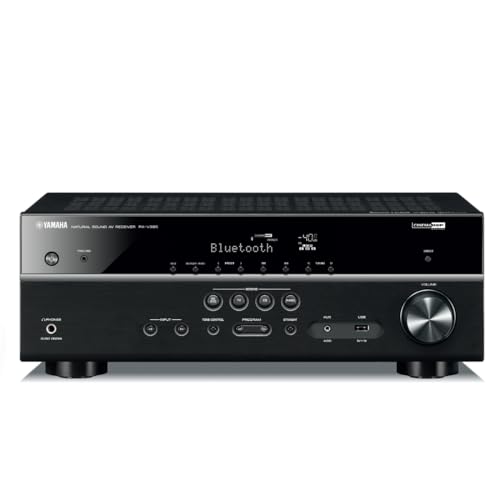
- Yamaha RX-V385 5.1-Channel AV Receiver — the complete hub, and this guide’s leading recommendation.
- Streaming Amplifier (Prose-Only Pick) — app-driven music and TV from a small box (prose-only pick, no single model linked).
- Zone 2 AV Receiver Setup (Prose-Only Pick) — one receiver serving the lounge and the patio separately (prose-only pick, no single model linked).
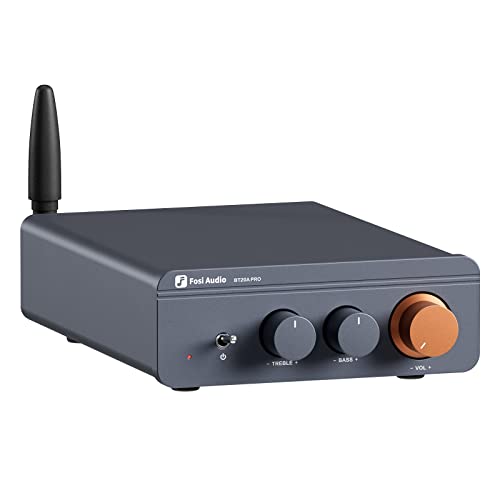
- Fosi Audio BT20A Pro Mini Stereo Amplifier — serious output from a palm-sized chassis.
- Fosi Audio BT20A Mini Stereo Amplifier — the modest spend that still does the job properly.
- Full-Size Stereo Integrated Amplifier (Prose-Only Pick) — the traditional hi-fi heart for a media room that also feeds outside (prose-only pick, no single model linked).
The reviews below explain which architecture suits which house. Read the signal-path essay first if the project is still a sketch, because the cable decisions matter more than the amplifier badge.
The scene behind this search is easy to picture. A television indoors shows the match, the film or the evening news, while the audience has drifted outside to a patio, a deck or the far end of the garden where the air is better. Someone raises the TV volume until the indoor speakers distort, someone else opens a window, and the household concludes what this guide exists to solve properly: the sound needs to live where the people are, delivered by speakers built for weather, fed by an amplifier that never leaves the house.
Getting there is less about power than about plumbing. Television audio must escape the TV by a route that keeps speech in step with lips, travel to an amplifier indoors, then continue along cable rated for sun and soil to speakers mounted under cover. Each pick below builds that route differently. A receiver makes the patio an extension of a surround system. A streaming amplifier makes it a zone in an app. A miniature amplifier makes it a single-purpose appliance beside the TV, and for many homes that simplicity is the whole appeal.
Boundaries, so nobody buys the wrong dream. This guide covers permanently installed outdoor speakers fed from a television in a typical house. It does not cover portable Bluetooth speakers carried outside for an afternoon, commercial systems for bars, or in-ground landscape systems designed by irrigation-style planning. Those are fine categories with different rules, and mixing their advice into a patio project produces expensive confusion.
Key Takeaways
- Only the speakers and their cable live outdoors; every amplifier in this guide stays inside, dry and ventilated.
- An HDMI ARC connection keeps television sound and pictures in step, while a Bluetooth hop from the TV often lets dialogue drift.
- Outdoors, covering the seating evenly beats playing loudly in one direction, for listeners and neighbours alike.
- Three linked models anchor the list; the remaining slots are categories with explicit checks to shop against.
In this guide
Quick Picks
Six ways to build the same evening. The right row is the one that matches the equipment already sitting under your television.
| Buyer type | Pick | Why it stands out | Link |
|---|---|---|---|
| Best Overall | Yamaha RX-V385 | A complete 5.1 hub whose HDMI handling includes 4K pass-through | Check price on Amazon |
| Best for App Control | Streaming amplifier | Music services live inside the box, no extra streamer required | Prose-only — see review |
| Best Two-Zone Setup | Zone 2 receiver setup | The living room and the patio can play different things at once | Prose-only — see review |
| Best Compact Power | Fosi Audio BT20A Pro | Its TPA3255 chip stays composed when the volume climbs | Check price on Amazon |
| Best Budget | Fosi Audio BT20A | A small footprint with an honest 100W x 2 rating class | Check price on Amazon |
| Best for a Media Room Base | Full-size stereo integrated amplifier | A proper remote and a generous spread of inputs | Prose-only — see review |
Households with no equipment at all should start at the first row. Households with a working indoor system should start at the third. Households with a shelf, a TV and nothing else should read the fourth and fifth rows twice.
How These Picks Were Chosen
The method began at the speakers and worked inward. Outdoor speakers are typically 8-ohm designs of modest sensitivity, asked to fill open air that swallows bass and offers no walls to help. Amplifiers were therefore judged on sustained output into 8 ohms, on the quality of their television connection, and on how their volume can be controlled from outside — by remote, by app, or by the TV’s own remote through HDMI control signals.
Linked models earned their links through identity verification: each was confirmed against Amazon’s Creators API through this site’s provider, with the returned title matched to the product before any link was allowed. Their specifications below come from those verified listings and the manufacturers’ own figures. The Yamaha leads because it solves the television problem completely, with ARC, room calibration and surround decoding in one box. The two Fosi models earn their places at the opposite pole, where a single outdoor pair and a modest budget make a receiver absurd.
Prose-only slots remain where households diverge too much for one model to be honest. Zone configurations, streaming ecosystems and full-size integrated amplifiers all depend on equipment and services already in the home, so those reviews specify the features to demand instead of pretending a universal answer exists.
Getting TV audio outside: the three honest signal paths
Path one is HDMI ARC, and it is the path this guide recommends whenever the television offers it. A single HDMI cable carries sound from the TV’s tuner and apps back into a receiver or ARC-equipped amplifier, while control signals let the TV remote raise and lower the volume. Speech stays locked to the picture because the connection was designed for exactly this marriage. If your TV labels one HDMI socket with ARC or eARC, that socket is the foundation of the whole project.
Path two is optical or analogue from the TV into an amplifier without ARC. Optical keeps the signal digital and immune to hum, though volume control usually stays with the amplifier’s remote rather than the TV’s. Analogue outputs, where a TV still provides them, are simplest of all and perfectly adequate for a patio pair, with the caveat that some televisions fix that output at full level, leaving every adjustment to the amplifier. Either variant suits the compact amplifiers in this guide, whose job begins once a clean line-level signal arrives.
Path three is the one to treat with suspicion: Bluetooth from the television to an amplifier or speaker. It is tempting because no cable crosses the room, but Bluetooth introduces delay, and delay shows itself mercilessly in dialogue, where lips and words part company. Some televisions offer lip-sync correction that can rescue the pairing for casual viewing. Test yours with a newsreader’s face before committing the project to this route, because sport commentary forgives what a close-up interview does not.
Whichever path carries the signal indoors, the outdoor leg is always copper. Speaker cable rated for burial or outdoor exposure runs from the amplifier to each speaker, and that run — its length, its gauge, its route through walls and soil — is the real project. The amplifier decision takes an evening. The cable decision is the one you will live inside the walls with, so the step-by-step section treats it with appropriate respect.
One more signal-path wrinkle deserves honesty, because many patios sit behind a games console or a streaming stick rather than the television’s own tuner. When sources plug into the television and the television feeds the amplifier by ARC, every source inherits the same tidy arrangement, which is a strong argument for wiring the TV as the hub even in homes that rarely watch broadcast channels. When sources plug into a receiver instead, the receiver becomes the hub and the television is merely its screen; that arrangement suits film households and is exactly what the Yamaha brief assumes. Either hub works. What fails is indecision — some sources wired each way, with lip-sync and volume behaviour changing as you switch between them, and the household blaming the outdoor speakers for an indoor tangle.
Weather also edits the signal path in a small, practical sense. The wall penetration where cable leaves the house is the single point where the indoor and outdoor worlds meet, and it deserves the same care as a plumbing joint: a proper exterior plate or sealed gland, a route that sheds water rather than collecting it, and enough slack indoors to re-terminate in five years without opening the wall again. Projects that skimp here usually work beautifully until the second winter.
Lip-sync, volume and the neighbor test: living with the system
Lip-sync deserves a second mention because it is the fault owners notice daily and forgive never. The safeguard is architectural: keep the television’s sound on a wired path, set any delay controls to their minimum while testing, and judge with speech rather than music. Music hides a hundred milliseconds of error without complaint; a weather presenter exposes ten. Once dialogue sits correctly, it tends to stay correct across sources fed through the same path.
Volume outdoors behaves unlike volume indoors. Without walls, sound does not build; it simply travels, which tempts owners to keep turning up until the far chair hears clearly and the fence line hears everything. The cure is coverage: two speakers aimed into the seating at moderate level, or four smaller ones distributed, will always beat one pair straining from a single wall. Several picks in this guide exist largely to make that coverage easy to control.
The neighbour test is the social version of the same principle. Stand at your boundary at the volume you plan to use, at the hour you plan to use it, and listen as your neighbour will. If the words are intelligible at the fence, the system is too loud or aimed wrongly, and no amplifier feature will fix what geometry caused. Aiming speakers inward and downward, and agreeing a household maximum level after dark, keeps the project a pleasure rather than a dispute with a soundtrack.
Build those habits at installation time, when enthusiasm is high and adjustments are easy. A volume limiter setting, where the equipment offers one, converts good intentions into a permanent arrangement that guests and teenagers cannot casually override.
The Best Amp for Outside Speakers From TV
Six reviews follow, moving from the complete hub to the simplest appliance. Every one assumes the amplifier lives indoors and the cable does the travelling.

Yamaha RX-V385 5.1-Channel AV Receiver
Badge: Best Overall
The RX-V385 is the pick for the household starting from a television and good intentions. As a 5.1-channel AV receiver it takes the TV over HDMI with 4K Ultra HD pass-through and HDCP 2.3, decodes Dolby Audio and DTS-HD soundtracks, and gives the outdoor pair a home either as part of the main system or mirrored from it. Yamaha’s YPAO calibration, using the included microphone, sets levels and distances for the indoor speakers automatically, which matters because a well-balanced indoor system is what the patio feed borrows its good manners from.
In daily use, its virtues are domestic rather than dramatic. Bluetooth streaming covers phones and tablets when the television is off. Cinema DSP programs widen the sound for films without wrecking dialogue. And because the receiver is the hub, the television remote governs volume through HDMI control, so nobody outside needs to find a second remote to hear a commentator over a barbecue.
Key specifications
| Type | AV receiver with five amplified channels |
| Video handling | 4K Ultra HD pass-through over HDMI, with HDCP 2.3 |
| Calibration | YPAO automatic setup using a supplied microphone |
| Decoding | Dolby Audio alongside DTS-HD formats |
| Wireless | Bluetooth for streaming from phones and tablets |
| Extras | Cinema DSP sound programs for film and sport |
Strengths
- Television integration is complete, including remote volume through HDMI
- Automatic calibration balances the indoor system the patio draws from
- Surround decoding makes film nights outside a genuine event
Trade-offs
- Five channels means height speakers for Atmos are not on the menu
- Output is mainstream rather than mighty for demanding indoor towers
- A full receiver is a large box for a patio-only ambition
Best for: households building one hub for indoor viewing and outdoor listening / Not suited for: a patio pair that will never meet a surround system
Wiring the outdoor pair deserves a specific note with this receiver. Decide whether the patio mirrors the main zone or plays as an independent feed, and wire accordingly before the calibration microphone comes out, since YPAO’s measurements assume the layout it can hear. Owners who treat the patio as an extension of the main room get the simplest control story: one source, one volume logic, no surprises when the match goes to extra time.
Long-term, this is the pick least likely to be outgrown by the television itself. Televisions change every few years; a receiver with current HDMI handling and honest amplification absorbs those changes gracefully, and the outdoor speakers wired to it simply keep working through each upgrade cycle.
Streaming Amplifier (Prose-Only Pick)
Badge: Best for App Control
The streaming amplifier is the receiver’s younger, smaller relative: a compact stereo box with network streaming built in, controlled from a phone, and in TV-focused examples equipped with HDMI ARC so the television joins the same tidy arrangement. For a household whose music already lives in streaming services, this category removes a whole layer of equipment — no separate streamer, no receiver bulk, just an app, a pair of outdoor speakers, and a volume slider that works from the garden chair.
Shop the ecosystem before the amplifier. The services you use should be supported natively inside its app, multi-room compatibility matters if other rooms may join later, and a subwoofer output is worth having because outdoor listening benefits from low-frequency help more than indoor listening does. ARC presence separates the television-ready models from the music-only ones, and for this guide’s purpose it is close to mandatory.
Key specifications
| Type | Compact stereo amplifier with network streaming inside |
| Priority check | Your music services supported natively by its app |
| Inputs | Streaming over Wi-Fi or Ethernet; HDMI ARC on television-focused models |
| Outputs | A subwoofer output appears on many examples |
| Expansion check | Multi-room ecosystem fit, if more rooms are plausible later |
Strengths
- The phone becomes the remote, the source and the volume control
- Music plays outside without the television waking up
- Small chassis hides in ordinary furniture
Trade-offs
- The app experience is the product, for better or worse
- No surround decoding for film households
- Firmware and service support decide its lifespan
Best for: streaming-first households wanting app control from the garden / Not suited for: film lovers building toward surround sound
Network reliability is this category’s hidden specification. An amplifier at the end of a weak Wi-Fi path will stutter in ways owners misdiagnose as amplifier faults, so prefer a wired Ethernet connection where the router’s location allows, or confirm the Wi-Fi signal at the amplifier’s shelf with a phone before ordering. Once the network is solid, these boxes are close to invisible in daily life, which is their entire design philosophy.
Volume limiting, where offered in the app, is a gift to neighbourly relations. Set the ceiling during the neighbour test described earlier, and the slider’s top end becomes a promise the whole household can keep without thinking.
Zone 2 AV Receiver Setup (Prose-Only Pick)
Badge: Best Two-Zone Setup
A Zone 2 receiver setup answers the most sociable version of the problem: the match plays outside for one group while a film or the news continues indoors for another, both fed by a single receiver. Powered Zone 2 outputs drive the outdoor speakers directly, and the better implementations let the second zone choose its own source, its own volume, and its own schedule entirely. Households with teenagers will understand immediately why this category exists.
The checks are specific. Confirm that Zone 2 can genuinely play a different source rather than merely echoing the main room. Establish whether using Zone 2 borrows channels from the main layout, which matters if the indoor system aspires to more than five channels. And plan control: an app or a second remote that reaches the receiver from the patio turns a clever feature into a usable one, while a setup that demands trips indoors for every adjustment will quietly stop being used.
Key specifications
| Type | AV receiver offering powered outputs for a second zone |
| Priority check | The second zone can select a source different from the main room |
| Inputs | HDMI serves television indoors; streaming commonly serves the patio |
| Channel check | Whether second-zone power reduces the main room’s channel count |
| Reminder | The outdoor leg still needs weather-rated cable, whatever the receiver does |
Strengths
- Two rooms, two programmes, one piece of equipment
- Independent volume respects both audiences at once
- Builds on a receiver purchase many households make anyway
Trade-offs
- Setup menus for zones are famously unintuitive
- Analogue-only second zones exist and disappoint the unwary
- Control from outside needs planning, not hope
Best for: households where indoor and outdoor audiences regularly differ / Not suited for: single-audience homes, where mirroring is simpler
A volume-control detail separates the satisfying installs from the frustrating ones. Some receivers limit which sources can reach the second zone, historically restricting digital inputs; modern examples have largely fixed this, but the manual’s zone chart is worth reading before money moves. Five minutes with that chart has saved more returns than any other paragraph in this guide.
Wire for the future while the walls are open. A second pair of cable runs, capped and labelled, costs little during installation and converts a later four-speaker patio expansion from a building project into an afternoon’s wiring.
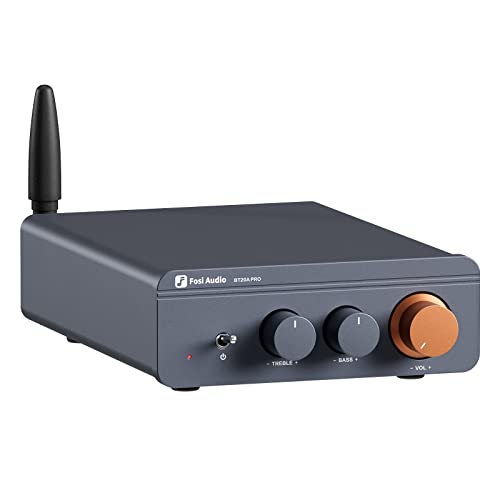
Fosi Audio BT20A Pro Mini Stereo Amplifier
Badge: Best Compact Power
The BT20A Pro is the minimalist’s answer: a mini two-channel Class D amplifier built around the TPA3255 chip, rated at up to 300W per channel at maximum, with Bluetooth 5.0 and RCA inputs, front-panel volume, bass and treble controls, and a pre-out that can feed a powered subwoofer or a second amplifier later. It sits beside the television, takes the TV’s analogue or a converter’s output, and drives the outdoor pair with a composure that embarrasses far larger equipment.
The chip is the story. The TPA3255 generation runs cleaner at high output than the older designs in this size class, which matters outdoors where volume requests are ambitious and distortion carries across a garden with nothing to absorb it. Owners stepping up from the standard model below consistently describe the same difference: not louder, exactly, but calmer at the loudness both can reach.
Key specifications
| Type | Miniature two-channel Class D integrated amplifier |
| Amplifier chip | TPA3255 |
| Rated output | Up to 300W per channel at maximum |
| Inputs | Bluetooth 5.0 and RCA |
| Extra output | Pre-out for a powered subwoofer or another amplifier |
| Controls | Volume, bass and treble knobs on the front panel |
Strengths
- Remarkable output reserves for its footprint
- Pre-out keeps a subwoofer upgrade open
- Physical tone controls suit quick, gloved adjustments
Trade-offs
- No HDMI, so television connection needs an analogue or optical route
- Bluetooth from the TV can drift against the picture
- The external power supply is part of the footprint
Best for: a single outdoor pair fed from a nearby television, with headroom valued / Not suited for: households wanting the TV remote to run everything
Feed it thoughtfully. The RCA input from a television’s headphone socket gives TV-remote volume control in many setups, since the headphone output usually follows the TV’s volume; a fixed line output leaves control with the Fosi’s knob. Decide which arrangement your evenings prefer before the cable run is finalised, because swapping later means reopening the route.
Heat and shelter apply indoors too. The little chassis sheds heat through its case, so give it a shelf rather than a closed cabinet, and keep the power brick ventilated. Treated kindly, it is the sort of component that simply never gets thought about again, which for a patio system is high praise.

Fosi Audio BT20A Mini Stereo Amplifier
Badge: Best Budget
The original BT20A is the Pro’s elder sibling and the budget anchor of this guide: a TPA3116-based mini amplifier rated at 100W per channel, with Bluetooth 5.0 and RCA inputs, front volume, bass and treble controls, and its power supply included in the box. For a modest patio pair at conversational-plus volume, it contains everything the project actually requires and nothing it does not.
Its honesty is its charm. The rating class is genuine, the controls are physical, and the whole unit can be replaced for less than the cost of the outdoor cable it feeds, which reframes reliability worries entirely. Many owners buy this model as the experiment, discover the experiment works, and never upgrade — the highest compliment a budget component can earn.
Key specifications
| Type | Miniature two-channel Class D integrated amplifier |
| Amplifier chips | TPA3116 |
| Rated output | 100W per channel |
| Inputs | Bluetooth 5.0 and RCA |
| Controls | Volume, bass and treble on the front panel |
| In the box | Power supply included |
Strengths
- The smallest spend that still constitutes a proper system
- Bluetooth covers phones; RCA covers the television
- Tiny enough to mount behind the TV itself
Trade-offs
- Less composure than the Pro when pushed hard
- No pre-out for an easy subwoofer addition
- Knob-only control, with no remote option
Best for: modest patios, first systems and second zones on a budget / Not suited for: large gardens or owners who listen loudly outside
Pair it with efficient outdoor speakers and sensible expectations. At the volumes the neighbour test approves, this little amplifier operates in the comfortable middle of its ability, where it sounds clean and runs cool. Ask it to fill a long lawn at party level and you have simply chosen the wrong row of the table; the Pro exists for that household.
Installation could hardly be simpler, which suits its role. Television to RCA, amplifier to outdoor cable, power brick to a socket that stays indoors. Label the outdoor cable pair at the amplifier end, because in a year the question of which run feeds which speaker will otherwise be answered by trial, error and a stepladder.
Full-Size Stereo Integrated Amplifier (Prose-Only Pick)
Badge: Best for a Media Room Base
The traditional integrated amplifier is the choice for a household whose indoor listening is stereo-first: records, CDs and a television sharing a serious pair of indoor speakers, with the outdoor pair as the system’s second act. Full-width, remote-controlled and input-rich, with multiple RCA connections and optical or coaxial digital inputs on many models, it brings hi-fi manners to the patio project. Speaker A/B switching, where fitted, is the classic mechanism: A for the room, B for the garden, both when the party spans the doorway.
Judge this category by conservative numbers. A continuous rating into 8 ohms with both channels driven, printed without asterisks, signals the engineering culture you want. A moving-magnet phono stage appears on many examples and matters if a turntable shares the shelf. A subwoofer output, where present, helps indoors more than out, but versatility is this category’s entire argument.
Key specifications
| Type | Full-width stereo integrated amplifier |
| Rating evidence | Conservative continuous output into 8 ohms, both channels driven |
| Inputs | Several RCA inputs, with optical or coaxial on many models |
| Controls | Remote control included; headphone socket on the front |
| Often included | Moving-magnet phono stage; subwoofer output on some designs |
Strengths
- The best indoor stereo sound in this guide
- Input generosity ends source juggling permanently
- Built and supported like a long-term appliance
Trade-offs
- No video handling, so the TV connects by audio only
- A/B switching shares power between rooms when both play
- Size and cost exceed the patio’s own requirements
Best for: stereo households whose media room anchors the whole system / Not suited for: television-first rooms planning surround sound
One caution on the A/B arrangement: playing both speaker pairs together can present a lower combined impedance to the amplifier, so check the manual’s guidance for simultaneous operation and keep volumes moderate when the whole house is listening. Within that courtesy, this is the connoisseur’s route — the patio inherits the sound quality of a real hi-fi system rather than a television accessory.
Longevity argues for this category too. Integrated amplifiers are repaired, resold and handed down in a way disposable electronics are not, and a household that values that culture will find the outdoor speakers are merely the newest chapter of a long story.
Comparison Table
| Pick | Type | Key specification | Link |
|---|---|---|---|
| Yamaha RX-V385 | 5.1-channel AV receiver | 4K HDMI pass-through with HDCP 2.3 | Check price on Amazon |
| Streaming amplifier | Compact amplifier with streaming built in | Your services supported natively in its app | Prose-only |
| Zone 2 receiver setup | Receiver with powered second zone | Second zone able to choose a different source | Prose-only |
| Fosi Audio BT20A Pro | Mini two-channel Class D amplifier | TPA3255 amplifier chip | Check price on Amazon |
| Fosi Audio BT20A | Mini two-channel Class D amplifier | TPA3116 amplifier chips | Check price on Amazon |
| Full-size stereo integrated amplifier | Full-width stereo integrated amplifier | Conservative continuous rating into 8 ohms | Prose-only |
The table’s real divide is control: receivers and streaming boxes put volume in an app or the TV remote, while the mini amplifiers keep it on a knob indoors. Choose the control story your household will actually use.
One household pattern deserves a direct answer, because it arrives in this search constantly: the television is new, the soundbar is staying, and the patio is an afterthought somebody promised to solve. A soundbar rarely offers a route to outdoor speakers, so the honest options are a separate small amplifier fed from the television’s other audio output, exactly the Fosi arrangement, or accepting that the patio system lives its own life with its own sources. Trying to conscript the soundbar into patio duty wastes weekends; a parallel mini system works the same evening it is installed.
How do you choose the right amplifier or receiver for outdoor listening?
Inventory the room first. A television standing alone points toward the receiver or one of the mini amplifiers. A television above an existing surround system points toward Zone 2 thinking. A television in a stereo household points toward the integrated amplifier. The outdoor speakers are the constant; the indoor equipment is the variable, and honest inventory prevents buying a second hub to rival the first.
Next, decide how volume will be governed from a garden chair. If the answer is the television remote, ARC and a receiver or streaming amplifier become requirements rather than features. If a trip indoors is acceptable, or a phone is always in hand anyway, the simpler categories open up and the budget falls dramatically. Then count speakers: one pair now, or a plausible second pair later? Distributed coverage favours zone-capable equipment from the start.
Finally, walk the cable route with a tape measure before ordering anything. The length of that run sets the cable gauge, hints at whether a second zone’s wiring is feasible in the same trench, and occasionally vetoes a mounting position entirely. Outdoor audio is one of the few electronics projects where the building gets a vote, and it casts it early.
What should you check on the listing before you order for an outdoor system?
For receivers and streaming amplifiers, verify the television connection you intend to use is genuinely present: ARC is a feature, not a standard fitment, and its absence changes the whole control story. Confirm the speaker terminals accept the cable gauge your run requires, since long outdoor runs push owners toward thicker cable than indoor habits suggest. For zone claims, find the sentence that says the second zone can select a different source, because similar-looking models differ on exactly this point.
For the mini amplifiers, check what the rating’s conditions are and whether a power supply is included, since the two Fosi listings differ in emphasis there. Confirm the input you plan to use exists on the rear panel in a photograph, not only in the description’s enthusiasm. And for every category, read the returns terms with the cable run in mind: equipment can be returned, but a trench cannot, so the amplifier is the flexible part of the project and should be bought from somewhere that treats it that way.
How to run TV sound to outdoor speakers, step by step
- Choose the signal path first — ARC where the television offers it — and test it indoors with the amplifier and a short cable before any drilling.
- Decide speaker positions by coverage, standing in the seating and aiming for ears rather than for symmetry on the wall.
- Measure the full cable route, including vertical rises and the slack that terminations need, then add a margin for the route reality chooses.
- Select outdoor-rated or burial-rated cable of a gauge suited to that length, and buy it in one continuous length per run.
- Drill and seal the wall exit properly, with a drip loop outside so rain follows the loop rather than the cable into the house.
- Mount speakers under cover wherever possible, angled into the seating, with stainless fixings that will not streak the wall.
- Connect with polarity consistent at both ends of every run, then label each cable at the amplifier before testing.
- Test with dialogue at low volume, walk the seating and the boundary line, set a maximum level, and only then call it finished.
While the trench or the wall route is open, photograph it with a tape measure in frame and keep the picture with the house documents. Future projects — a garden office, a fence replacement, an irrigation line — will all want to know where that cable sleeps, and a photograph answers in seconds what memory will argue about for an hour.
Notice that the amplifier is connected almost last. In outdoor projects the infrastructure is the product; the electronics are the interchangeable part at its centre.
The specifications that matter, in plain language
Output into 8 ohms, continuously, is the figure that predicts patio performance, because outdoor speakers almost universally present that load and open air is an unforgiving listener. HDMI ARC and its enhanced sibling describe how television sound and control signals travel; either is sufficient for this project, and the presence of one matters far more than which. Zone terminology deserves translation: a zone is simply an area with independent source and volume, and the word powered confirms the receiver amplifies it directly rather than handing the job to another box.
Ingress protection ratings belong to the speakers rather than the amplifier, yet they shape the system: a speaker’s rating tells you how directly weather may strike it, which in turn decides mounting positions and therefore cable lengths. Bluetooth version numbers matter less than the delay behaviour discussed earlier; a newer version does not repeal the physics of a wireless hop. And damping, wattage peaks and other headline ornaments can be safely ignored by a buyer whose cable, coverage and control decisions are sound.
Where does this system go next? A sane upgrade path
The satisfying sequence begins with one well-aimed pair and a television path that keeps speech honest. A second pair for coverage usually follows before any amplifier upgrade, because evenness impresses guests more than loudness ever will. A subwoofer rated for outdoor duty, or a powered indoor sub near an open doorway for film nights, comes third for households that miss real bass. Control refinements — an app-driven zone, a volume limiter, outdoor-rated volume controls on the wall — tend to arrive last and stay longest, because convenience is the upgrade that gets used every single day.
What rarely needs upgrading is the cable, provided it was specified generously at installation. That is the deepest argument for treating the first trench as a permanent decision and every electronic box as a temporary one.
Common Buying Mistakes
Mounting speakers fully exposed
Weather-rated means a speaker survives weather, not that it enjoys a decade of direct sun and driven rain. Eaves, soffits and covered pergolas multiply a speaker’s life for the price of a ladder climb.
Leaving the amplifier outdoors
A covered porch is still outdoors: humidity, insects and temperature swings all get in. Every amplifier in this guide belongs inside, and the cable exists precisely so it can stay there.
One pair played at its limit
A single pair straining to cover a whole garden distorts, annoys neighbours and wears itself out. Coverage through distribution is quieter at every seat and kinder at the fence.
Aiming across the fence
Speakers aimed over the seating and toward the boundary export your evening to people who did not buy a ticket. Aim inward and downward; the garden hears better and the street hears less.
No level discipline after dark
Sound travels further in cool evening air, and enthusiasm rises as light falls. A preset maximum level, agreed in daylight, prevents the nightly negotiation entirely.
Running indoor cable outside
Indoor cable jackets crack under ultraviolet light and admit moisture at every nick. Outdoor-rated or burial-rated cable costs a little more and is the difference between a system and a seasonal hobby of repairs.
Forgetting the wire run is the project
Owners budget for boxes and improvise the infrastructure, then wonder why the system disappoints. Measure, trench and seal with the same care given to choosing the amplifier.
Skipping polarity checks across pairs
With speakers on different walls, a reversed pair cancels bass in ways that sound like a placement problem. Check polarity at installation, when the fix takes a minute.
Consider also how the system will be used in its second year, because first-year enthusiasm is a poor specifier. The novelty phase involves films, matches and playlists at generous volume. The settled phase involves radio in the morning, a podcast while gardening, and background music at levels a conversation can ignore. Equipment that serves the settled phase gracefully — instant-on behaviour, an app that opens quickly, a volume control that responds from the chair — is what owners end up valuing, and it is worth weighting those behaviours while choosing, even though they never appear in a specification table.
There is a related trap in buying for the largest gathering of the year. A system sized for a forty-person party will spend fifty ordinary evenings oversized, overcomplicated or both. Size for the household’s real life, rent or borrow reinforcement for the exceptional day, and the patio system stays the simple pleasure it was meant to be.
Value, tiers and where the money actually goes
The budget tier, represented by the smaller Fosi, buys a correct system for a modest patio and leaves money for the cable, which is where it belongs. The middle tier buys control: ARC, apps, zones and remotes that make the system pleasant to live with daily. The upper tier buys integration with a serious indoor setup, where the patio inherits surround decoding or hi-fi stereo quality.
Across all tiers, the spending that never regrets itself is identical: outdoor-rated cable of adequate gauge, mounting hardware in stainless steel, and enough speakers for coverage. Electronics date quickly; infrastructure installed generously serves every future version of the system.
Final Recommendation
Start from nothing and buy the Yamaha: it is the complete, television-fluent hub around which an outdoor setup can grow. Own a surround system already and pursue the Zone 2 brief. Want the simplest possible patio pair and choose between the two Fosi models by garden size and volume honesty — the Pro for ambition, the original for economy. Stereo households with a media room should let the integrated amplifier brief carry the project.
What to check before you order
- The television connection on the listing matches the path you tested.
- Speaker terminals accept the cable gauge your measured run requires.
- Zone claims, where relevant, explicitly allow a different source.
- The amplifier’s home is indoors, ventilated and within cable reach.
- Power supply inclusion confirmed for compact models.
Seasonal habits extend the system’s life out of proportion to their effort. In autumn, a glance at the speaker terminals for corrosion and a check that the drip loop still loops costs ten minutes. In spring, before the first gathering, play something at low volume and walk the garden, because a winter-damaged cable announces itself quietly before it fails loudly during a party. Amplifiers indoors ask for almost nothing beyond dust and ventilation, which is the dividend the whole architecture was designed to pay.
And when guests ask how the television got outside, the honest answer is that it did not. A cable did, an amplifier stayed home, and a pair of speakers agreed to live under the eaves. That division of labour, unglamorous as it sounds, is the entire secret this guide has to tell.
Frequently Asked Questions
Will the TV’s remote control the outdoor volume?
With an ARC-connected receiver or streaming amplifier, generally yes, through HDMI control signals. With a mini amplifier fed from a headphone socket, often yes as well; fed from a fixed line output, volume lives on the amplifier instead.
Can I leave the amplifier outside if it is under a cover?
No arrangement of covers changes the recommendation. Covers trap humidity against electronics, and insects treat sheltered boxes as housing. Keep the amplifier indoors and let rated cable take the weather.
Can outdoor speakers play something different from the TV inside?
That is precisely the Zone 2 arrangement, or a streaming amplifier working independently of the television. Mirrored setups cannot split sources, so decide which behaviour your household wants before choosing the architecture.
How many outdoor speakers can one amplifier zone run?
Most zones happily drive one pair. A second pair is possible in parallel or series depending on impedance, but coverage-hungry gardens are better served by equipment designed for the load than by hopeful wiring.
What cable should I run to outdoor speakers?
Cable explicitly rated for outdoor exposure or direct burial, in a gauge chosen for the run’s length. Longer runs need thicker cable to keep resistance from eating the amplifier’s control over the speakers.
How loud should outdoor speakers be?
Loud enough for clear conversation-level listening at the furthest seat, and no louder at the boundary than a murmur you would accept from a neighbour. Coverage, not level, is how the far seat gets served.
Can the outdoor speakers play music while the TV is off?
Yes in most architectures here: the receiver’s Bluetooth, the streaming amplifier’s services, or a phone paired to a mini amplifier all work with the television asleep. It is one of the system’s quiet daily pleasures.
How far can the amplifier be from the outdoor speakers?
Farther than most owners expect, provided the cable gauge grows with the distance. Very long runs favour thicker cable and modest expectations of ultimate volume, but ordinary houses present no obstacle at all.
Before the first gathering, do one unglamorous thing: write down the system’s settings and cable routes in a note kept with the house paperwork. Which input the television uses, where the outdoor cables enter, what the agreed maximum level is, and which breaker feeds the amplifier’s socket. Systems outlive memories, houses change hands, and the next person to troubleshoot a silent patio will bless the page you left behind.