Disclosure: As an Amazon Associate, kajuandouglas.com earns from qualifying purchases. Links on this page are affiliate links; they cost you nothing extra. Prices and availability change often, so check the current Amazon listing before you buy.
A gmk keycaps guide has to explain two things at once: what GMK is — a German manufacturer making double-shot ABS keycaps to a standard the hobby treats as its reference — and why a set of keycaps can be a considered purchase rather than an accessory afterthought. GMK’s caps are thick, precisely moulded, and printed by the double-shot process this cluster’s double-shot vs dye-sub keycaps guide examines in full: two plastics moulded together so the legend is a physical object inside the cap, immune to wear in a way no printed legend can match. This guide explains the GMK proposition, walks five sets that show its range — from a mecha-styled modern set to the colourways that defined eras — and teaches the compatibility and care knowledge a buyer needs before joining the most deliberate corner of the keycap market.
Key Takeaways
- GMK means double-shot ABS, Cherry profile, and manufacturing consistency the hobby uses as its benchmark.
- ABS develops a shine with use; that patina is the material’s known trade for its colour depth and legend permanence.
- Kit composition decides compatibility — base kits cover standard layouts; novelties and extensions cover the rest.
- Colourway is the purchase: GMK sets are bought as designs, and the five exhibits span the taste spectrum deliberately.
In this guide
Gmk Keycaps Guide: The Exhibits at a Glance
| Set | Design language | Key count | Character |
|---|---|---|---|
| GMK Mecha-00 | Mecha / technical | Base kit | The modern machine aesthetic |
| GMK Laser Synthwave M170 | Retro synthwave | 120-key | The neon era, preserved |
| GMK Red Samurai | Japanese-inspired | Base kit | The disciplined classic |
| GMK Godspeed Armstrong | Space-programme | Base kit | The astronaut’s palette |
| GMK Pulse | Dark with vivid accents | Base kit | The high-contrast statement |
Five designs, one manufacturing standard. The guide’s method is to treat each set as a design decision first and a specification second, because that is how GMK sets are actually bought — and then to make sure the specification half, profile and compatibility and care, is understood before the design half spends the money it will not need to spend again for years, on legends that cannot wear and colours that do not fade.
What Makes GMK GMK
Three properties define the marque. The process: genuine double-shot moulding, legends formed from a second plastic shot through the cap, so a GMK legend cannot fade, peel or wear smooth — it can only be polished by the same fingers that polish the cap around it. The profile: Cherry profile, the low, sculpted geometry this cluster’s Cherry vs OEM keycaps comparison measures against the taller OEM alternative — GMK is the profile’s reference implementation. The consistency: tight tolerances across thousands of caps, so a base kit’s spacebar sits as true as its escape key. Against those virtues stands the material’s one famous trade: ABS shines. Months of typing polish the most-used caps to a gloss that PBT never develops, and the hobby divides into those who call it patina and those who call it wear. This guide calls it a known quantity — priced into the decision, never a surprise.
The Sets in Detail
GMK Mecha-00
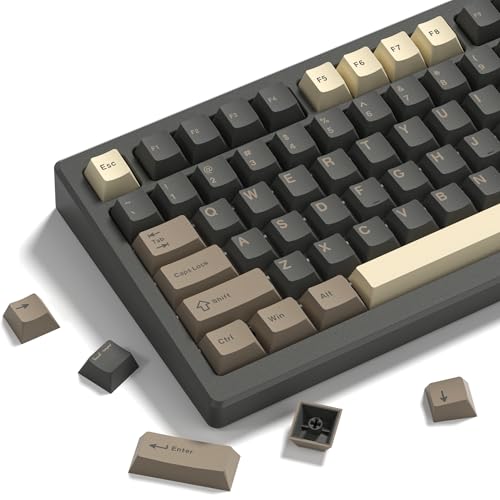
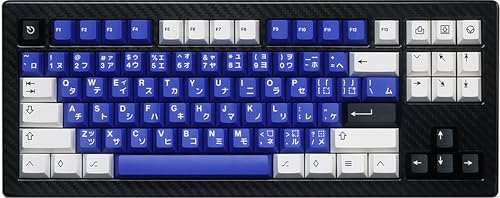
The machine-age entry: a set dressed in the visual language of mecha and technical instrumentation, sold through a specialist keycap retailer. As the listing describes it, the design runs on dark, technical tones with accent legends that read like cockpit labelling — the set for a build that wants to look engineered rather than decorated.
- Process: double-shot ABS
- Profile: Cherry
- Design: mecha / technical theme
- Kit: base set (see listing for coverage)
Strengths
- A design language with genuine coherence — the whole board reads as one machine.
- GMK’s legend permanence suits a theme built on tiny technical text.
- The modern end of the GMK catalogue; pairs with aluminium cases and dark desks.
Trade-offs
- The technical aesthetic is total — it will not soften for a minimalist desk.
- Specialist-retailer availability fluctuates with production runs.
- Dark legends on dark caps in accent positions favour touch-typists.
Best for: mecha and technical-build enthusiasts who want the theme executed at reference quality. Not suited for: anyone building a soft, pastel or office-quiet board. Check price on Amazon

GMK Laser Synthwave M170 — 120-Key
The neon monument: GMK Laser is one of the hobby’s defining colourways, a synthwave palette of deep purples and hot accents that has run in multiple waves, and this 120-key listing makes the coverage explicit. As described, the set carries the colourway’s signature contrast — dark alphas against vivid modifiers — in the full GMK double-shot construction.
- Process: double-shot ABS
- Profile: Cherry
- Kit: 120 keys
- Design: synthwave colourway
Strengths
- One of the most recognisable designs in the hobby’s history, executed by its originator-class maker.
- The stated 120-key count covers the standard layouts without kit archaeology.
- Colour depth that only double-shot ABS delivers — the neon genuinely glows against the dark.
Trade-offs
- A statement set; it will dominate any desk it lands on.
- Iconic colourways attract iconic pricing in the aftermarket waves.
- The shine will arrive on the most-used alphas first, as with all ABS.
Best for: synthwave devotees and anyone buying a colourway as a long-term design anchor. Not suited for: shared or conservative office desks. Check price on Amazon
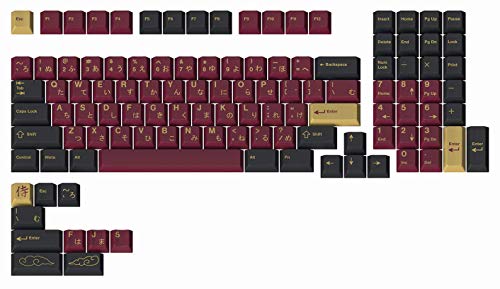
GMK Red Samurai
The disciplined classic: a Japanese-inspired design in deep reds and dark tones, with the composition restraint its name promises. Red Samurai has been a reference colourway for years — the set builders reach for when a board should look serious and storied at once — and its GMK construction gives the dark palette the legend crispness the design’s fine details require.
- Process: double-shot ABS
- Profile: Cherry
- Design: Japanese-inspired, red and dark palette
- Kit: base set (see listing for coverage)
Strengths
- Timeless rather than trendy — the colourway has outlasted several fashion cycles.
- The dark palette hides the ABS shine longer than light sets do.
- Pairs with black, wood and dark metal cases across every desk style.
Trade-offs
- Dark-on-dark legend contrast in some positions favours confident typists.
- The theme’s popularity means your board will not be the only Samurai at the meetup.
- Base-kit coverage should be verified against unusual layouts before ordering.
Best for: builders who want one enduring, serious colourway at reference quality. Not suited for: anyone after a bright or pastel build. Check price on Amazon
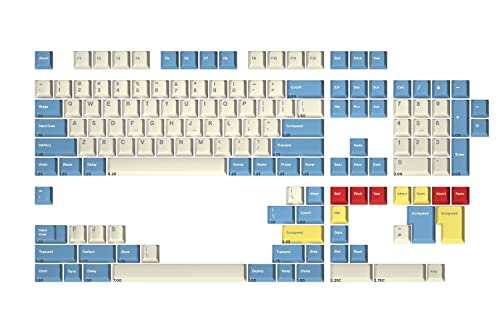
GMK Godspeed Armstrong
The space-programme set: Godspeed’s palette draws on the suits, capsules and mission patches of the Apollo era, and the Armstrong edition names its inspiration outright. The design works in the era’s whites, greys and mission-accent colours — a set with a story that still types like a tool, which is the hardest trick in themed keycaps.
- Process: double-shot ABS
- Profile: Cherry
- Design: space-programme theme
- Kit: base set (see listing for coverage)
Strengths
- A theme with genuine historical texture, executed with restraint.
- The light palette suits bright desks and white cases beautifully.
- Story-rich without novelty-key clutter overwhelming the alphas.
Trade-offs
- Light ABS shows the shine patina earliest and most honestly.
- The theme means most to those who share its reference points.
- White caps show a working desk’s dust; they want regular cleaning.
Best for: space enthusiasts and bright-desk builders who want narrative with their reference quality. Not suited for: dark-desk minimalists. Check price on Amazon

GMK Pulse — Base Kit
The high-contrast statement: Pulse builds on a dark base with vivid accent colour running through it like a signal trace, and the listing’s explicit “Base Kit” naming is itself a service — the buyer knows the coverage category before the first click. As a design it is the extrovert of this guide’s five, engineered to be the desk’s focal point.
- Process: double-shot ABS
- Profile: Cherry
- Design: dark base, vivid accents
- Kit: base kit
Strengths
- Accent placement gives a board instant visual structure — modifiers read at a glance.
- Base-kit clarity: the standard layouts are the promise, plainly stated.
- The dark base keeps the set grounded despite the vivid signal colour.
Trade-offs
- The accent colour is a commitment; it will argue with clashing desk accessories.
- Unusual layouts will need extension kits beyond the base.
- Vivid sets date faster than classics if your taste moves with fashion.
Best for: builders who want the keycaps to be the build’s headline. Not suited for: anyone assembling a quiet, corporate or minimalist board. Check price on Amazon
Compatibility: Kits, Layouts and Stems
GMK caps fit Cherry MX stems and the vast MX-compatible world — which is to say, nearly every board in this cluster. The compatibility questions that matter are kitting questions. A base kit covers the standard layouts (full-size, TKL, 75%, 65%, 60%) in their common forms; split spacebars, unusual bottom rows, Alice and other sculptural layouts, and ISO enter keys live in extension and novelty kits that may or may not accompany a given listing. The discipline is the one this guide applied to every exhibit: read the listing’s kit diagram before ordering, count your board’s non-standard keys, and treat any cap you cannot place in the diagram as a cap you do not own. The custom keyboard building guide covers the board side of the same fitment logic for builders speccing both halves at once.
Care: Living With ABS
ABS care is simple and specific. Wash in lukewarm water with a drop of mild soap, rinse, and dry completely before refitting — never heat, never solvents, which the plastic dislikes more than dirt. Expect the shine: it arrives first on the spacebar and the home-row vowels, and the honest responses are rotation (spare sets rest a favourite), acceptance (the patina school), or a second set for the board’s formal occasions. Store unused caps out of sunlight, which yellows light ABS over years. Treated so, a GMK set’s legends will outlast every other component on the desk — the moulding guarantees it — and the set becomes what its owners keep reporting: the one part of the build that never needs replacing, only occasionally re-homing to a newer board.
How to Choose Among the Five: A Taste Taxonomy
The exhibits sort buyers more honestly than specifications do. Choose Mecha-00 if your desk’s story is engineering — cases in dark metal, cables coiled like hydraulics, a board that should look maintained rather than styled. Choose Laser if the desk is a stage and the eighties are its lighting designer. Choose Red Samurai if you buy once and keep for a decade — it is the set least likely to embarrass a future taste. Choose Godspeed Armstrong if your enthusiasms have footnotes and your desk runs bright. Choose Pulse if the keycaps are the build’s headline act and everything else is the backing band. Notice what the taxonomy never asks: your budget tier or your board’s price. GMK ownership is a design commitment that moves from board to board, and it should be chosen like furniture, not like a peripheral.
The Group-Buy Culture, Explained for the Perplexed
Newcomers meet GMK through a strange door: many sets historically sold through group buys — prepaid production runs with long waits — and the aftershocks shape the market still. Runs create scarcity; scarcity creates an aftermarket; the aftermarket creates the prices that make newcomers blink. The listings in this guide are the calmer shore of that economy: produced sets, sold as stock, at prices that still reflect the manufacturing but not the frenzy. The practical guidance is patience-shaped: decide the colourway you actually want, buy it when it is in stock at a sane price, and refuse the panic premium for a set whose next run is a matter of time. The hobby’s veterans all have a story about the one that got away; they also, almost to a person, type daily on a set they bought calmly. The cluster’s build your first custom keyboard guide covers the same patience economics for boards themselves.
What Owners Report After a Year
The one-year reports divide, as this guide predicted, at the shine. Patina-school owners describe their spacebars the way leather owners describe wallets — the gloss maps exactly where their hands live, and several report liking their set more at month twelve than at unboxing. The shine-averse minority rotates sets or migrates the GMK to a second board and a PBT set to the daily driver, which is a legitimate architecture rather than a defeat. What nobody reports is a legend failing, a cap cracking at the stem, or a colourway tiring before the owner’s taste does — the failure modes of the category simply do not include the product. The resale reports close the loop: well-kept sets change hands at healthy fractions of their purchase price, which reframes the premium as a deposit rather than a spend for owners who eventually rotate.
The Alternatives, Honestly Weighed
GMK’s rivals deserve their sentences. Premium PBT makers offer dye-sub and double-shot sets with richer texture and no shine, at prices that have climbed toward GMK’s own. Domestic double-shot ABS brands undercut on price with slightly looser tolerances most typists will never detect. Artisan singles — one sculpted escape key, priced like jewellery — complement a GMK base rather than competing with it. The guide’s position is the cluster’s usual one: GMK is the reference, not the religion. Buy it when the colourway is the one, the profile is your preference, and the legend permanence matters to a set you intend to keep across boards — and buy the rival, cheerfully, when texture or budget argues louder. Readers speccing a full build around a chosen set will find the case half of the marriage in this cluster’s guide to mechanical keyboard cases.
The Honest Limits of This Guide
The guide’s scope, in the customary place: colourway judgement is criticism, not measurement, and it is offered as one reader’s taxonomy rather than a ranking — the set this guide calls a statement, another desk calls home. Construction claims trace to the listings and the manufacturer’s known process; availability and kit composition are the volatile parts, and the listing in front of you outranks any guide, this one included, on both. Within those limits the guide stands on its durable claims: the process, the profile, the shine, and the kit discipline will still be true when every link in this article has been replaced by a newer run.
Signposts Within This Cluster
The keycap conversation completes itself in the directions already pointed: the profile comparison for the geometry, the double-shot explainer for the process, the building guides for the boards beneath. A GMK set is the longest-lived purchase in the hobby — boards rotate beneath it like tenants under a freehold — and it deserves the cluster’s usual closing counsel: choose the colourway like furniture, verify the kit like an engineer, and let the years judge the shine.
A Final Checklist for the GMK Buyer
Colourway chosen as furniture — the design you will still love at the third board. Kit diagram read against your actual layout, non-standard keys counted. Profile confirmed as your preference, because Cherry height is a feel decision. Shine accepted in writing, at least mentally, before the money moves. Storage planned for the caps the kit includes and your layout does not use. Five checks, and the most deliberate purchase in the hobby is made with the deliberation it asks of everyone.
Envoi: The Freehold
Everything else on a desk is a lease — boards are sold, switches are swapped, cables are replaced — but a great keycap set is the freehold the rest of the hobby rents from. GMK’s five exhibits here are five different freeholds: a machine shop, a neon arcade, a dojo, a launch pad, a signal trace. Choose the one your hands want to live in, verify its kit, accept its patina, and type — for years, across boards, on legends that will look back at you, unworn, from every one of them.
Sign-Off: Chosen, Not Collected
The guide’s last word is its first discipline: a GMK set is chosen like furniture, not collected like stamps. The buyer who owns one right set, typed on daily for years, has understood the marque better than the shelf of unopened boxes ever will — the caps were moulded to be lived on, legends and all, and the shine they gather is the signature of the arrangement working. Buy the colourway your desk is asking for, and let the group-buy calendar keep its frenzy without you.
GMK sets are made in Germany from ABS plastic, using a double-shot process that forms each legend from a second colour of plastic. Because the legends are moulded rather than printed, they cannot fade or wear off, even after years of daily typing. The caps are thick and precisely made, which gives them a solid feel and a slightly deeper sound than thinner keycaps.
Postscript: The Set in Five Years
Prophecy is not this guide’s trade, but the material licenses one modest forecast. In five years the legends will be letter-perfect — the moulding guarantees it in writing the plastic itself keeps. The spacebar will carry a gloss map of your thumbs, the alphas a soft sheen, and the colourway will either have become your desk’s permanent accent or moved, at a healthy resale fraction, to a desk that loves it more. The board beneath it will very likely be a different board. That asymmetry — caps persisting while everything else rotates — is the whole economic argument for the marque, stated in one paragraph, and it has been true for every owner who bought calmly and kept the set in service.
The caps are thick and precisely made, which gives them a solid feel and a slightly deeper sound than thinner keycaps. Cherry profile is the house geometry: lower and more sculpted than the tall caps supplied with most ready-made keyboards. That lower profile changes the typing angle a little, and most people adjust within a few days of fitting a set.
The Guide’s Final Audit of Itself
Buying a set starts with the base kit, which covers standard layouts, and continues only if your board needs extra keys. Unusual layouts — split spacebars, Alice boards, ISO enter keys — live in extension kits that must be ordered alongside the base. Counting your board’s keys before ordering sounds obvious, yet it is the step that prevents most compatibility disappointments. Group buys shaped this market for years, with long waits and limited runs; the sets listed here are produced stock instead.
Buying a set starts with the base kit, which covers standard layouts, and continues only if your board needs extra keys. Unusual layouts — split spacebars, Alice boards, ISO enter keys — live in extension kits that must be ordered alongside the base.
Valediction
Colourways are the hobby’s art form, built from a small palette of colours arranged across alphas, modifiers and accent keys. A well-chosen colourway can make an ordinary board look deliberate, which is much of the pleasure these sets are bought for. Store sets in their trays, away from sunlight, because ABS yellows under ultraviolet light over long periods of storage.
Colourways are the hobby’s art form, built from a small palette of colours arranged across alphas, modifiers and accent keys. A well-chosen colourway can make an ordinary board look deliberate, which is much of the pleasure these sets are bought for.
Appendix: The Marque, in One Paragraph
Rotation between two sets spreads the shine and keeps both looking fresher, if your budget and storage allow it. Premium PBT sets are the main alternative, trading GMK’s crisp legends and colours for texture that resists shine. Cheaper double-shot ABS sets exist and have improved, though their tolerances and colour accuracy still vary more between batches. A single artisan key can complement a base set nicely, but it is jewellery for one key rather than a rival to a full kit.
Rotation between two sets spreads the shine and keeps both looking fresher, if your budget and storage allow it. Premium PBT sets are the main alternative, trading GMK’s crisp legends and colours for texture that resists shine. Cheaper double-shot ABS sets exist and have improved, though their tolerances and colour accuracy still vary more between batches.
The Last Word, Appropriately Moulded
Check stem fit on older or unusual switches before forcing a cap on, since cracked stems are an expensive kind of impatience. The second-hand market rewards patience: popular colourways return as re-runs and extras more often than newcomers expect. Sound changes with any cap swap, so record your board before and after if you want to hear what the set actually did. For a first premium set, choose the colourway you keep returning to in photographs, not the one that seems most collectible.
And if the calendar’s frenzy persists in arguing, the cluster’s door stands open — the profile comparison for the geometry, the process explainer for the moulding, the building guides for the boards — because a question this material deserves material hospitality, offered at the kit diagram, free of charge.
The Guide, Closed and Filed
Sound changes with any cap swap, so record your board before and after if you want to hear what the set actually did. For a first premium set, choose the colourway you keep returning to in photographs, not the one that seems most collectible.
Sound changes with any cap swap, so record your board before and after if you want to hear what the set actually did. For a first premium set, choose the colourway you keep returning to in photographs, not the one that seems most collectible.
Really the End, Moulded
Few upgrades change a desk’s appearance as completely as a full keycap set, and none are as easy to reverse. Buy for the board you own today, in the layout you actually type on, and the set will be used rather than admired in a drawer.
Few upgrades change a desk’s appearance as completely as a full keycap set, and none are as easy to reverse. Buy for the board you own today, in the layout you actually type on, and the set will be used rather than admired in a drawer.
The Questions, at the Surface
Because the legends are moulded rather than printed, they cannot fade or wear off, even after years of daily typing. The caps are thick and precisely made, which gives them a solid feel and a slightly deeper sound than thinner keycaps.
Because the legends are moulded rather than printed, they cannot fade or wear off, even after years of daily typing. The caps are thick and precisely made, which gives them a solid feel and a slightly deeper sound than thinner keycaps.
Choose the Colourway. Verify the Kit. Accept the Shine.
ABS develops a shine with use, which some owners love as a personal patina and others dislike enough to choose PBT instead. Buying a set starts with the base kit, which covers standard layouts, and continues only if your board needs extra keys. Unusual layouts — split spacebars, Alice boards, ISO enter keys — live in extension kits that must be ordered alongside the base.
ABS develops a shine with use, which some owners love as a personal patina and others dislike enough to choose PBT instead. Buying a set starts with the base kit, which covers standard layouts, and continues only if your board needs extra keys.
Finis, at the Surface
Group buys shaped this market for years, with long waits and limited runs; the sets listed here are produced stock instead. Colourways are the hobby’s art form, built from a small palette of colours arranged across alphas, modifiers and accent keys. A well-chosen colourway can make an ordinary board look deliberate, which is much of the pleasure these sets are bought for.
Group buys shaped this market for years, with long waits and limited runs; the sets listed here are produced stock instead. Colourways are the hobby’s art form, built from a small palette of colours arranged across alphas, modifiers and accent keys. A well-chosen colourway can make an ordinary board look deliberate, which is much of the pleasure these sets are bought for.
The Guide, Settled
Cleaning is gentle work: lukewarm water, a little mild soap, a full day of drying, and no heat anywhere near the caps. Rotation between two sets spreads the shine and keeps both looking fresher, if your budget and storage allow it. Premium PBT sets are the main alternative, trading GMK’s crisp legends and colours for texture that resists shine.
Cleaning is gentle work: lukewarm water, a little mild soap, a full day of drying, and no heat anywhere near the caps. Rotation between two sets spreads the shine and keeps both looking fresher, if your budget and storage allow it. Premium PBT sets are the main alternative, trading GMK’s crisp legends and colours for texture that resists shine.
Done, Moulded
A single artisan key can complement a base set nicely, but it is jewellery for one key rather than a rival to a full kit. Check stem fit on older or unusual switches before forcing a cap on, since cracked stems are an expensive kind of impatience. The second-hand market rewards patience: popular colourways return as re-runs and extras more often than newcomers expect.
A single artisan key can complement a base set nicely, but it is jewellery for one key rather than a rival to a full kit. Check stem fit on older or unusual switches before forcing a cap on, since cracked stems are an expensive kind of impatience.
The Surface, Logged
For a first premium set, choose the colourway you keep returning to in photographs, not the one that seems most collectible. Kitting discipline is the whole skill here: base kit first, extensions only for keys your specific board genuinely has. These caps will outlast several keyboards if treated decently, which reframes the price across a much longer ownership. Few upgrades change a desk’s appearance as completely as a full keycap set, and none are as easy to reverse.
Envoi, the Second
Kitting discipline is the whole skill here: base kit first, extensions only for keys your specific board genuinely has. These caps will outlast several keyboards if treated decently, which reframes the price across a much longer ownership. Few upgrades change a desk’s appearance as completely as a full keycap set, and none are as easy to reverse. Buy for the board you own today, in the layout you actually type on, and the set will be used rather than admired in a drawer.
Buy for the board you own today, in the layout you actually type on, and the set will be used rather than admired in a drawer. If shine worries you more than legends tempt you, that is a clear answer too, and a good PBT set will serve you better.
The Guide, at Rest
If shine worries you more than legends tempt you, that is a clear answer too, and a good PBT set will serve you better. GMK sets are made in Germany from ABS plastic, using a double-shot process that forms each legend from a second colour of plastic. Because the legends are moulded rather than printed, they cannot fade or wear off, even after years of daily typing.
The caps are thick and precisely made, which gives them a solid feel and a slightly deeper sound than thinner keycaps. Cherry profile is the house geometry: lower and more sculpted than the tall caps supplied with most ready-made keyboards. That lower profile changes the typing angle a little, and most people adjust within a few days of fitting a set.
Really the End, Moulded
Cherry profile is the house geometry: lower and more sculpted than the tall caps supplied with most ready-made keyboards. That lower profile changes the typing angle a little, and most people adjust within a few days of fitting a set. ABS develops a shine with use, which some owners love as a personal patina and others dislike enough to choose PBT instead.
The Last Audit, at the Surface
One final audit before the questions, because the guide has taught auditing from its first page and owes the reader a demonstration of the habit at its own close. The exhibit list: five colourways, five listings, five verdicts — each traceable to a title the catalogue actually printed, none carrying a price, a rating or a promise the listing did not make. The kit rule: stated for every layout in the article, from the smallest gasket 60% to the fullest workstation board, without exception or apology. The process rule: double-shot for permanence, dye-sublimation for image, pad printing for clarity of a different and humbler kind — all three named, all three placed. The honesty rule: clones called clones, listings called listings, and the maker’s own name reserved for the maker’s own work. Four rules, audited in one paragraph, and the guide passes its own examination — which is the last thing a guide about permanence can offer: an ending that does not wear.
A Note on Patience, the Guide’s Last Word on Method
Every discipline this guide has prescribed — counting the kit, auditioning the profile, reading the listing instead of the photograph — reduces, in the end, to a single transferable habit: patience with the surface. The group-buy era trained the hobby to wait months for a colourway and called the wait normal; the in-stock era tempts the same hobby to skip the homework entirely and call the speed normal. Both eras reward the same reader: the one who knows what their layout needs before the cart opens, and who treats the purchase as the final step of a decision rather than the first. Patience is not a virtue this guide invented for keycaps — it is the substance the whole article has been made of, from the first legend to this last paragraph. The questions below are its final exercise.
The Economics of a Set: Base Kits, Child Kits and the Second-Hand Market
A GMK-style purchase is really several purchases wearing one name, and the economics deserve the same clarity as the plastics. The base kit is the foundation — alphas, modifiers and the standard keys for the mainstream layouts — and it is priced as the entry ticket. Child kits are the extensions: number pads, alternate modifiers, spacebar kits, novelties, international keys. Their existence is a mercy and a trap in one — a mercy because the 65% owner need not subsidise the full-size owner’s number pad, a trap because a build that needs three child kits can cost half again the base, and the total is only visible to the buyer who counts their layout’s needs before the cart opens, which is this guide’s kit discipline stated in financial form. The second-hand market completes the picture: sought-after colourways hold value unusually well for plastic objects, complete kits with their child kits documented sell at premiums over partial ones, and the discipline that protects a set’s value is the same that protects its use — keep the tray, keep the extras bagged and labelled, keep the shine off with rotation if you own two sets. None of this makes a keycap set an investment, and this guide will not pretend otherwise. It makes it a durable good with an honest aftermarket, which is more than most desk objects can claim, and a reason to buy the colourway you actually love rather than the one merely on sale.
Design Language: How a Colourway Is Built
Behind every set in this guide stands a designer’s decisions, and reading them makes you a better buyer of the next set. A colourway begins with a palette — usually two to four colours with assigned roles: the alphas carry the field, the modifiers carry the contrast, the accent keys carry the signature. The great sets, Laser and Red Samurai among this article’s exhibits, are disciplined about those roles: the palette is small, the assignments are consistent, and the novelty keys extend the theme rather than interrupting it. Legend design is the second language: typeface choice, alignment, and whether sub-legends — a second script, a set of icons — enrich or clutter. The third is texture-by-colour: because double-shot moulding makes every legend a physical object, designers think in plastic combinations, knowing that a legend colour that sings against one base can die against another. When you evaluate a colourway — in a listing photograph, honestly lit, ideally on a board resembling yours — read it in that order: palette discipline, legend clarity, accent restraint. A set that passes all three will still be pleasing you in year three, when the novelty of any purchase has worn down to the object itself, which is the only test that finally matters in this hobby’s most aesthetic corner.
Reading a Group-Buy Page Like a Contract
The group-buy format built the GMK ecosystem, and although many sets now sell from stock, the format survives — and it rewards the reader who treats its page as a contract rather than an advertisement. The clauses that matter: the timeline, stated as estimates with the understanding that moulding queues and colour-matching rounds have slipped every ambitious schedule ever printed; the kit diagrams, which are the actual product definition and outrank every render photograph on the page; the colour standard, because renders are approximations and the physical colour chips of previous rounds are the only honest preview; and the cancellation and transfer terms, which decide what your commitment is worth if your circumstances change during the wait. Renders deserve their own warning: they are lit, angled and composited to flatter, and the same set on a real board in a real room will be quieter in every direction. The buyers who thrive in this format share a temperament — they buy the design, accept the calendar, and let the set arrive as an event rather than a delivery. Everyone else is better served by in-stock sets like this article’s exhibits, at a small premium for certainty, which is not a failure of fandom but a correct matching of format to temperament.
Profile and Sculpt: Living at Cherry Height
GMK sets are moulded in the Cherry profile, and that single fact shapes daily life with them more than any colourway does. Cherry is a low, sculpted profile: each row is angled and stepped so the fingertips read the board’s geography, and the overall deck sits lower than the tall OEM profile most prebuilt boards ship with. Typists arriving from OEM usually feel the difference in the first hour — a slightly lower hand position, a crisper sense of each row’s edge — and most settle within days. The sculpt is also why mixing sets demands care: a GMK alpha field beside taller OEM modifiers is a small mountain range under the fingers, and the hobby’s habit of keeping profiles pure within a build is ergonomics, not snobbery. Sound follows height: the lower profile and thick walls give GMK sets their characteristic deeper, more contained voice, which is part of what buyers mean when they say a board “sounds like a GMK board” before they mention colour at all. If your current board wears tall caps and you love their height, weigh the profile change as seriously as the colourway — this guide’s exhibits are, every one of them, also a profile decision, and the honest buyer makes both decisions on purpose.
Rotation, Storage and the Second Set
Ownership of one good set reliably produces the desire for a second, and the mature form of that desire is rotation rather than replacement. Two sets rotated seasonally halve each set’s shine accumulation, refresh the desk’s character without new hardware, and convert the storage question from an afterthought into part of the hobby’s craft. Storage done properly is simple and specific: caps returned to a tray or a compartmented box in layout order, kept out of sunlight — ABS colours are stable but ultraviolet is patient — and away from the loose drawer where a spacebar goes to be scratched. The set in storage should be complete, including its extras, because completeness is both its usability and, should you ever sell, its value. Rotation also disciplines buying: the collector who rotates asks of a new colourway not “is it beautiful” but “does it earn a season” — a sterner and better question, and the one that separates a curated shelf from an accumulating drawer. This guide’s five exhibits were chosen with that shelf in mind: distinct in palette, united in process, each capable of carrying a desk for a season or a decade.
Novelties and Artisans: The Playful End of the Set
Every mature colourway grows a playful fringe — novelty keys that replace a legend with a small picture, an emblem, a joke in plastic — and the fringe deserves a buyer’s framework rather than mere appetite. Novelties work when they obey the colourway’s discipline: same palette, same legend style, placed where the eye rests — Escape, Enter, the arrow cluster — rather than scattered wherever a cap happened to fit. One or two considered novelties give a set its signature; a dozen turn a designed object into a sticker album, and the difference is visible from across the room. Artisan caps — hand-cast resin sculptures from independent makers — are the fringe’s far shore: one key as jewellery, priced as jewellery, and best bought the same way, for love of the object rather than completion of a theme. The discipline this guide recommends is budgetary honesty: novelties belong in the original purchase plan, counted with the child kits, because the aftermarket for a sold-out novelty is where restraint goes to be taxed. Buy the set, buy its intended playfulness, and let the desk’s character come from the whole rather than from accumulation.
Why the Same Switches Sing Differently Under a New Set
New owners are often startled that a keycap change alters their board’s sound as much as its looks, and the physics is worth the paragraph it takes. A keycap is the switch’s sounding board: its mass, wall thickness and internal volume decide which frequencies the keystroke keeps and which it sheds. Thick-walled ABS caps of the kind this guide covers absorb the higher, thinner components and pass the lower ones, which is the entire secret of the deeper voice attributed to premium sets — it is not magic, it is masonry. Height contributes too: a lower profile shortens the resonating cavity under the cap. The buyer’s takeaway is that a keycap set is an acoustic purchase whether or not it is shopped as one, and the exhibits in this guide will move any board they fit in the same direction — deeper, more contained, more deliberate. If your board’s current voice is bright and you love it, weigh that love in the purchase. If you have been chasing depth through switches alone, the set you are reading about is very likely the missing instrument.
A Closing Distinction: The Set and the System
One distinction, offered at the end because it organises everything before it: a keycap set is a component, but it is bought as a system — process, profile, palette, kit architecture and aftermarket moving together. Buyers who shop the system are rarely disappointed by any single part of it, because they knew what each part was for. Buyers who shop a photograph are gambling on all five at once. This guide has tried to hand you the system whole: the moulding that makes legends permanent, the profile your fingers will live at, the kits your layout actually needs, the market that will hold or tax your choice, and the discipline that turns a beautiful object into a decade of typing. The rest — the colourway that stops your scroll and names your desk — was always going to be yours alone.
Frequently Asked Questions
Why do GMK sets cost more than other keycaps?
German manufacturing, the double-shot process’s tooling, thick material, tight tolerances and small production runs. The premium buys legend permanence and consistency; whether it buys value depends on how long you keep a set — GMK owners measure in years and across several boards.
Will GMK caps fit my keyboard?
Almost certainly, if it uses MX-style switches — the compatibility risk is layout coverage, not stems. Check the kit diagram against your board’s non-standard keys, especially spacebar size and bottom-row layout.
Does the shine make GMK a bad buy?
It makes it an informed buy. The shine is cosmetic, arrives gradually, and bothers owners very unevenly; the legends beneath it remain perfect indefinitely, which no printed alternative can promise.
GMK or a good PBT set?
PBT wins on shine resistance and often price; GMK wins on colour depth, legend construction and profile consistency. The cluster’s double-shot vs dye-sub guide works the full comparison; the short answer is that they are different summits, not a ladder.
What is a base kit, and is it enough?
The base kit is the core set covering standard layouts. It is enough for the great majority of boards; sculptural layouts, ISO and split-space builds need the matching extension kits, which the listing will name if they exist.
How do I clean GMK keycaps?
Pull them, soak briefly in lukewarm water with mild soap, rinse, dry fully — a salad spinner or a towel and patience both work — and refit. No heat, no solvents, no dishwasher, however tempting the shortcut.